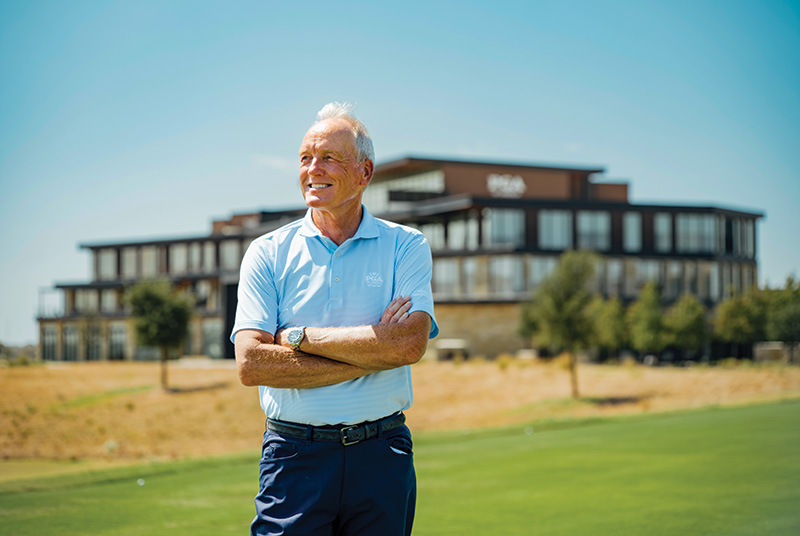
PGA of America Chief Championship Officer Kerry Haigh has been in charge of setting up golf courses for marquee events for decades. Photo by Daryl Johnson/Astute Imagery
You may not see him much, but you have seen his work. Millions of others have, too.
Kerry Haigh has traveled coast-to-coast and border-to-border to ensure every championship on his watch is a memorable, successful experience for his staff, players, volunteers and everyone involved. He’s overseen major championships and the Ryder Cup at places such as Bellerive Country Club, Quail Hollow Club and Whistling Straits.
But he’s more of a behind-the-scenes type and likes it that way. For more than 30 years, Haigh has been front and center for the PGA of America, highlighted by his role as chief championship officer of the organization. He’s the one who often sets up courses for the world’s most well-known golfers during major championship events.
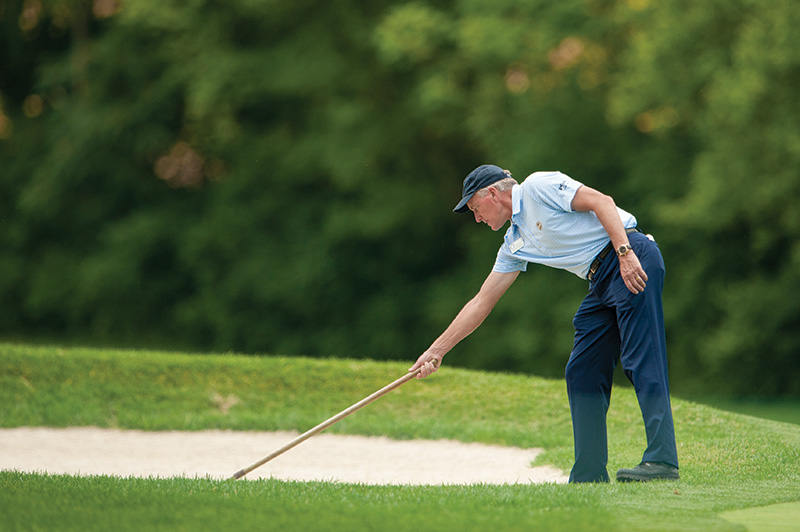
The hands-on approach works for Haigh, who’s a champion of superintendents.
While Haigh wasn’t born in the U.S., his body of work has made a lasting impression in golf championships in America.
“He takes care of us to the end,” says Mark Kuhns, CGCS, 2009 GCSAA president and 46-year association member. Kuhns, who has managed two major championships with Haigh on-site, calls him “a champion for superintendents.”
So it should come as no surprise that GCSAA has named Haigh the recipient of its Outstanding Contribution Award for 2027, given to an individual who has made a significant contribution to the membership through outstanding work for the golf course industry. It must be significant in both substance and duration.
“I’m honored and extremely excited,” Haigh says. “I’m biased, but I really admire what all superintendents do. They all seem to reflect the same great traits and are extremely knowledgeable and personable.
“The way they continue to move the industry forward and work with technology and data that has taken such great strides in recent years is incredible.”
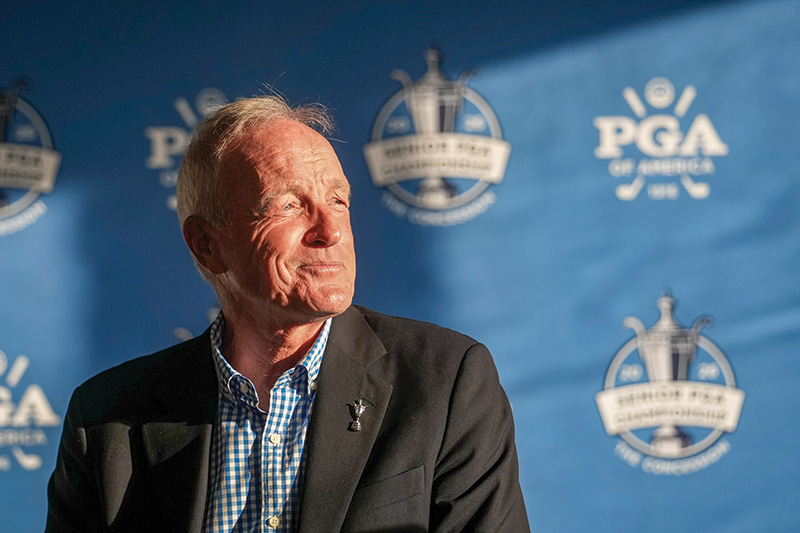
Haigh has been dedicated to handling matters at high levels in his time at the PGA of America. Photos courtesy of the PGA of America.
The horse-hoof moment
The son of a teacher, Haigh was introduced to the game by his father, Gordon. Growing up in a coal-mining town, he tagged along with his dad every weekend at Wheatley Golf Club in Doncaster, Yorkshire, which was originally laid out by 1920 Open champion George Duncan. The club was supportive of junior golf, Haigh says, and let him play whenever he wanted.
Haigh was good enough to play for his college team, the University of Leeds. There, his classes foreshadowed his future: Haigh studied planning and administration, setting the stage for his career. An internship for six weeks at Gleneagles Hotel in Scotland gave him his first experience working in golf, where he learned “generally what goes into managing and operating on the club side.”
He played competitively at the amateur level, with his parents’ support. But, Haigh says, “I wasn’t sure I was committed enough to play, nor did I want to put my parents in the position of supporting me to play at that level. I did love the game, however, and thought, ‘wouldn’t it be great to work in this game that I enjoyed and love?’ ”
That’s Haigh in his younger days with major champion Tom Kite, who was Ryder Cup captain in 1997.
Knowing the rules is a significant part of his job, and Haigh specifically remembers the moment he realized he needed to improve his knowledge. It was the spring of 1981 at Ferndown, a course near Bournemouth on England’s south coast.
Post college, Haigh landed his first job with the PGA of Great Britain, whose headquarters were at The Belfry Hotel & Resort in Sutton Coldfield, in the heart of England. The learning curve was quickly tested.
“I sort of was thrown into the deep end,” Haigh says. “I was told to go and run the (golf) events, which was a great way to learn the business. I pretty much had to learn how to do everything, be it scoring, pairings or rulings. At the end of the day, I was calling the press on a pay phone, spelling out the top five players’ names with their scores, letter by letter, just to get something printed in the newspaper with the scores.”
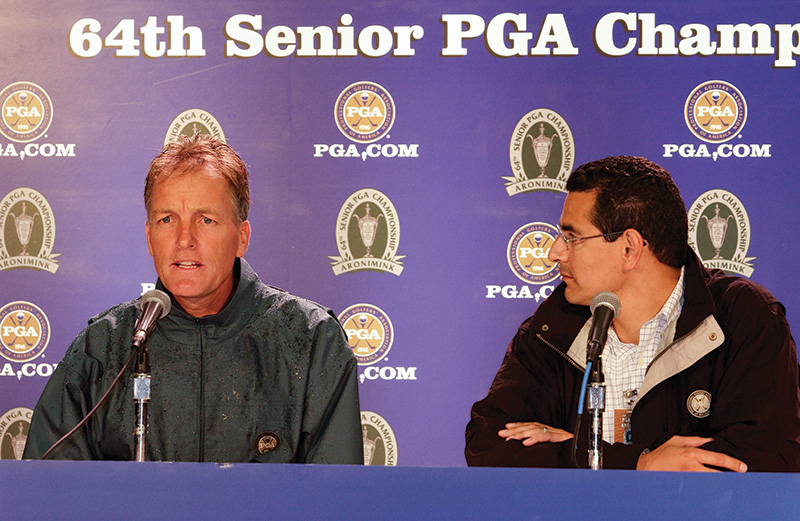
Spending time in front of the media is among Haigh’s many duties.
“The lady professional involved had hit her tee shot way right on the first hole,” Haigh says. “I sprinted down the hole and found her ball lying in a horse’s hoof mark in a sandy area in the rough.
“The player was saying, ‘What can I do?’. I figured then and there I better learn these rules quickly because you’re the only one there having to make decisions.”
What was Haigh’s decision that day? He didn’t give relief.
“It was way out in the rough.”
Spending time in front of the media is among Haigh’s many duties.
Getting his feet wet
That horse hoof moment was part of Haigh’s industry growth. From 1981-84, during his British PGA years, he saw varied sites that featured myriad levels of golfers. Club professionals, assistants, Women’s PGA and European Tour events provided a wide variety of tournament venues and experiences. He even helped a couple of European Tour men’s events, including in Tunisia.
“The British PGA was a great starting point for me to learn about a lot of different varieties and types of golfers of different abilities, players and venues,” he says. “For four years, I did everything I could and learned everything I could to run and manage events, oversee rules, learn more about agronomy, golf course setup, roping, staking.”
People noticed. The European Tour offered him a position at the same time the LPGA offered him a role. The European Tour was big, established and safe, but Haigh says the LPGA really pursued him.
“I had never been to America, so I thought, why don’t I go over, learn everything I can, and I can always go back to the European Tour.”
He never did.
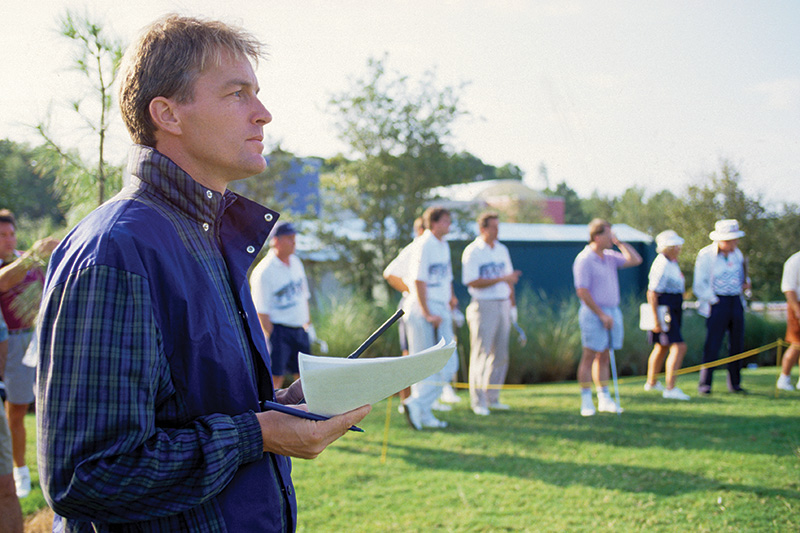
Spending time on the course, including pre-championship and week-of days, is when Haigh is in his element.
Coming to America
Moving across the pond, Haigh settled in Sugarland, Texas, where he was with the LPGA from 1985-88. During those years, he saw a lot of the U.S.
“Thirty-three weeks a year on the road in the U.S., along with a couple of events in Japan, while continuing to learn how events are run and operated here,” Haigh says.
He later worked for Kemper Sports (1988-89), managing the 1989 PGA Championships at Kemper Lakes. At that time, host clubs were in charge of running the PGA Championships, as they were the US Opens.
Then-PGA of America CEO Jim Awtrey interviewed Haigh to alter the association’s direction, managing all the PGA of America championships (including the PGA Championships, Ryder Cup and Senior PGA Championships). In August 1989, Haigh took the reins.
What’s the common denominator in running an organization of that magnitude? Haigh says several factors are involved. “A main one is communications with anyone and everyone involved, be it the club, the superintendent, general chair. Willing to listen, and treating people the way you would want to be treated is important.
“I think if you’re fair and honest and explain that we’re here to make the golf course look good, and we want the championship to look good and the course to be fair yet challenging, and we want you to help us lead in getting there and to get everyone on the same page — then you’ve got a really good chance for it to be successful.”
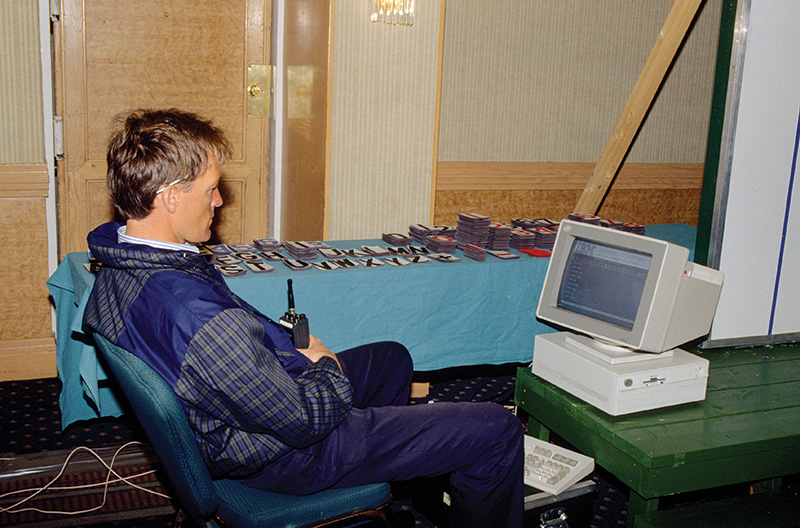
Keeping an eye on all aspects of what’s happening is part of Haigh’s daily routine.
“He makes it easy”
John Gosselin, a 41-year GCSAA member and director of agronomy at Aronimink Golf Club in Newtown Square, Pa., has worked alongside Haigh for the 2020 KPMG Women’s PGA Championship and this year’s PGA Championship. Suffice to say, he’s been impressed.
“He’s pretty much involved in all aspects of the tournament,” Gosselin says. “He spends a lot of time on the course, the greens, everything is well thought-out … He makes it easier for us. He really puts the agronomy team first, so it always seems agronomy is a priority.”
As Haigh says, in most cases for PGA and bigger events, they’re already working with really good golf courses, so “we don’t come in trying to significantly change a course, but if there’s a way to make little things better or bring out features in the golf course that may be hidden or not there, and we feel the membership and the club would enjoy it.
“Throwing out those ideas early has been well-received and in most cases, a lot of those ideas are implemented.”
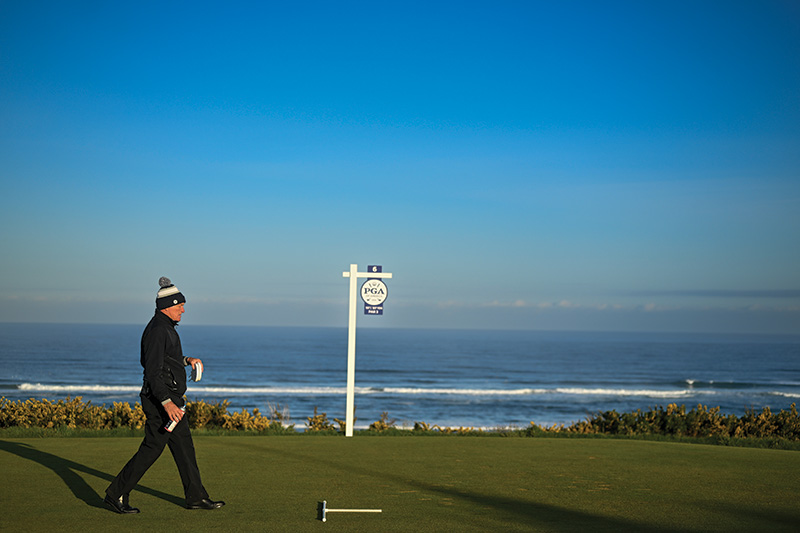
Scenic settings are a perk when Haigh is doing his job.
Being a good teammate
The team ranks high in Haigh’s world, and getting to know the host superintendent and how much or how little they use and embrace data have been key to his work.
“If they don’t use data, there’s no point in me asking for it. It is a team effort, and they are the experts,” Haigh says. “The superintendent at a particular facility, I strongly believe, knows far more about that golf course than I do or anyone else. They’re the experts, and I thank them for that and use their knowledge to help better the championship.
“The chemistry and the teamwork between the setup people and the superintendent are crucial, and I’ve been very fortunate and feel blessed to have worked with so many great superintendents.”
In his younger days, Haigh even helped the maintenance team during tournaments.
“There was a picture of me in the 1981 Ryder Cup helping lay out straw at Walton Heath after heavy rains,” Haigh says. “Other times I’ve raked bunkers, have pumped water, do whatever I could to help the team. There’re times you need all hands on deck.”
Most occasions, though, he gets things done, gets out of the way and lets others shine.
It’s been his life’s work.
Howard Richman (hrichman@gcsaa.org) is GCM’s associate editor.