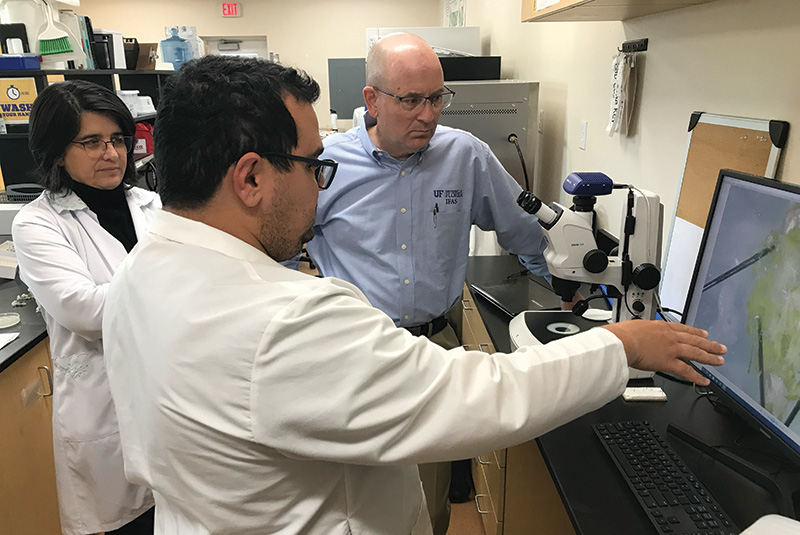
Turfgrass research at the University of Florida will benefit from recent support toward a goal of $2 million.
For turfgrass research funding, 2026 almost certainly is historic in the level of support for university-based turfgrass programs.
In August, the Oregon State University turf management program got a huge boost when the Oregon Turfgrass Foundation presented a $450,000 check to bring the total past the $1 million mark to help reach the OSU Foundation’s goal of creating a second endowed faculty position.
Not long afterward, a campaign led by golf course superintendents in Florida reached $400,000 toward its goal of $2 million for the Florida Turfgrass Industry Endowed Research Fund, benefitting the University of Florida.
The fund is intended to aid UF turfgrass operations, which faculty say will help ensure the university’s commitment to the turfgrass program.
“We strongly believe that having this industry-led and funded endowment ensures that UF will retain its globally recognized turfgrass program far into the future,” said Kevin Kenworthy, Ph.D., professor and graduate coordinator for plant breeding in the UF Institute of Food and Agricultural Sciences’ Department of Agronomy. “This endowment doesn’t just make the future of the program more secure; it brings the industry and UF closer together.”
The funding will help the university attract and retain top talent.
“The endowment will help UF continue to attract the best trained and experienced Ph.D.s, help them to achieve tenure and reduces the possibility of losing good scientists,” Kenworthy said. “When current faculty retire, the industry now has a good foot in the door to make sure those people are replaced with individuals that have the talent to meet current and future needs of the turfgrass industry.”
Initial funding of $375,000 came from two chapters of the Florida Golf Course Superintendents Association — the Seven Rivers GCSA and the Everglades GCSA. It also includes a $25,000 donation from the Hoffman Family Foundation. The foundation was established by former CEO of The Toro Company, Mike Hoffman, and his wife, Tami.
Jason Frank, Harrell’s vice president of business development, marketing and research and development, is among industry leaders in Florida helping coordinate fundraising.
“We hope and anticipate that other industry parties will get behind this effort that is truly in the best interests of the entire turfgrass industry,” Frank said. “The future of our industry depends on the people we prepare today. As a UF graduate, I’ve seen firsthand how its turfgrass program turns education and research into real value for our industry. This endowment helps ensure the next generation has those same opportunities. Supporting that pipeline isn’t just an investment in UF; it’s an investment in the future of our entire industry.”
Meanwhile, in Oklahoma, supporters of Oklahoma State University Agriculture gathered June 27 to celebrate the grand opening of the Lionel K. Bentley Turfgrass Center. The center, on a 100-acre facility, is named in honor of the late Lionel Bentley of Washington, Okla. The new center will specialize in ornamental and recreational turfgrass research, creating adaptive turfgrasses and developing eco-friendly pest management solutions.
Bentley graduated from OSU in 1970 with a bachelor’s degree in agronomy, focused on turf management. In 1984, he retired from the City of Norman as director of the Parks and Recreation Department to pursue Bentley Turf Farms, a turf establishment and erosion-control company. Bentley was known as a turfgrass sod pioneer in Oklahoma, offering customers U-3 bermudagrass, Tifway bermudagrass and his own Gracemont bermudagrass. Bentley’s wife, Lou, made the gift in memory of her husband. She said it was rewarding to highlight his passion for turfgrass, including his ongoing research and experimentation, as well as his continued association with the OSU turfgrass program.
“I wanted to honor Lionel with something of a permanent nature — an honor that would stand up to the incredible person he was, and that his name and life would be honored, but not forgotten, and that exemplified his love for his life’s work,” she said.
The Turfgrass Center will support faculty and students and host workshops, field days and industry collaboration.
From Oregon to Oklahoma to Florida, such significant support from industry and others shows the future of turfgrass research is in great shape.
Darrell J. Pehr (dpehr@gcsaa.org) is GCM’s science editor.