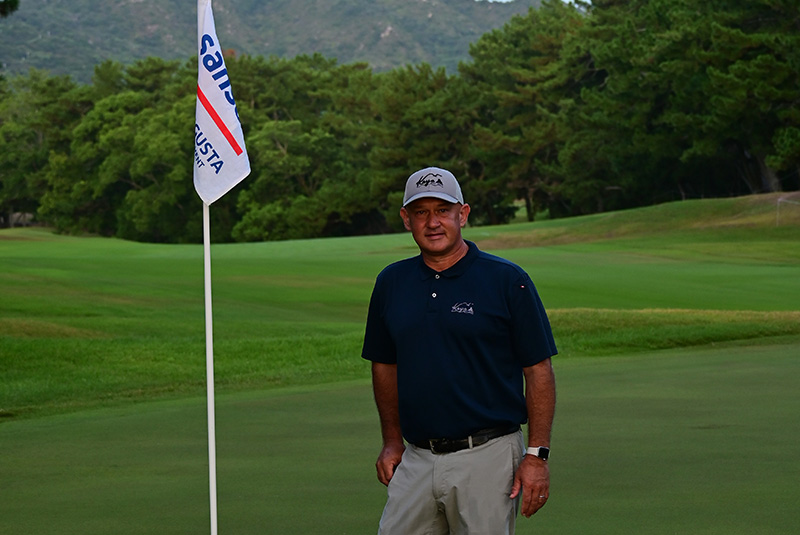
Andrew McDaniel is the GCSAA Class A Superintendent at Keya Golf Club in Itoshima, Japan. Photos courtesy of Andrew McDaniel
Last month, Japanese viewers tuning in to KBC News got a look behind the scenes of a day in the life of a golf course superintendent. But it wasn’t just any superintendent. KBC followed Andrew McDaniel, an American superintendent who’s been living and working in the country since 2002. McDaniel, a 27-year GCSAA member, is the Class A superintendent at Keya Golf Club, one of the top courses in the country.
“I’m not the only foreign superintendent working in Japan. However, I am the only foreign superintendent working at a Japanese-owned and operated golf course, out of more than 2,000 golf courses in Japan,” McDaniel says. “That has brought some attention.”
McDaniel first came to Japan for an internship in the summer of 2001 with Micah Woods, Ph.D., a 32-year GCSAA member who was then working with Environmental Turfgrass Systems in Chiba, Japan. At the time. McDaniel was a student at Mississippi State University. It was his first time on an airplane. “The opportunity caught my eye,” he says. “I would get paid while gaining what I thought could be a once-in-a-lifetime experience.”
That once-in-a-lifetime experience eventually became a 24-year-long career, with the last 13 spent at Keya Golf Club. The course, well-known nationwide, hosts the KBC Augusta tournament on the Japan Golf Tour. Keya Golf Club is the only course on the tour to feature zoysia greens (called “korai” in Japan).
“Having a foreign superintendent at a Japanese golf course with korai greens and hosting a professional tournament immediately caught people's attention,” McDaniel says.
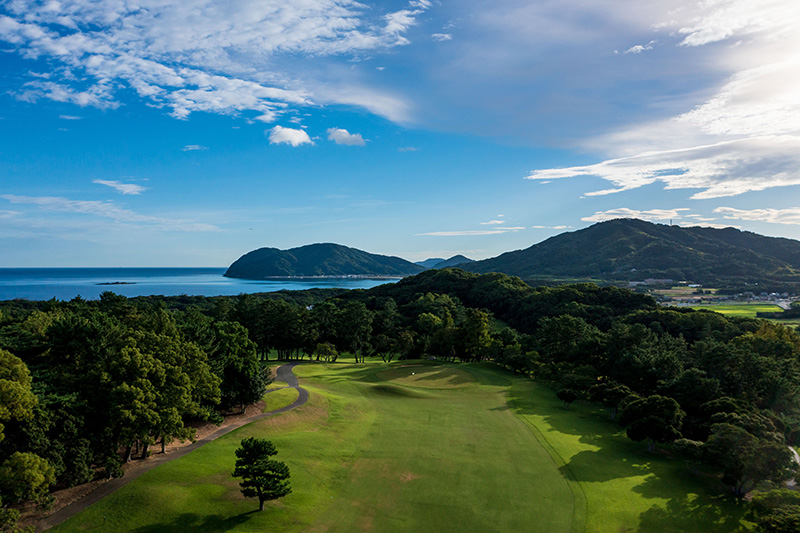
The 14th hole at Keya Golf Club.
By this point, McDaniel says, he’s an old hand at talking to the Japanese press, though he admits it was intimidating at first.
“To be honest, I really didn't know what I was getting into. Right out of the gate, there was a major newspaper article about me,” McDaniel says. “Then, when the first tournament came around, I was interviewed, and the interview was broadcast on national television. They continued interviewing me for several years during the tournament, asking how the course was playing that year, what my expectations were, and so on. Eventually, that kind of coverage slowed down, but I still had at least one newspaper or magazine article about me almost every year.”
It didn’t help that McDaniel hadn’t yet mastered the language when he first arrived.
“Work and daily life can get very irritating when you cannot communicate. More so daily life because it just makes everything so inconvenient when you cannot just get across what you want to say,” McDaniel says. “At work, people are generally working together as a team and you can eventually figure it out.”
Over the years, McDaniel’s been interviewed on national TV, and even featured in a weekly comic in a golf magazine. “In 2018, I was interviewed by writers from a weekly golf magazine that published golf stories in manga, essentially Japanese-style comics or graphic novels. I was featured as a character, which was published weekly for more than a year,” McDaniel says. “That was pretty bizarre!”
This most recent time, however, was different. Instead of grabbing a few quotes for a two-minute segment, the KBC crew followed McDaniel around for the whole day, including following him home to meet his family.
They followed me around the course for an entire day while I was working. Then they asked if they could come to our house and meet my family and have them say a few words,” McDaniel says. “That was probably the most surprising experience of all, but the kids really enjoyed it.”
Keya Golf Club features zoysia matrella on tees, fairways and greens, and zoysia japonica on its rough. McDaniel says growing conditions are similar to the transition zone of the U.S., with rainy seasons between spring and summer. “Typhoons are another factor, he says. “We appreciate the rain they bring, but strong typhoons can create a lot of work by damaging the course and knocking down trees.”
The game itself also varies a little in Japan. Most courses, McDaniel says, have start times on the front nine and the back nine, which means he needs more staff in the morning to prepare the course. Golfers often play nine holes, take a lunch break, then return for the final nine holes. “The average Japanese golfer also tends to be more concerned with the tidiness and appearance of the course than with playability,” McDaniel says. “Keeping the course neat, clean, and well-maintained is extremely important.”
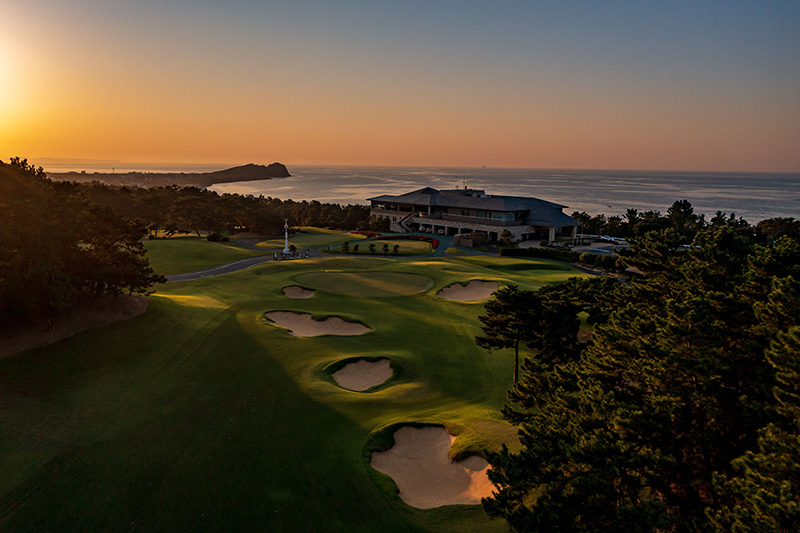
The 18th hole at Keya Golf Club.
Overall, McDaniel says, life in Japan has been good to him, press attention and all.
“It is a very safe country, and people are generally kind, respectful, and considerate of one another. One thing I especially appreciate is how strongly Japanese people hold on to their culture and traditions. At times, this can make Japan seem a little old-fashioned or less efficient than other countries, but I think there is also something reassuring about that consistency,” he says. “You generally know what to expect, and I think that sense of stability is part of what makes people so respectful, considerate of others, and conscious of keeping their communities clean and orderly.”
Abby Olcese is GCM's online editor