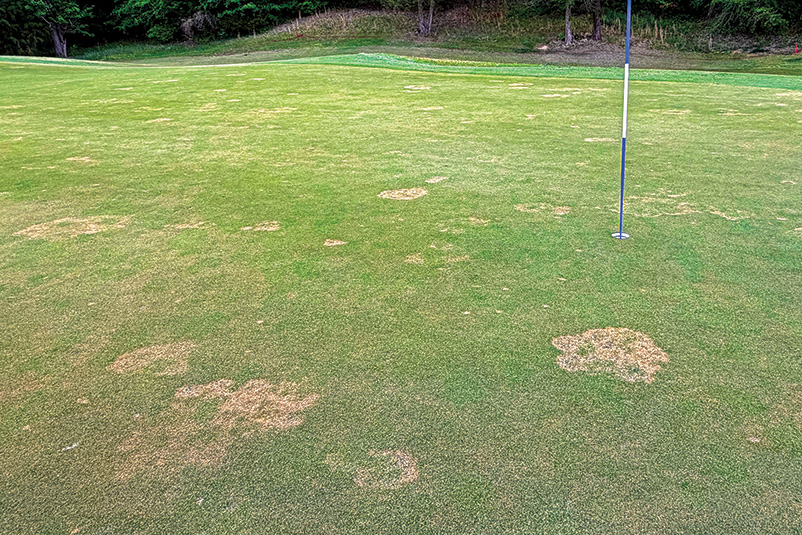
Figure 1. Take-all root rot symptoms like these often begin to appear in fall and tend to persist throughout the winter and spring until temperatures increase and turf begins to actively grow.
Editor’s note: This article is reprinted with permission from the June 19, 2026, issue of the USGA Green Section Record. Copyright USGA. All rights reserved. The original article can be accessed at: https://bit.ly/4gtLcYx.
Take-all root rot is a common disease that affects the roots, stolons and rhizomes of highly maintained warm-season turfgrasses. On golf courses, it is most problematic on bermudagrass putting surfaces. It is caused by multiple soilborne fungi, either individually or in various combinations. Originally identified as bermudagrass decline, the disease was renamed take-all root rot after the initial causal fungus (Gaeumannomyces graminis var. graminis) and similar symptoms were observed in other warm-season grasses (5, 15). TARR symptoms begin as irregular, off-white or white-colored patches 8-24 inches (20-61 centimeters) in diameter that can coalesce if the disease is not controlled (6, 15). Underground, affected roots and rhizomes are in poor health, usually shortened and necrotic. These symptoms often appear during late summer and fall following periods of hot and humid weather, frequently in conjunction with rainfall and low light (6, 15) (Figure 2).
TARR can be especially frustrating for golf course superintendents because once symptoms are observed, the damage has been done, and the only short-term management option is recovery. If the weather is not conducive to warm-season turf growth, damage from this disease may linger for extended periods, leading to unhappy golfers — particularly if it occurs on putting surfaces. Successful management of TARR requires a highly proactive approach, and this article will guide you through current recommendations based on research and the latest field experience.
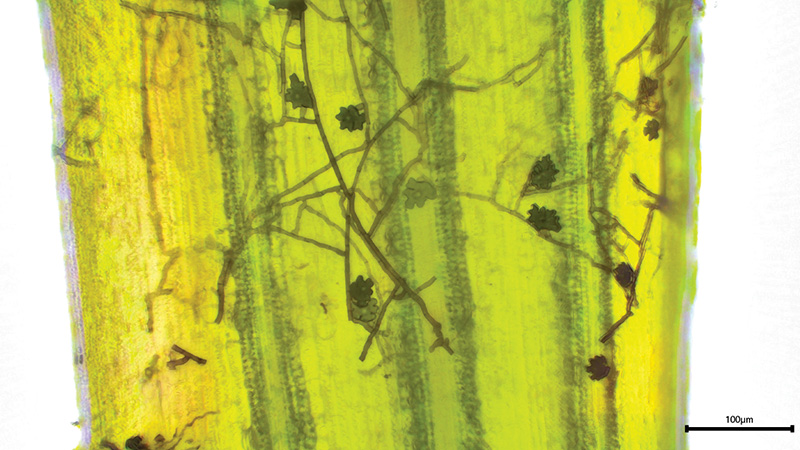
Figure 2. Take-all root rot is a soilborne disease, and the fungal pathogen primarily infects underground structures such as roots and rhizomes. However, in extreme cases the fungi can colonize stem and leaf tissue, like in this image. TARR attachment structures, called hyphopodia, that the fungi use to connect to the plant have a distinct, lobed shape. Photo courtesy of Lee Butler, NCSU Turf Diagnostics Lab
TARR identification
With any suspected turfgrass disease, proper identification is critical in forming a treatment plan. Aside from the previously described visual symptoms, sending potentially infected samples to a turfgrass diagnostic laboratory for disease confirmation will provide the starting point. When preparing the sample for shipment, be sure to follow the listed instructions and provide as much information about your course as possible, including photos of the damaged areas, recent cultural practices, weather conditions, sample location and anything else that might be helpful.
Current research indicates that multiple fungal pathogens are responsible for TARR. Gaeumannomyces graminis, G. graminicola, G. nanograminis, Candidacolonium cynodontis and Magnaporthiopsis cynodontis are the pathogens most frequently associated with TARR (4, 12, 16, 17, 18). These pathogens can act individually or together to cause disease symptoms, and multiple pathogen combinations have been found in diseased samples (14). In addition to these findings, scientists have shown that the pathogens have varying degrees of aggressiveness, with some causing more visual damage than others (12). However, the pathogens respond similarly to various fungicides, so the control mechanisms are essentially the same regardless of the specific mix present (13).
Once TARR has been identified on your course, it’s time to get to work. Most TARR symptoms occur later in the growing season, which makes recovery challenging for superintendents. Fortunately, there are many options for managing future disease outbreaks. Even if you haven’t had TARR issues at your course, it’s important to have a preventive program in place before problems occur for the reasons outlined above. Many courses have been caught by surprise in recent years.
First steps
When TARR symptoms first arise, a good way to minimize the damage is by adjusting your cultural practices. Most research suggests that raising mowing heights right away is beneficial (3, 7, 15). It is also recommended to reduce mowing frequency, reduce aggressive verticutting practices and use rollers to improve putting consistency. Additionally, applying a slow-release and/or acidifying fertilizer, such as ammonium sulfate — while avoiding nitrate source fertilizers — can provide nutrients to help plants grow through the outbreak (3, 7, 15, 19).
If symptoms are evident, it will be important to communicate with golfers and decision-makers about the nature of TARR. Most of the time, when symptoms become visible, the damage to roots and underground structures has already been done. Research has found that, upon inoculation, visible aboveground turf damage takes 14 to 21 days to appear (12). In the field, symptoms tend to appear in the shoulder seasons, and turf quality may not begin to suffer until fall or early spring — when temperatures and daylight are at their minimums and growth is slow — or after cloudy, rainy, cool weather when bermudagrass vigor declines (7, 10, 11, 12, 14). Because of this timing, most warm-season turfgrasses will have a hard time recovering until the following spring or summer, when growth begins to accelerate (Figure 3).
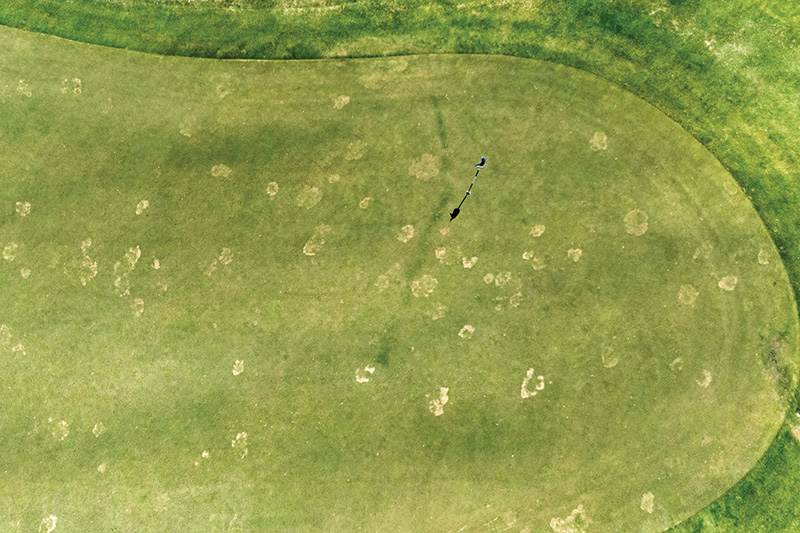
Figure 3. Most of the time, when TARR symptoms are visible aboveground, the damage underground has already been done. This can make it challenging for warm-season turfgrasses to recover until the following spring or summer.
Fungicides
After a TARR diagnosis, making a “curative” fungicide application may prove unsuccessful in the short term, as the pathogens are likely no longer active. However, many effective preventive fungicides are available for TARR management, especially when used at the proper timing.
Fungicide timing
TARR pathogens grow best at temperatures between 77 and 86 F (25 and 30 C). This means the ideal soil temperatures for pathogen growth probably occur from May to September in most parts of the U.S. (10, 12, 18). This is also the time when pathogens are likely to cause the most damage underground, though it may not be noticeable on the surface, as it coincides with vigorous warm-season turf growth. Fungicide applications should be made preventively when the five-day average soil temperatures are around 80 F (26.6 C) at a 2-inch (5-centimeter) depth, and they should continue based on the recommended interval on the fungicide label, usually every 14 to 28 days, until soil temperatures drop to around 60 F (15.5 C) (9, 11, 12, 13). Preventive applications will decrease the risk of TARR damage lingering into winter and spring. Later applications, when the weather cools off, may also help provide sustained suppression through spring (11). While you want to stay ahead of the disease with preventive fungicide applications, it is important not to apply too early. Research has shown that applications beginning too early in the summer do not help with disease suppression later in the year without follow-up applications (11).
Fungicide selection
If you have dealt with TARR in previous years, you know that it can always come back. Fortunately, there are plenty of good fungicides available for TARR management, and some are better than others. To start with, research has consistently shown that TARR pathogens are not susceptible to succinate dehydrogenase inhibitor (SDHI) fungicides, such as fluxapyroxad, penthiopyrad and isofetamid (7, 13, 14). They are, however, moderately sensitive to quinone outside inhibitors (QoI) and demethylation inhibitors (DMI) fungicides. Both of these classes consistently reduce disease pressure and provide acceptable levels of control, especially when disease pressure is low to moderate (14). Focusing on DMI applications going into the fall can be helpful for a TARR prevention program.
Specific fungicide recommendations include: azoxystrobin, pyraclostrobin, tebuco-nazole, mefentrifluconazole, difenoconazole, prothioconazole, trifloxystrobin and some combination products like Resilia (fluopyram, prothioconazole and propamocarb), Briskway (azoxystrobin and difenoconazole), Navicon (mefentrifluconazole and pyraclostrobin), Tartan (triadimefon and trifloxystrobin) or Lexicon (fluxapyroxad and pyraclostrobin) (7, 13, 14). It is important to be conscientious of application timing when using combination products, especially if the goal is also to spray preventively for spring dead spot (SDS). SDHIs are effective against SDS but not TARR. Fall preventive applications with combination products will not have a curative effect on TARR, but they may provide some preventive control through winter, so these products can still be beneficial for TARR management (2, 7, 8, 11). As with all soilborne diseases, when using fungicides to target TARR, always water the application in immediately with at least 0.125 inches (0.3175 centimeters) of water or more (3) (Figure 4).
Cultural management
An important part of managing TARR and minimizing potential damage is to cultivate healthy growing environments. During the most active growing season, core aeration is key, along with regular topdressing and solid-tine aeration to help relieve compaction and generally improve turf health (15). Maintain proper plant nutrition — especially nitrogen and potassium — as low fertility can increase the potential for severe outbreaks (7, 15).
As turf growth starts to slow at the end of summer, avoid overregulation with plant growth regulators, raise cutting heights, ensure proper fertility and limit excess moisture.
Improving drainage in wet areas will also help decrease the potential for severe TARR symptom development (3, 7).
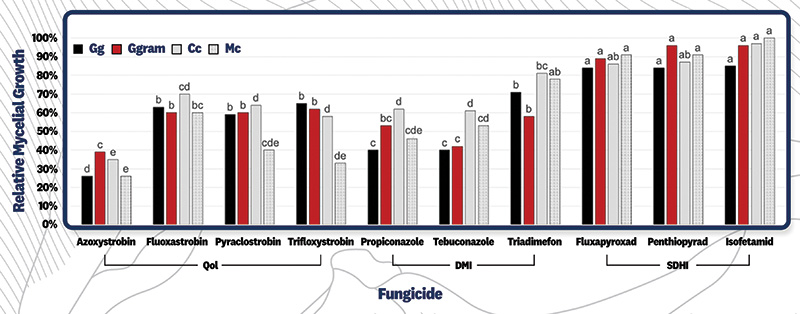
Figure 4. This graph shows the results of a study that evaluated the relative mycelial growth of four TARR pathogens — Gaeumannomyces graminis (Gg), G. graminicola (Ggram), Candidacolonium cynodontis (Cc) and Magnaporthiopsis cynodontis (Mc) — against 10 fungicides (10, 13). The QoI and DMI fungicides provided the most growth suppression, while the SDHI fungicides did not suppress growth. Growth bars with unique letters represent different statistically significant levels of growth and are compared within each pathogen.
Conclusion
TARR is a detrimental disease of warm-season turfgrasses that can cause long-lasting damage, especially on ultradwarf bermudagrass greens. It has been the most-commonly diagnosed disease on ultradwarf bermudagrass greens at the N.C. State Turf Diagnostics Lab since 2016 and was diagnosed every month in 2025 (1).
Given this prevalence, it is important for turfgrass managers to stay on top of preventive fungicide application timing, even when the turf looks good, and to keep cultural management practices at the forefront once TARR is detected.
The research says
- QoI and DMI fungicides provide the best control of take-all root rot (TARR). Applications should be timed for when five-day average soil temperatures at a 2-inch depth are around 80 F.
- When TARR symptoms are observed, most underground damage has already been done. “Curative” applications will not help, so the focus must shift to cultural management techniques like raising mowing heights, reducing mowing frequency and avoiding disruptive practices to minimize further damage and promote recovery.
- If TARR damages playing surfaces, explain to golfers and decision-makers that the turf likely won’t fully recover until optimal growing conditions return, which could be months away.
- Specific fungicide recommendations include: azoxystrobin, pyraclostrobin, tebuconazole, mefentrifluconazole, difenoconazole, triadimefon, trifloxystrobin, flutriafol and prothioconazole.
Literature cited
- Butler, E.L. 2026. 2025 Turf Diagnostics Lab Review. Retrieved May 14, 2026, from https://turfpathology.ces.ncsu.edu/news/2025-turf-diagnostics-lab-review/.
- Butler, E.L., and J.P. Kerns. 2019. Spring Dead Spot in Turf. Retrieved May 13, 2026, from https://content.ces.ncsu.edu/spring-dead-spot-in-turf.
- Butler, E.L., J.P. Kerns and C.M. Stephens. 2019. Take-all root rot in turf. Retrieved May 6, 2026, from https://www.turffiles.ncsu.edu/take-all-root-rot-in-turf/.
- Elliott, M.L. 1991. Determination of an etiological agent of bermudagrass decline. The American Phytopathological Society 81(11):1380-1384.
- Elliott, M.L., and P.J. Landschoot. 1991. Fungi similar to Gaeumannomyces associated with root rot of turfgrasses in Florida. Plant Disease 75:238-241 (https://doi.org/10.1094/PD-75-0238).
- Freeman, T.E., and B.J. Augustin. 1985. Bermudagrass decline. Plant Pathology Fact Sheet, Florida Cooperative Extension Service, University of Florida.
- Martin, B. 2017. Take-all root rot on the increase in the Carolinas. Golf Course Management 85:72-77.
- Landschoot, P. 2025. SDHI Fungicides for Turfgrass Diseases. Retrieved May 13, 2026, from https://extension.psu.edu/sdhi-fungicides-for-turfgrass-diseases.
- Leininger, M. 2025. September turf defense: Managing root disease and weather issues. Green Section Record 63(16).
- Stephens, C.M., E.L. Butler, T.W. Gannon and J.P. Kerns. 2019. Take-all root rot: A complex disease. Retrieved May 1, 2026, from: https://turfpathology.ces.ncsu.edu/news/take-all-root-rot-a-complex-disease/.
- Stephens, C.M., T.W. Gannon, M.A. Cubeta and J.P. Kerns. 2023a. Influence of fungicide selection and application timing on take-all root rot management under field and greenhouse conditions. Crop, Forage & Turfgrass Management 10(1) (https://doi.org/10.1002/cft2.20261).
- Stephens, C.M., T.W. Gannon, M.A. Cubeta, T.L. Sit and J.P. Kerns. 2022. Characterization and aggressiveness of take-all root rot pathogens isolated from symptomatic bermudagrass putting greens. Phytopathology 112(4):811-819 (https://doi.org/10.1094/PHYTO-05-21-0215-R).
- Stephens, C.M., T.W. Gannon, L.D. Thiessen, M.A. Cubeta and J.P. Kerns. 2023b. In vitro fungicide sensitivity and effect of organic matter concentration on fungicide bioavailability in take-all root rot pathogens isolated from North Carolina. Plant Health Progress 24(2):162-170 (https://doi.org/10.1094/PHP-08-22-0072-RS).
- Tomaso-Peterson, M., M.A. Tucker and C.M. Stephens. 2021. A detrimental root disease of bermudagrass putting greens. Mississippi Turfgrass, Spring 2021:8-13.
- Tredway, L.P., M. Tomaso-Peterson, J.P. Kerns and B. Clarke. 2023. Take-all root rot and bermudagrass decline. Page 106. In: Compendium of turfgrass diseases, Fourth Edition. The American Phytopathological Society Press.
- Vines, P.L. 2015. Evaluation of ultradwarf bermudagrass cultural management practices, identification, characterization, and pathogenicity of ectotrophic root-infecting fungi associated with summer decline of ultradwarf bermudagrass putting greens. (Publication No. 2079) [Master’s thesis, Mississippi State University] (https://scholarsjunction.msstate.edu/td/2079).
- Vines, P.L., F.G. Hoffmann, F. Meyer, T.W. Allen and M. Tomaso-Peterson. 2021. Gaeumannomyces nanograminis, sp. Nov., a hyphopodiate fungus identified from diseased roots of ultradwarf bermudagrass in the United States. Mycologia 113(5):938-948 (https://doi.org/10.1080/00275514.2021.1911192).
- Vines, P.L., F.G. Hoffmann, F. Meyer, T.W. Allen, J. Luo, N. Zhang and M. Tomaso-Peterson. 2020. Magnaporthiopsis cynodontis, a novel turfgrass pathogen with widespread distribution in the United States. Mycologia 112(1):52-63 (https://doi.org/10.1080/00275514.2019.1676614).
- Zhou, Q., B. Merrick and J.P. Kerns. 2025. Take-all root rot response to nitrogen rate and source in ultradwarf bermudagrass. International Turfgrass Society Research Journal 15(1):1105-1109 (https://doi.org/10.1002/its2.70073).
Brandi Merrick (bmerrick@usga.org) is manager of Green Section Education, Chris Neff is senior agronomist, East Region, and Mitch Leininger is agronomist, East Region, all at USGA; Lee Butler is an extension specialist at North Carolina State University, Raleigh.