Problem A: Brown area under tree
Location: East Dubuque, Ill.
Turfgrass area: Rough
Turfgrass variety: Kentucky bluegrass
Problem B: Brown area of turf
Location: Oxford, Miss.
Turfgrass area: College campus
Turfgrass variety: Kentucky bluegrass
Scroll down for answers.
Problem A: Brown area under tree
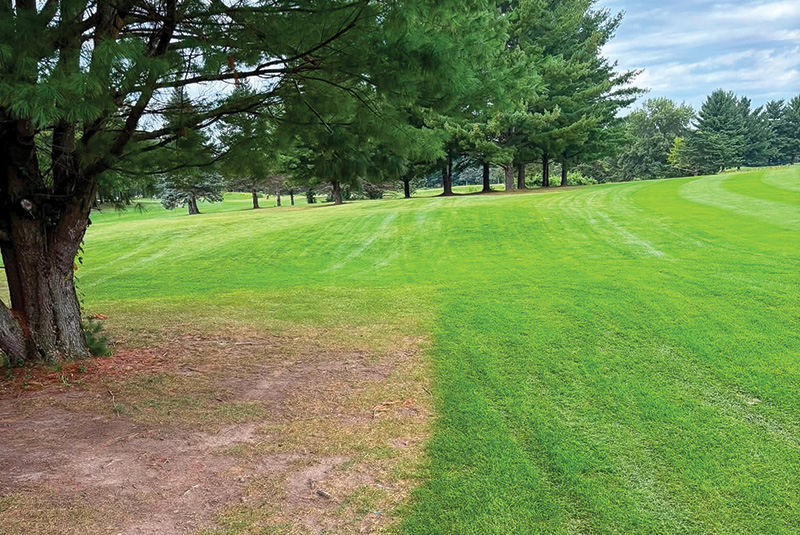
As everyone in the business knows, grass almost never turns brown in a perfectly straight line, so what is going on under this tree? The tree is a white pine, which typically develops a wide-spreading, relatively shallow root system rather than a deep taproot once established.
This golf course owns a tractor-mounted, vibratory deep-soil aerator that can penetrate to a depth of approximately 10 to 15 inches. The superintendent notes that the unit is “a little rough going through areas near trees depending on the amount of roots,” so the crew generally stays just outside the tree canopy line. Another beneficial result of using this machine is its ability to cut through smaller tree roots, particularly when the area is treated on a yearly basis.
As you can see in this photo, taken at the end of July, the root-pruning effect produced much healthier turfgrass in the treated area compared with the turf beneath the tree, where the machine was not used. Under the tree canopy, the turfgrass had to compete with the white pine’s extensive root system for available water and nutrients. During the summer stress period, this competition resulted in the clearly defined area of brown, stressed turf, while the root-pruned area remained noticeably healthier and greener.
Photo submitted by Rob Cunningham, project manager at Midwest Irrigation LLC. Story submitted by John Ballantine, golf course superintendent at Lacoma Golf Club in East Dubuque, Ill.
Problem B: Brown area of turf
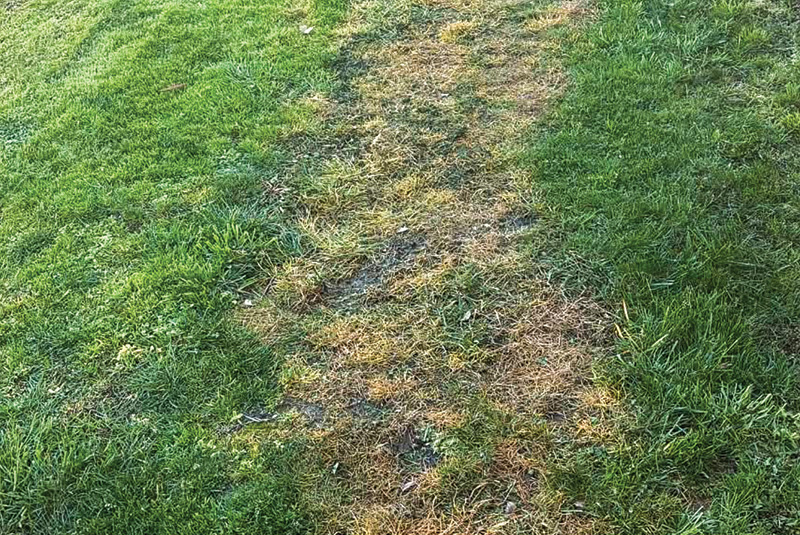
As with many college campuses, sidewalks and walking paths are occasionally relocated or eliminated as pedestrian traffic patterns change or new buildings are constructed. In this area, a sidewalk had become obsolete. Rather than removing the concrete, it was covered with a thin layer of soil and new sod. For quite some time, the area looked normal, with little indication that a concrete sidewalk remained buried beneath the turf. However, during an extended period of hot, dry weather, an unusual brown strip began to appear in the grass, closely following the path of the old sidewalk.
Because there was only a thin layer of soil between the turf and concrete, the grass directly above the sidewalk had a much shallower root zone and dried out more quickly. The result was a clearly defined brown pathway that revealed the location of the hidden sidewalk. Once the cause was identified, the area was excavated, the concrete removed, additional soil added, and new sod installed.
Photo submitted by Gary Morris, retired golf course superintendent at Ole Miss Golf Club, Oxford, Miss.
Editor’s note: Have a photo of an on-course anomaly? GCM would love to have a look! Email it to Photo Quiz author John Mascaro.
John Mascaro is the president of Turf-Tec International.