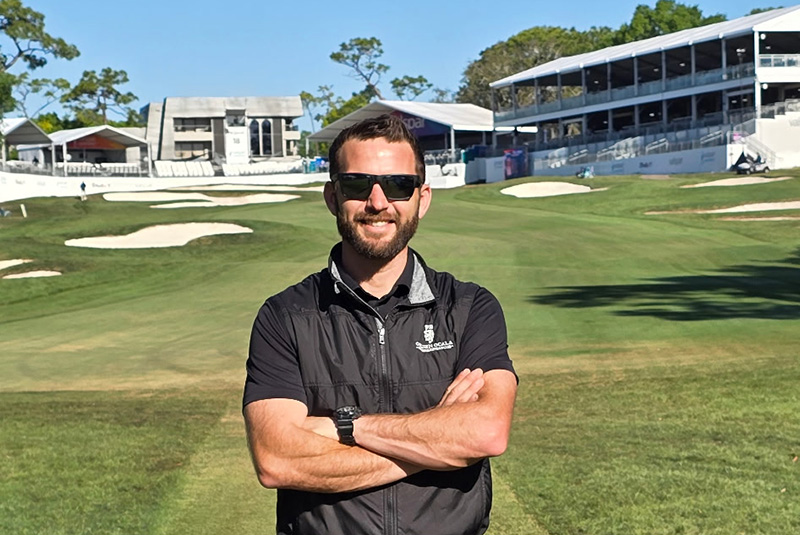
Taylor Anders at the Valspar Championship at Innisbrook Resort and Golf Club - Copperhead Course in Palm Harbor, Fla. Photos courtesy of Taylor Anders
My favorite stories have always been about redemption, comebacks and people who overcome impossible odds. Never in my life did I imagine that I would become the main character in one of those stories.
Mine is a story of achieving success through grit, determination and relentless hard work, only to throw it all away and choose a path of self-destruction. It is a story of losing everything, confronting the consequences of my own decisions, and finding a way back when it seemed impossible. Looking back, I can say with humility that this story almost never had an ending. In many ways, it almost didn't happen at all.
Growing up, sports played a defining role in shaping the path that eventually led me to a career in the turfgrass industry. I was never the fastest, strongest, or most naturally gifted player on any team, but I always had a reputation for showing up early, staying late, putting in the extra work and being coachable. Talent may have opened doors for others, but discipline became my greatest strength.
As reality set in and my dream of playing in front of thousands of fans slowly slipped away, I found a new passion: Turfgrass maintenance. Before long, it became more than a passion. It became an obsession. Looking back now, I realize it wasn't the first obsession to take hold of my life, and it certainly wouldn't be the last.
My career in turfgrass began when I was 15. My best friend's dad, the superintendent at a local golf course, hired me as a summer maintenance worker. At the time, I was in high school and had just experienced my first run-in with the law. After a night of drinking with friends, we made the reckless decision to take my friend's grandmother's car for a joyride. Looking back, I realize how much worse the situation could have been. Thankfully, the police issued us a fine and left the real punishment to our parents. It was a lesson I wouldn't soon forget.
Ironically, that miserable experience became the reason I got my foot in the door of the turfgrass industry. What felt like one of the lowest moments of my young life ended up introducing me to a profession that would give me purpose, direction, and opportunities I never could have imagined.
At first, I looked at my job as a greenskeeper as nothing more than a way to earn enough money to pay off the fine I owed. It didn't take long for my mindset to change. I found myself in a profession that rewarded the very qualities sports had instilled in me. I could show up early, stay late, put in the extra work, and ask questions about why things were done a certain way. The more I learned, the more I wanted to know.
Several years later, I enrolled in the Rutgers Professional Golf Turf Management School in New Brunswick. For the first time, I was surrounded by people who were just as passionate about turfgrass as I was. They shared the same work ethic and embraced the same relentless pursuit of excellence. I had finally found where I belonged.
What I didn't know was that life had a different plan for me. The road ahead wouldn't be defined by promotions or achievements alone. It would test me in ways I never imagined and force me to fight battles no classroom could have prepared me for.

The view the fourth green at Golden Ocala Golf and Equestrian Club.
Although I experienced my share of accomplishments early in my career, I also accumulated more than my share of regrets. What I couldn't see at the time was that my alcoholism was progressing alongside my success. As my career advanced, my drinking did too, until my life slowly became unmanageable. From the outside, it looked like I was living the dream. Inside, I was fighting a battle no one could see.
The sleepless nights became routine. One drink was never enough, and every promise that "tonight will be different" ended exactly the same. I'd have too much, swear I was finished, and then do it all over again the next day. I was building a successful career while quietly destroying the person behind it.
My tailspin was rapid and unforgiving. In just a few short years, I went from building a promising career in the turfgrass industry to being completely consumed by alcoholism. Before I knew it, I wasn't just out of the profession I loved, I was knocking on death's door.
Although I was facing a disease that has destroyed countless lives and families, I was fortunate in one important way: I didn't have to face it alone. When I could no longer believe in myself, there were people who refused to give up on me. Their hope carried me through the darkest chapter of my life until I was finally able to find some of my own.
My family knew it was time for treatment long before I did. My last memories before everything went black are hazy. Hours later, I woke up in an emergency room with an IV in my arm as doctors told me my liver was failing. If I wanted to live, I had a choice to make. I chose life.
Rehab became much more than a place for self-discovery and introspection. It gave me purpose. I was no longer fighting for myself alone. I had family, friends and mentors who believed in me and wanted me to become the person they knew I could be.
For the first time in years, I woke up each morning eager to learn something new about myself and the people around me. The fog that had clouded my life slowly began to lift, and everything became clearer. I learned that recovery wasn't about winning the whole battle in a day. It was about winning one day at a time. One small victory led to another, and before long, those small victories began to rebuild my life.
After treatment, I spent 10 meaningful months in a sober house, where I could focus on new priorities while experiencing real life without alcohol. My first instinct upon reentering society was to get back on a golf course as quickly as possible. I wanted to return to what I knew, something I was confident and comfortable doing.
I also realized that comfort was exactly what had led me astray before. My mind was trying to convince me that familiar meant safe, when in reality, it often meant repeating the same mistakes. I knew I needed to humble myself, so I chose the harder path.
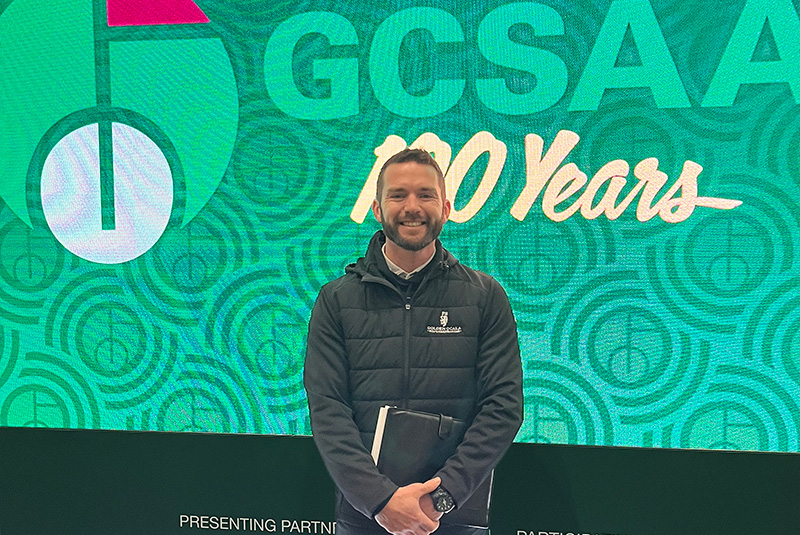
Anders at the 2026 GCSAA conference in Orlando.
For two years, I biked five miles to a local grocery store and five miles back home, rain or shine. Driving would have been easier, but that wasn’t an option with a suspended license. There I was — a Rutgers turf graduate and former assistant superintendent — stocking shelves as a grocery clerk. To some, it might have looked like rock bottom. To me, it was the beginning of a new life, and I was more grateful than I had ever been.
During those two years, I committed fully to rebuilding myself. I attended daily AA meetings, worked hard in the gym, and repaired relationships I had once damaged. I was experiencing a different kind of success for the first time. But even then, I could feel it; I wasn’t finished. My comeback was far from over.
My first job back on a golf course took me right back to where it all began, when I was 15 and first stepped into a greenskeeper role. Years later, I found myself doing the same work again, and I loved every second of it. The passion for this industry had never left me. When I walked into the interview with the superintendent, I expected he thought I was applying for a management position. But I had no interest in skipping steps. I wanted to start at the bottom and earn everything the right way, and that’s exactly what I did.
At the time, the standard wage for a full-time groundskeeper in Florida was capped at $16 an hour — nowhere near enough to cover rent and expenses. I worked nights at a grocery store after finishing my shifts on the course. It became a steady grind, rebuilding my life personally while laying the foundation for the future I had always imagined.
Within a few months, I had worked my way up to second assistant superintendent. I kept moving forward, refusing to look back, with my sights set on something bigger than I had ever allowed myself to believe was possible.
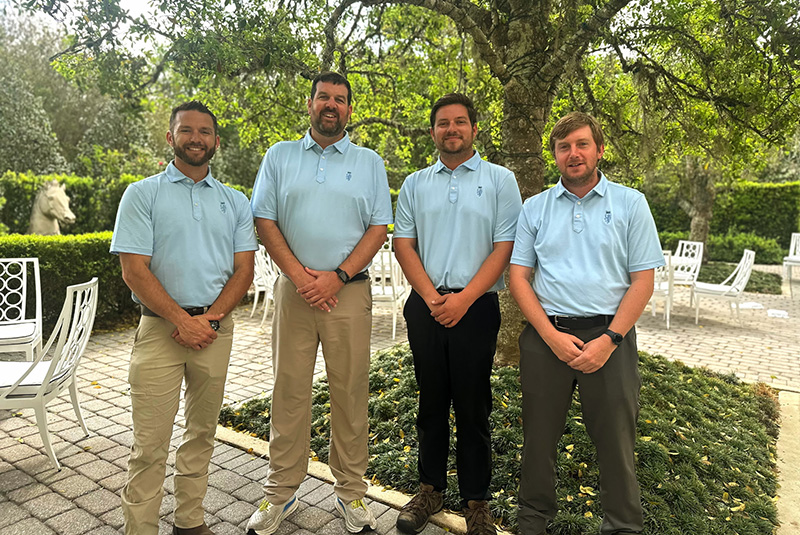
Anders with fellow turf managers at Golden Ocala Golf and Equestrian Club: Lou Eckhart, superintendent and 14-year GCSAA member; Lou Collela, assistant superintendent and nine-year GCSAA member; James McLeod, assistant superintendent and one-year GCSAA member.
Shortly after my first year back in the industry, I applied for the Assistant Superintendent position at Golden Ocala Golf & Equestrian Club in Ocala, Florida. The in-person interview was one of the most difficult experiences of my life. I laid out everything: My career on and off the course, the mistakes I had made, and the person I used to be. I didn’t hold anything back. Later, the superintendent told me my honesty and character set me apart from the other candidates. I told him the truth, that honesty and character were the only reason I was still alive today.
The job boards are set. The crew is eager to be turned loose. The sky is just beginning to break through the darkness. I’m an assistant golf course superintendent. Is there a better feeling than that? Maybe, but only if you’ve been to the lowest depths I once found myself in. Only if you’ve fought your way back from a place you weren’t sure you’d ever leave.
I’ve been to that place. I’ve danced with the devil, and I’ve made it out. My name is Taylor Anders, and I am a recovering alcoholic. This is my story.
Taylor Anders is an assistant superintendent at Golden Ocala Golf and Equestrian Club in Ocala, Fla.