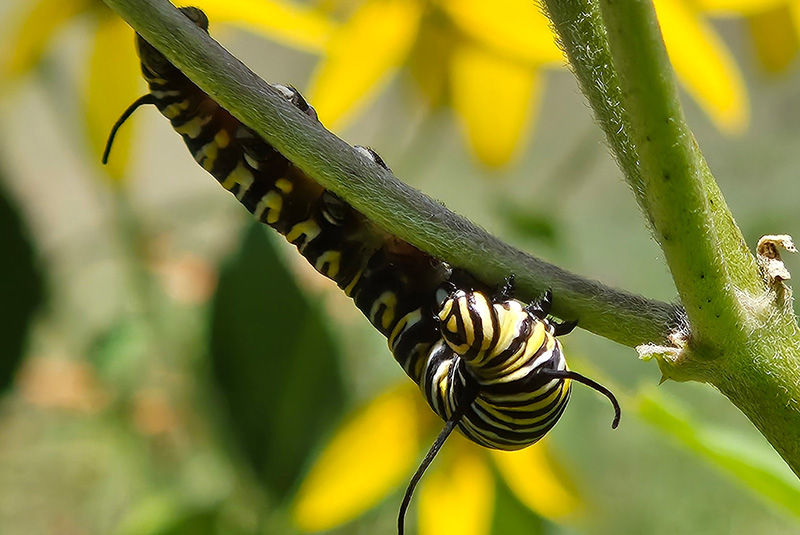
A monarch caterpillar crawls on a leaf at Flat Creek Golf Club in Peachtree City, Ga. Photos courtesy of Harold Ammons
Editor's note: The following article was supplied by Audubon International. All product claims, research cited and other information are directly from the organization.
If Flat Creek Golf Club is a sanctuary – and it most certainly is, for wildlife of many kinds, and for golfers increasingly tuned into their natural environment – then longtime Superintendent Harold Ammons is its biggest evangelist. And he just keeps bringing the good news, even when the midsummer sun is pounding down on fairways and greens in Peachtree City, Ga.
“We have 29 bentgrass greens, so we’re chasing them this time of year,” he said in early July. “Just putting just enough water on them, but not too much.”
Keeping grass healthy, and the water that irrigates the grass clear and chemical-free, are central to achieving and maintaining Audubon Cooperative Sanctuary for Golf certification, which Ammons and his crew have done since 2017.
“It’s been a great experience. It started when we got a directive from our regional vice president of agronomy, who wanted all of the golf courses to be certified,” Ammons continued. “Nobody did it except for us. It’s not easy, but not so difficult that you can’t do it. So I put my assistant on it. We worked together on it, it took a little over a year to do it, which is pretty quick. We stayed with it.”
For this year’s recertification, Environmental Specialist Sarah Honan came away from her site visit with a new appreciation of the lengths Flat Creek goes to raise its sustainability game on the course itself, and beyond it, into carefully tended native areas. It’s not just about agronomy and water and bird box maintenance, though all are near and dear to Ammons’ heart. It’s also about balance and abundance in every area of operations.
Nothing says “abundant” like a wildly successful beekeeping operation, which Flat Creek boasts thanks to the input of local experts and volunteers. “The first year we got about six gallons of honey,” Ammons says, “And last year we got a little over 15 gallons. I just bottle it and give away. The members really, really appreciate it. If they see me on the course they’ll ask me, ‘you got any more honey?’ You only get one big run a year, usually around June. The nectar flow this year has not been as good, but we still got about 10 gallons. That’s close to 100 bottles I can give away.”
Ammons adds that the bees are as complex as self-sustaining ecosystems get. A queen will fly off, leaving the need for another, and entire hives can float off for greener pastures. “They’re very temperamental. You can’t spray pesticides or herbicides near them, so you look for better alternatives. You’ve got to be very careful. Last year we lost three hives. You need to feed them enough. We’ll fill up troughs with sugar water, and they take it right up and start building hives and making honey. That’s their food through the wintertime, so we want to build them up now. Whatever they build up, they keep.”
A pollinator makes a visit to a flower. Flat Creek produces honey from the beehives kept at the golf club.
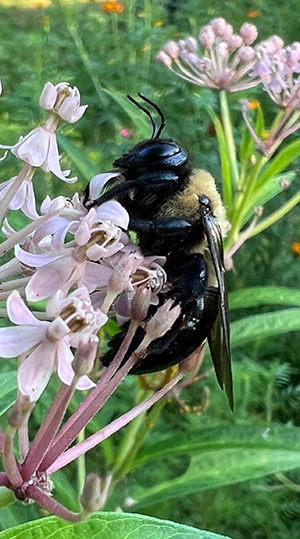
Indeed, bees are a temperamental bunch, but Ammons’ community partners help keep them around. That, in turn, helps keep flowers pollinated while contributing to the course’s overall health. “Instead of just spraying some herbicide, you start looking for something different that would not kill the bees. It changes your thinking – not going with the same thing you've done for 30 years. You do more preemergent [application] in those areas so that you don't have to spend herbicide money on it in summer and running the risk of [bees] landing on it, collecting it, taking it back to the hive and causing a big problem.”
While building Flat Creek’s beekeeping bona fides led the way to its latest recertification, Ammons is ever on the lookout for stewardship strides he can take to further the club’s commitment. Even though the course isn’t on a traditional migration route, he’s long been involved with Audubon International’s Monarchs in the Rough program, setting aside milkweed habitat so the colorful butterflies can lay their eggs and take a rest. He’s continually looking for ways to expand and deepening the course’s wildlife habitat.
Bird-loving members help maintain a slew of Purple Martin birdhouses and bluebird boxes. Ammons says they’ve raised more than 100 fledglings each year for the past five years, with up to three families sharing nests that one dedicated volunteer keeps cleaned out. “We’ve also got barn owl boxes we’re putting up this fall. We’ve got coyotes, deer, rabbits, squirrels, foxes. We’ve had turtle come up on the course and lay eggs in a bunker. We put caution tape around the area. It took exactly 63 days for about 20 of them to hatch – tiny little things that we set free at the creek.”
Turtles, butterflies, birds: They’re all part of the Flat Creek family, and part of Ammons’ endless quest to find new ways to “take care of our surroundings. Recertification keeps you motivated to do a lot of new things each year.”
That carries over the water treatment, too. Instead of treating ponds and irrigation channels with chemicals, Flat creek bought 60 carp last spring, then added 30 to 40 more to help take care of invasives like hydrilla and unwanted, flow-choking grass. “It’s controlling them pretty well, and part of thinking, ‘How can I do it safer for wildlife, and for us?’”
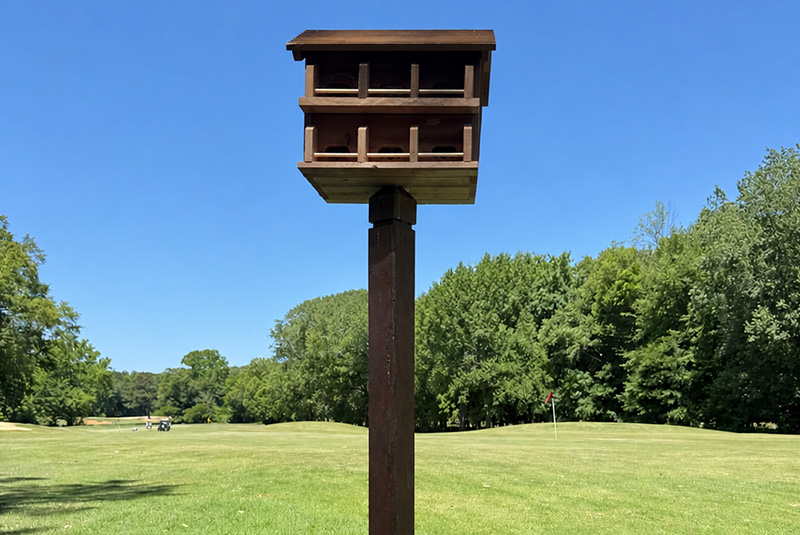
One of Flat Creek Golf Club's many birdhouses, which members help maintain.
And there’s a lot of “us” – 4,000 or so members in their six-course golf portfolio – which gives Ammons plenty of ammo to get out the good word about Flat Creek’s sustainability practices. Outreach is key to ACSP certification, and he takes it seriously, employing surveys and newsletter items to keep folks apprised and engaged. “We’ll tell them what we're doing, say thank you, and ask for feedback on what they enjoy when they visit the course. We have a lot of people coming and going and coming and going, and a lot of people do know about [Audubon International certification]. We promote it on our company page.
“Sometimes I'll just pick out an individual respondent and say, hey, I appreciate you for taking the time filling it the survey. I didn't know if you know, but we are an Audubon-certified golf course. We raise honeybees here. I'd love to give you some. They’re thrilled.”
Beyond the membership, Ammons has gained a reputation as Georgia’s greatest golf course sustainability evangelist among his peers, as well. He recently helped lead a seminar on Best Management Practices for the state’s superintendents’ association, presenting a PowerPoint slideshow of best practices in action – protecting wildlife, avoiding chemical applications in water features, organic turf science – and garnering a lot positive feedback.
“A lot of them wanted to connect after the meeting, get my number, and get more information on what we’re doing. It’s nice getting recognized through our company, and now I’m example for other courses. A lot of them have a fire lit under them again. It’s been very rewarding.”
And, with the bees’ help, a sweet deal for all.