Photos by Darrell J. Pehr
Oregon Turf Foundation donation funds new faculty position at Oregon State
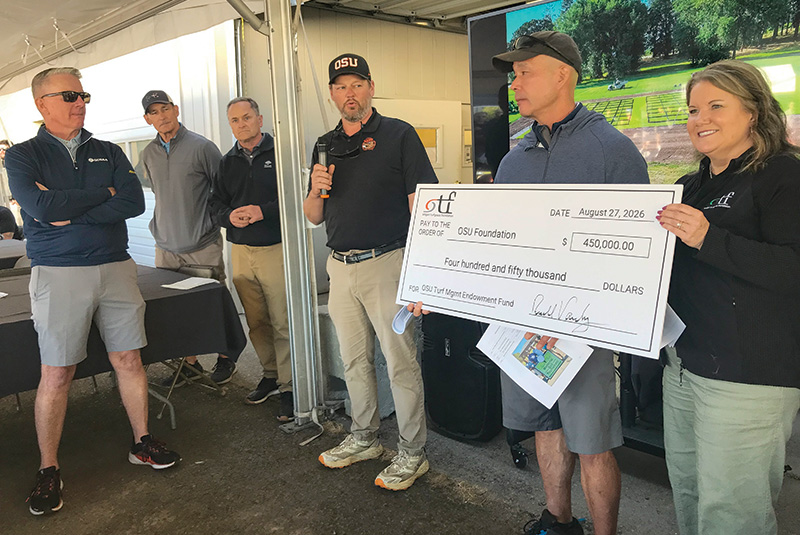
Oregon State University’s Turf Management Program received a big boost Aug. 27 during the program’s 2026 Turfgrass Field Day with the donation of $450,000 from the Oregon Turfgrass Foundation. The donation brings the OSU Turf Management Endowment Fund to more than $1 million, which will fund a second endowed faculty position in the program. The annual field day at OSU’s Lewis-Brown Horticulture Farm in Corvallis, Ore., drew a record 190 participants who learned about the latest turfgrass-related research projects being conducted by faculty and students at the university. The event kicked off with the announcement of the donation and the presentation of an oversized check. “What this check marks is that we’ve finally reached the $1 million goal.
We’ve actually surpassed the $1 million goal for the endowment support fund,” said Chas Schmid, Ph.D., assistant professor at OSU and Giustina endowed turfgrass specialist. “Every one of the OTF board has been working tirelessly to get people into the club donation program, into the golf tournaments … through their hard work, we’ve reached that $1 million goal toward hiring a second endowed position. We’re really excited about hitting this goal and continuing to work with OTF and more success in the future. I can’t thank you enough for the donation and the support you guys give.” The money was raised by the Oregon Turfgrass Foundation through golf tournaments and other fundraisers. The fund was started in 2007. The event included a golf tournament, coordinated by David Phipps, GCSAA’s Northwest regional field staff representative and Class A golf course superintendent. The tournament saw participation that surpassed prior years’ tournaments.
Assessing golf course superintendent stress in winter to inform timely outreach strategies
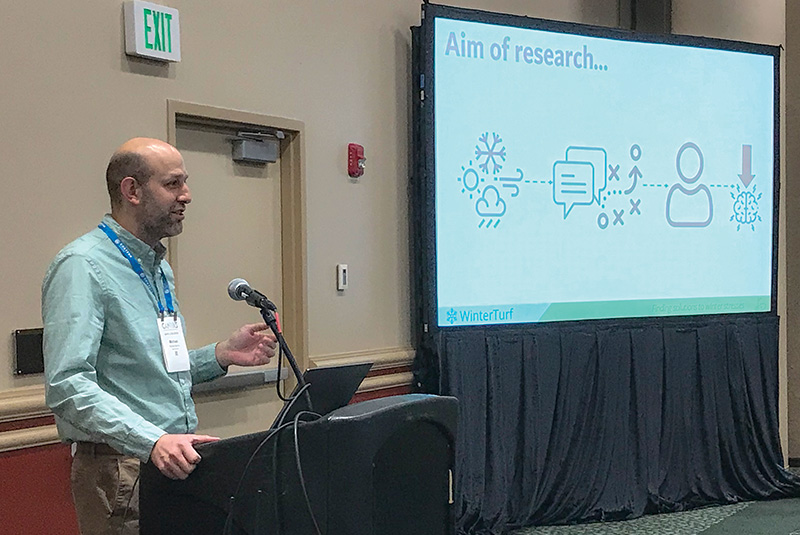
Golf course superintendents in cold climates can experience stress during the winter season as they contend with shifting weather conditions and utilize various and often untested management strategies to overcome turfgrass injury on their courses. Stress can have a significant impact on an individual’s short- and long-term health, increasing anxiety and depression, high blood pressure and impacting sleep. The current study assessed superintendents’ stress along with ongoing environmental conditions (e.g. precipitation, snow depth, ice cover and soil temperature) on golf greens on their courses via a weekly survey during the winter season from 2021-2024.
Results indicated that superintendent stress was low and generally stable except in situations where there was persistent ice, increased snow depth and higher precipitation affecting golf greens. Conversely, stress was lower when soil temperatures were lower. These findings have implications for timing outreach materials for superintendents and other turfgrass professionals that align with environmental conditions that are stress-inducing and put turfgrass at risk of winter injury.
— Michael R. Barnes, Ph.D., (barne369@umn.edu) University of Minnesota-Twin Cities, Saint Paul
Darrell J. Pehr (dpehr@gcsaa.org) is GCM’s science editor.