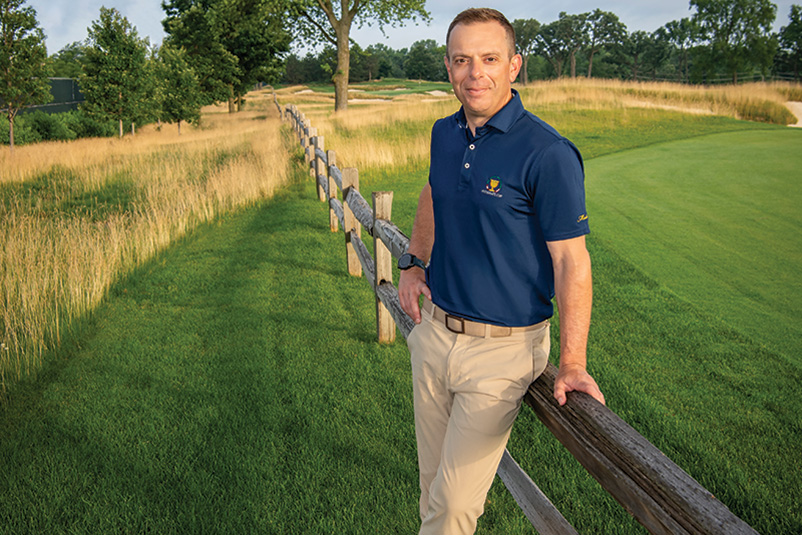
Ben McGargill, CGCS, and the team at Medinah Country Club are eager to introduce the facility’s reimagined Course No. 3 to the world when it hosts the Presidents Cup. Medinah Country Club/Nick Novelli Photography
Ben McGargill, CGCS, is no stranger to putting on big events at big-name venues.
He was a second assistant superintendent at Oakland Hills Country Club when that storied facility in Bloomfield Township, Mich., hosted the 2004 Ryder Cup, and he was that facility’s South Course superintendent when it hosted the 2008 PGA Championship.
His current club, the famed Medinah Country Club, has an even more impressive list of bona fides. The Chicagoland golf mecca has hosted three U.S. Opens, a pair of PGA Championships and a Ryder Cup.
Come Sept. 22-27, Medinah CC will reach even more rarefied air when it hosts the 2026 Presidents Cup. In fact, no other facility can claim to have hosted the PGA-U.S. Open-Ryder-Presidents Cup grand slam.
Darned right McGargill is thrilled at the opportunity.
“It’s hard to explain,” says McGargill, Medinah CC’s director of golf course operations and 24-year GCSAA member. “It goes back to the reason most of us do what we do for a living. It’s a labor of love. You see the product day in and day out, and you know when it’s good and when it’s not good. It’s a very satisfying thing to be able to visually see and feel the fruits of your labor. And I think, at the end of the day, if everything goes well, that’s the best part of it. It’s our Super Bowl. Everybody wants to make it there. Everybody wants to win it. Most of us at clubs like Medinah, this is why we’re here.
“And as important as it is to me, it means a lot to the club and the membership of the club. We’ll be the first club in the world to host a PGA Championship, a Ryder Cup, a U.S. Open and a Presidents Cup. Events like this are woven into the fabric of the club.”
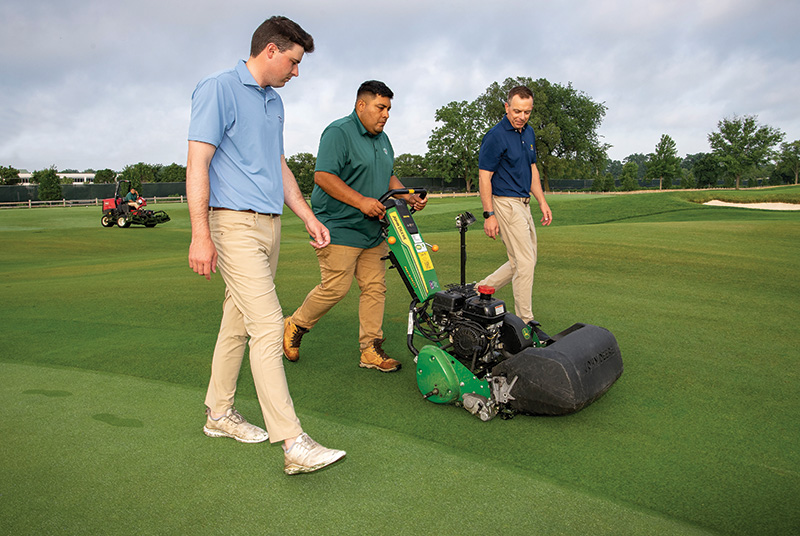
Ben McGargill, CGCS, and the team at Medinah Country Club are eager to introduce the facility’s reimagined Course No. 3 to the world when it hosts the Presidents Cup. Medinah Country Club/Nick Novelli Photography
‘I enjoyed mowing grass’
McGargill didn’t grow up longing to join the golf course management profession.
In fact, he didn’t even know there was a golf course management profession.
The product of a small-town Iowa farm, young McGargill’s first job in turf was mowing cemeteries as a teen.
“I knew then I enjoyed mowing grass,” he says.
Later, as a sophomore at Iowa State, he landed a job on a local golf course, and, he says, “I just fell in love with it.”
Coincidentally, Iowa State has an established, respected turfgrass program, so McGargill switched majors to horticulture with an emphasis on turf management.
“It’s funny. When I was young, I really had no idea this was a profession at any level,” he says. “It’s not just a guy sitting on a mower. When I realized I could tie something I loved doing and be able to see the fruits of my labor working with other people and could tie that in long term, that’s when I knew this was what I wanted to do.”
McGargill’s ISU internship took him to Oakland Hills CC, where he returned as second assistant superintendent after graduating.
“In terms of jumpstarting a career, that was too big to pass up,” he says.
He rose through the ranks there to South Course superintendent before becoming superintendent at another Chicagoland course, The Club at Wynstone, where he served 13 years until 2022.
“After a certain amount of time, after you make some of the larger improvements you do over a decade, decade and a half, things become routine,” he says. “I felt the need to challenge myself more than I was being challenged at that particular club. It is a wonderful club, and I enjoyed my time there, and after starting at a relatively young age, I felt I learned a lot. But after a while, I felt I needed something more. I needed some new challenges.”
Medinah’s sprawling complex, with its storied history, three courses and 59 total holes, certainly offered its challenges — not the least of which, for McGargill, came well before he moved there.
The Medinah job came open in 2018, and McGargill applied. He reached out to Steve Cook, the director of agronomy at Oakland Hills when McGargill was there.
“I told him he was on my reference list,” McGargill says. “He said, ‘I have a confession to make. I applied for it, too.’”
Cook got the job. He planned to work a few more years until retirement, but in December 2021, the club voted to hire an architect and reimagine its championship course, Course No. 3.
“He realized he’d be retiring toward the end of the project, and he felt it prudent if the club were to hire his successor, as opposed to him having to step out of the operation before it was over,” McGargill says.
Thus, McGargill reunited with his mentor and friend for 18 months in the transition.
“Fortunately for me, it worked out,” he says. “The project was a success. It was another feather in Steve’s cap. After his illustrious career, he did his final big, big, big project, and I was the benefactor of that.”
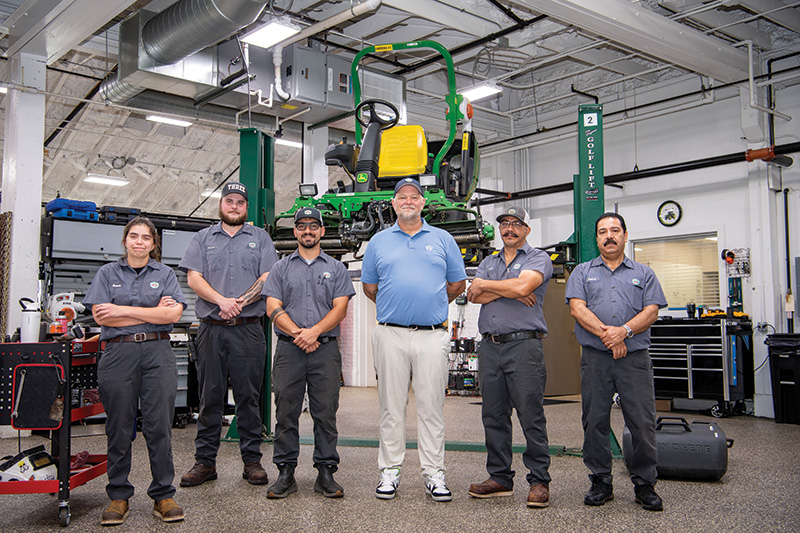
Inside the Medinah CC shop, from left: Amanda Javers, Kevin Rick, Franco Gazzano, equipment manager Jason Fontana, Alejandro Martinez and Pedro Gonzalez.
About that project …
When McGargill triples up on the “bigs” to describe the reimagination, he’s not slipping into hyperbole.
While Medinah boasts an impressive list of hosted events, it also has a long history stretching to 1924. Its first major was the 1949 U.S. Open, which returned in 1975 and in 1990. Tiger Woods won the two PGA Championships contested there, in 1999 and 2006, and the Ryder Cup came calling in 2012.
Though the facility has a history of toughening itself up to keep up with the challenges of an ever-evolving sport, by 2019, when it hosted the BMW Championship, it appeared the game might have pulled ahead of the course. Justin Thomas shot 25 under to win, and seven other players shot 7 under or better.
“That particular course, No. 3, was one that had been tinkered with over the years to get ready for the next tournament, the next thing,” McGargill says. “But the rankings were sliding a bit. I have to pass all the credit on to the membership of the club. They made the decision they wanted to remain relevant to championship golf in the United States. They understood they needed to undertake something that was bold. They couldn’t just tinker. They needed a complete rethinking of what Course No. 3 is.”
The club interviewed architects before settling on Australian firm OCM — Ogilvy, Cocking and Mead — for the work.
“The changes they proposed were by far the most drastic,” McGargill says, noting the O in OCM, Geoff Ogilvy, is the Presidents Cup International Team captain, adding an interesting subplot to September’s big event. “They’d only done one job in the United States. It was a very big and very bold and risky move for the club to hire OCM, but I think at the end of the day, it will pay huge dividends in the long run.”
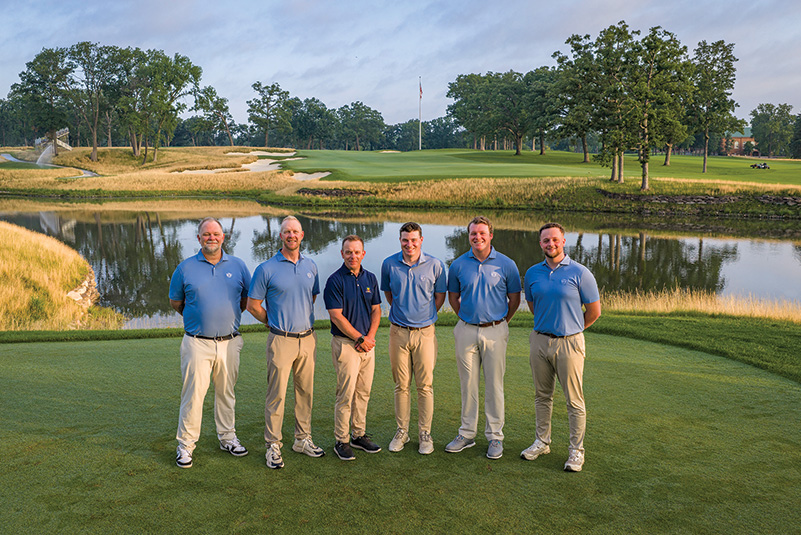
On Medinah CC’s 18th hole, from left: equipment manager Jason Fontana, head of agronomy Ethan Haveman, director of golf course operations Ben McGargill, Course No. 3 superintendent Nick Bell, Course No. 2 superintendent Ty Barschdorf and Course No. 1 superintendent Seth Jenkins.
The reimagination was drastic.
The narrow, tree-lined restrictive course was broadened, opened up. Trees were taken down and fairways reshaped. The golf course was completely reconstructed, resulting in near doubling in size of the course’s bunkers and greens. The last six holes were rerouted and completely replaced, and Lake Kadijah, around which much of the course is routed, was brought more into play.
“I’d never been involved with a renovation before, and it’s definitely not something I’ll forget,” says Course No. 3 superintendent Nick Bell, a five-year GCSAA member who started at Medinah in 2022 as an intern. “It was a fun year. Controlled chaos. It was incredible to see all the hard work put in. Especially to see it today … I have trouble trying to remember what the old holes looked like. Everything is more open now.”
“I think it allows play on the golf course to be as it was intended,” McGargill adds.
The renovation — ground was broken in April 2023, and the course reopened in July 2024 — also changed the way the Medinah grounds crew, which now numbers around 100, tends the place. Drastically.
“It’s much more challenging,” McGargill says. “One of the things I did in 2023, once we had a full grasp on the acreages, we did a lot of timing studies with the machinery we had. Do we have enough machinery? Do we want to hand-rake bunkers? How do we want to take care of the golf course? Do we have the right amount of people? The answer was no. I had to provide that information to the green committee. The club’s commitment and the support the membership has given us has been tremendous. They want to put Course No. 3 where it belongs. They want to give it the attention it deserves, and that includes the labor and equipment that’s required. It’s a large undertaking.”
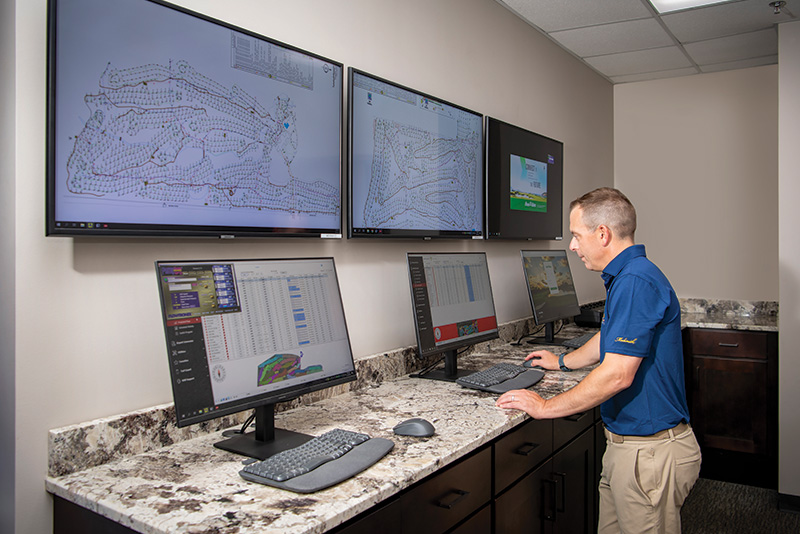
McGargill checking in on the facility’s irrigation.
The Medinah model
Another large undertaking is managing that three-digit staff.
Though each of the three 18-hole courses runs its own mostly dedicated crews, there is occasional overlap when, say, it’s time to aerify.
Everyone there, though, follows a model started at Medinah by Cook and expanded in earnest by McGargill. In essence, the Medinah model features a hierarchy of McGargill at the top, followed by Ethan Haveman, head of agronomy, with individual course superintendents, assistants and interns reporting up.
“We have 59 holes here, counting the practice facility. It’s hard for me to have time to do all the mentoring and coaching and keeping a strong bench,” McGargill says. “Ethan is our head of agronomy. That position is focused on mentoring and developing the assistant superintendents and superintendents that keeps a strong and deep bench here at the club and that allows us to develop young individuals right out of school so they’re ready to become course superintendents. The development of those people who start fresh out of school and rise through the ranks of the operation is one of the most joyful parts of the job.”
Haveman, a GCSAA Class A superintendent and 18-year association member, agrees. Like his boss a small-town Iowa farm kid who discovered the industry in college, Haveman was hired as an assistant under McGargill at Oakland Hills just in time for that 2008 PGA Championship. He moved east and landed a couple of head superintendent jobs before reuniting with McGargill at Medinah in 2023 as the renovation was wrapping up.
“With Steve (Cook) moving on and seeing how big Medinah is, he needed somebody to fill his role,” Haveman says of McGargill. “He needed another adult in the room. We have a lot of young guys here. He needed somebody who had faced the challenges of a superintendent at a big course, someone who has borne the weight.”
Bell is a perfect example of the model. The Course No. 3 superintendent came to Medinah as an intern and now, at the ripe old age of 23 (he turns 24 this month), will serve as superintendent of the course hosting one of golf’s biggest events.
“It’s by design,” Haveman says of the Medinah model. “It’s like they’re bowling, and we’re the bumpers. They’ll make mistakes. Hopefully, they don’t make too many mistakes. But we allow guys to grow and be decision-makers to prepare them when they’re department heads. We’re lucky Medinah attracts some of the best and brightest.”
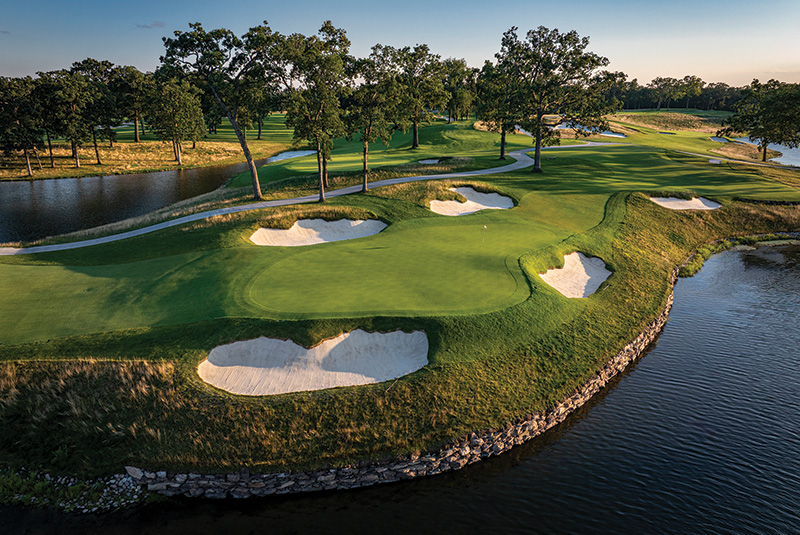
Medinah CC’s 17th hole
Course conditions
The Medinah CC crew is confident the new-look Course No. 3 will be ready for its closeup next month.
“We came out of the winter great,” McGargill said. “It’s been a really good year so far. One of the things we have that’s to our advantage is, September is usually a great month. If you ask most golfers in the Midwest, they’ll tell you September is the best month. The weather’s ideal, and it’s usually dry. It’s a great month for agronomics and the recovery of turf.”
“It’s in great shape,” echoes Bell, who cut his chops in big-event golf by volunteering at last year’s Ryder Cup. “We’re excited. The greens are healthy going into summer. We’re happy where we’re at.”
McGargill, for his part, is confident the team has or will have done everything it can to make Medinah Country Club’s Course No. 3 return to one of golf’s biggest stages a success.
“I’ll be honest, the biggest fear I have is the thing I can’t control, and that’s rain,” he says. “This golf course is designed to play firm and fast. We understand the amount of work that goes into hosting an event, the planning and prep to get the golf course to peak the week of the event, then a deluge of rain comes on Wednesday or Thursday, and you feel for the individuals who worked so hard on it. That’s my biggest fear. I’ve got a great team, a really good group of turf guys. I’m not worried about what we can control.
“This is the debut of the new Course 3 to the world, and we want that excitement there. We want the greens fast, the surrounds to be firm. We’re confident we’re doing everything we can to be successful.”
Andrew Hartsock (ahartsock@gcsaa.org) is GCM’s editor-in-chief.