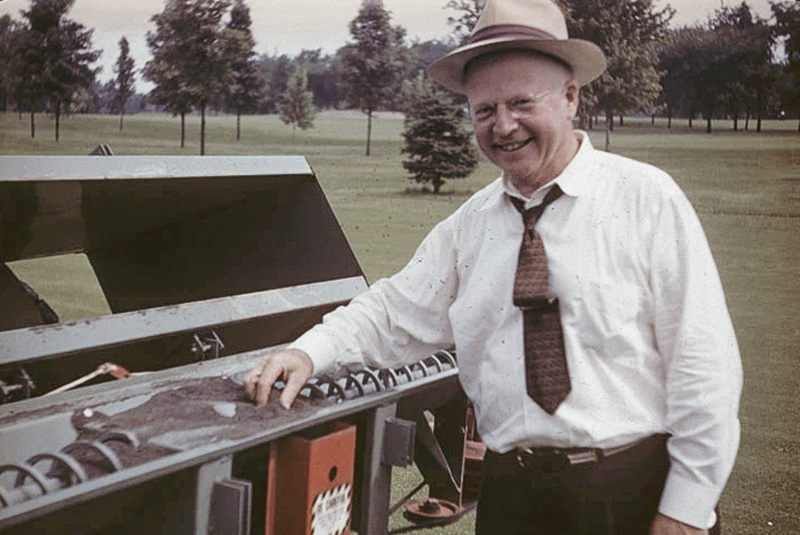
A three-time winner of GCSAA’s Distinguished Service Award, O.J. Noer established himself as a prolific adviser to superintendents and speaker at conferences and trade shows. Photo courtesy of O.J. Noer Memorial Turfgrass Collection at Michigan State University
Universities often name buildings and programs after people who have made a significant impact in their work, and the University of Wisconsin is no different. In 1992, the University of Wisconsin established the O.J. Noer Turfgrass Research and Education Facility, and, while I have yet to visit that research center, I was happy to learn a little about Oyvind Juul “O.J.” Noer in our work this summer preparing the Centennial edition of GCM.
Much like William H. Daniel, Ph.D., whom I wrote about for the July edition of GCM, Noer was a recipient of GCSAA’s Distinguished Service Award (now known as the Col. John Morley Award). In fact, Noer is the only person who received the award three times — in 1952, 1959 and 1960.
But Noer built his career from the ground up, literally, only using his education as a soil scientist for the benefit of turfgrasses later in life. After graduating from the University of Wisconsin with a degree in soil science in 1912, Noer served as a Wisconsin state soil chemist and is credited with establishing the first soil-testing laboratory in the country. During and after World War I, he served overseas as a captain in the U.S. Army’s Chemical Warfare Service, which worked to unite various scientific and military units to counter devastating German gas tactics on the Western Front.
From 1922 to 1924, as part of a fellowship with the College of Agriculture at the University of Wisconsin, Noer researched the agricultural value of Milogranite, which is now used as a slow-release nitrogen fertilizer composed of heat-dried microbes that have digested the organic material in wastewater.
Noer’s academic study led to a job leading the Milwaukee Sewerage Commission Turf Service Bureau, where he soon turned from focusing on the use of Milogranite for agricultural purposes to its use on golf courses, which at that time were relying on manure and ammonium sulfate as fertilizer. One of Noer’s first test plots was at Blackhawk Country Club in Madison, Wis. Over time, he expanded his research and established turf test plots across the country.
Noer visited approximately 80% of all the golf courses in North America advising superintendents and was a popular speaker at industry conferences and trade shows. In 1928, Noer published “The ABC of Turf Culture,” one of the earliest books about turfgrass, which helped lay the groundwork for modern turfgrass management, soil properties and golf course maintenance.
Among Noer’s findings was that thatch influenced turf nutrition, and he requested thatch be included as part of any soil sample. His later research found that most herbicides and insecticides react differently when applied to thatched versus non-thatched turf. Noer also was the first to diagnose iron chlorosis as a nutrient deficiency rather than the result of a disease.
In GCM’s Centennial edition, writer Larry Aylward outlined Noer’s impact as a pioneering agronomist. Aylward reported that in 1961, Noer wrote about the “tremendous surge” in golf course construction but acknowledged the corresponding increase in golf course maintenance.
“In addition to increased costs of operation, the increase in golf play per facility is placing an increased tax on turfgrass condition and an increased burden on the superintendent in planning maintenance time,” Noer wrote. “Despite these problems, golfers will continue to demand and seek the best in golf facilities and turf maintenance standards.”
Noer stressed it was up to superintendents to meet these demands. He praised efforts to provide more educational opportunities for superintendents, including turfgrass conferences to spread the word about research developments.
“Many great developments in management techniques have resulted from the combined effort of turf research centers, industry and progressive superintendents,” Noer wrote.
Noer also was the recipient of the 1963 USGA Green Section Award for “distinguished service to golf through work with turfgrass.” He died in 1966 and was later inducted into the Wisconsin State Golf Association’s Hall of Fame at the 1985 Wisconsin Golf Turf Symposium.
Thanks to the ongoing work being done at the O.J. Noer Turfgrass Research and Education Facility in testing, development and promotion of turfgrasses and turfgrass management technologies, Noer’s legacy lives on.
Darrell J. Pehr is GCM’s science editor.