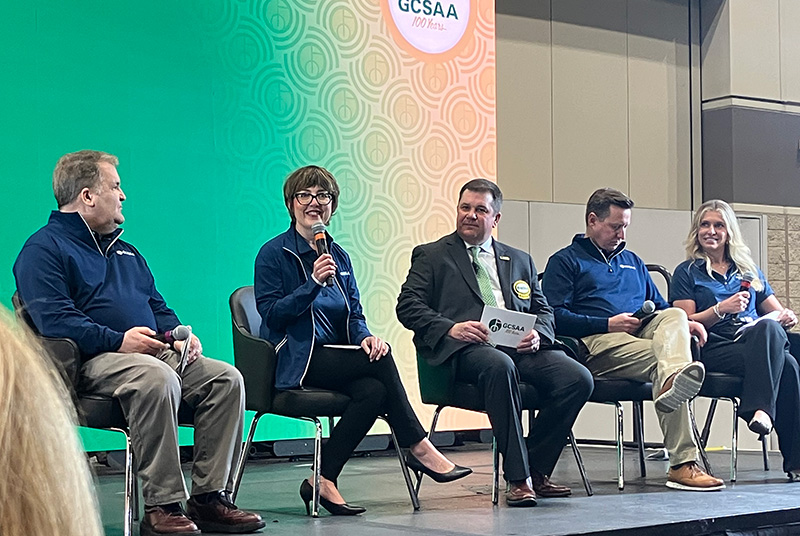
The GCSAA Government Affairs team discussed upcoming legislative changes, challenges and strategies with attendees at the 2026 GCSAA Conference and Trade Show. Photo by Phil Cauthon
Attendees at the GCSAA Conference and Trade Show gathered Thursday at the GCSAA stage to hear the association’s Government Affairs team discuss the legislative and regulatory proposals facing superintendents in the year ahead.
The four members of the team are Chava McKeel, director of government affairs; Bob Helland, director of congressional and federal affairs; Michael Lee, senior manager of government affairs; and Kelly Lonker, grassroots advocacy specialist.
McKeel kicked off the session by noting three of the accomplishments she’s been proud of since she became director in 2012. First on the list: bringing the government affairs team out of the shadows.
“That’s been a core mission of mine and I think we’ve done a good job of that. And now we’re considered a pillar of the organization,” McKeel said. “The second thing I’ve noticed is that we’ve become very proactive instead of being reactive. We launched a Grassroots Ambassador program and that’s very proactive. We’ve also brought forward a political action committee, where we pool our dollars to build champions for golf.”
“The third and final change I’ve seen is the attitude from our members in terms of us working with and not against our elected officials and regulatory officials. We’ve developed a very positive approach with the EPA, with Congress and with others. I think it’s paid big dividends.”
Helland said that in the coming year, the major thing that can be expected is a change in power between parties. “What that means for our agenda is that we are going to see some bills that we’ve wanted to pass move faster. There is a backlog and growing pressure to move on the Farm Bill. One of the last things I did before coming here for Show is I talked to the chair of the Ag Committee about including turf grass research funding in the next iteration of the Farm Bill. That is going to happen regardless of which party controls Congress,” Helland said.
“Second is the PAR Act. It’s our number one policy goal, which is to get golf out of discriminatory language in the tax code, which has hurt what you do at your facility. That has a greater likelihood of passing, too,” Helland said. “After that, we just stay in our lane and we focus on the issues that are important to us and make sure we keep a dialogue open with both sides.”
Lee said everything the team does is guided by the Government Affairs committee at GCSAA and the priorities agenda that it crafts. “Certainly one of the focuses is all the pesticide regulations, because those products are critical for a lot of superintendents across the country,” Lee said. “We do great work with regulators and agencies…you have some smart minds in these agencies and they’re pretty good on these issues. The problem is when you see bills in legislatures that would take away products. We’d far rather work on regulations with these agencies than have legislation dictate what is on the market.”
Lonker said that calling the team’s efforts an “educational opportunity” is key, such as the Grassroots Ambassador program, which she oversees.
“Calling it an ‘educational opportunity’ removes the negative connotation someone might have towards the Ambassador program,” Lonker said. “The core of this program is all about building relationships. It’s about making a connection. Talking about the game of golf, which all superintendents love to do. They love to support their industry, so they really don’t have to have a passion or knowledge of the policy — that’s our job. All you need to do is just have a passion to protect your industry.”
“A lot more of our members are seeing the value of this program, so that increases participation, and more participation increases member-driven outreach. That increases more connections with congressional members and that allows our industry to have more credibility, more awareness and more protection of the issues that matter to us.”