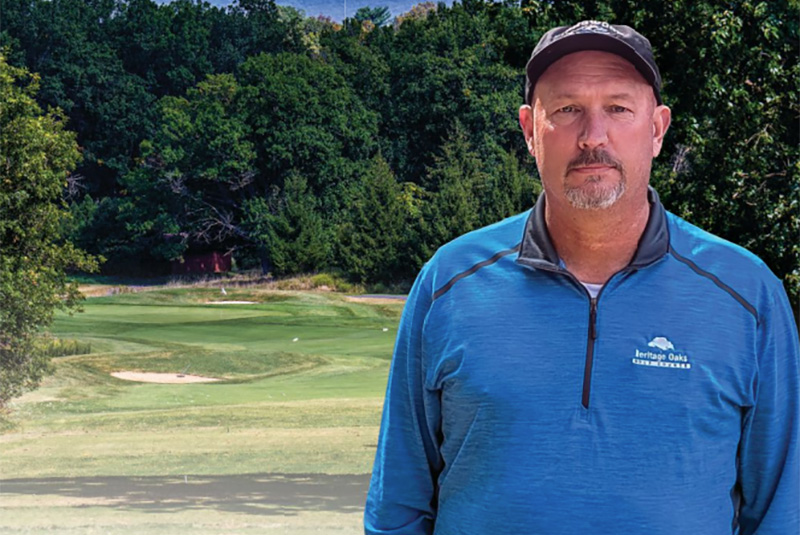
Charlie Fultz, GCSAA Class A superintendent and general manager at Heritage Oaks Golf Course in Harrisonburg, Va., which is pictured in the background, is the winner of GCSAA’s 2025 Leo Feser Award. Photos courtesy of Charlie Fultz
In early 2023, Charlie Fultz’s life had come crashing down around him.
The GCSAA Class A superintendent and general manager at Heritage Oaks Golf Course in Harrisonburg, Va., faced a series of challenges all at once — any one of which would be difficult to deal with.
His dad was diagnosed with stage-4 prostate cancer. One of his sons faced a life-altering medical condition. His other son faced a life-altering legal issue. And Fultz was having troubles in his home life.
“I was not equipped to handle it all,” Fultz wrote in an article for GCM magazine published in June 2025. “I tried, albeit poorly, to compartmentalize each event on its own and try to handle it separately. I was failing miserably. After a few weeks of helplessly trying to cope, I concluded that I needed help.”
For his article, “Help wanted: Why knowing when to ask for help with your mental health can be a good thing,” Fultz has been selected to receive the 2025 Leo Feser Award. Now in its 48th year, the award is presented annually to the author of the best superintendent-written article published in GCM, the association’s flagship publication, during the previous year.
“I was shocked to find out I won. It was pretty emotional to get the news,” says Fultz, a 20-year association member. “The article was really personal. I was just hoping to get the message out there when I wrote it. I remember telling my girlfriend if one person reads this and it in any way helps them, then the article did what I hoped for. I’ve even had a couple phone calls saying the article was really important. Winning this award is without a doubt one of those moments that I’ll put on my career milestones list.”
With a little help from his friends — and a therapist
Fultz’s article was a look at struggles in his personal life and his journey to mental health. He wrote, “The realization that I needed help was the most important step I took to find my own well-being and to help me handle life a little better than I had been.”
It wasn’t easy to take that step, though, says Fultz.
“Without a doubt, one of the hardest things to do is to admit there are certain things you can’t do without help. We’re equipped with an ability to handle stress, but there is a point that you have to look within yourself and ask, ‘Am I feeling better?’ or, ‘Am I getting over this in a way that is healthy?’ Or is it something that just won’t go away?” Fultz says. “I was just feeling bad. Health-wise, I had lost weight. I certainly wasn’t eating well. I wasn’t sleeping well.”
His friends could tell, he says. “I’m really blessed with a group of friends that are just amazing,” Fultz says. “I was having a particularly rough time, and I was texting with one of these longtime friends. She could evidently tell by what I was saying in my texts that I was really beat up and pretty down. She said, ‘Can I call you?’ We talked for about 30 minutes. I was driving home from work, and I just kind of had a breakdown. It was entirely too much. She asked if I’d thought about going to talk to somebody. She said she thought it was too much for any one person to handle. I kind of put that away in the back of my head and thought, ‘Well, maybe I might.’”
That friend — Amy Proctor — soon reached back out with a therapist recommendation.
“I sat on that a couple of days and decided, ‘What do I have to lose at this point?’ So I called and made the therapist appointment, and that would become the next 15 months of my life,” Fultz says.
That was the spring of 2023. For about six months, he and the therapist met twice weekly and then stepped it back to once weekly. Recently, he’s made appointments only on an as-needed basis, which has proved to be once a month or so.
“I credit the therapy with my recovery,” Fultz says. “The therapist lets the conversation steer itself. We just kind of talk about what’s going on with me today or last week and just go from there. As we went through it, we got deep into not only the things I was facing currently but going back to stuff from my childhood and through the course of my adult life — things that had always been there, but I never really got a grasp on. There were a lot of intense sessions of deep soul-searching, a lot of getting to the heart of things, self-esteem issues that I’ve had my entire life, but not realizing how bad they were. It took me 54 years to look in the mirror and like what I saw, and that’s entirely too long.”
For those who are skeptical about seeing a therapist, Fultz encourages them to take the leap and see if it helps.
“Seeking out therapy was an extremely difficult step — I will not lie. But if something is affecting your life for the worse on a daily basis, wouldn’t you want to live a little bit better?” Fultz says. “It without a doubt changed my life. I’ve looked back at what I was going through and the shape I was in and can say, ‘Man, I waited too long to get help.’ It shouldn’t have taken those four big things to get me to a place where I got help. I just waited entirely too long.”
The same goes for skepticism about taking medication. Fultz started taking busiprone for ADHD and anxiety around the time he started therapy. “The medication allowed me to focus,” he says. “Without the medication, trying to process and handle everything I was going through was tough. The medication — the best way to describe it — it leveled out my brain to allow me to process what was going on.”
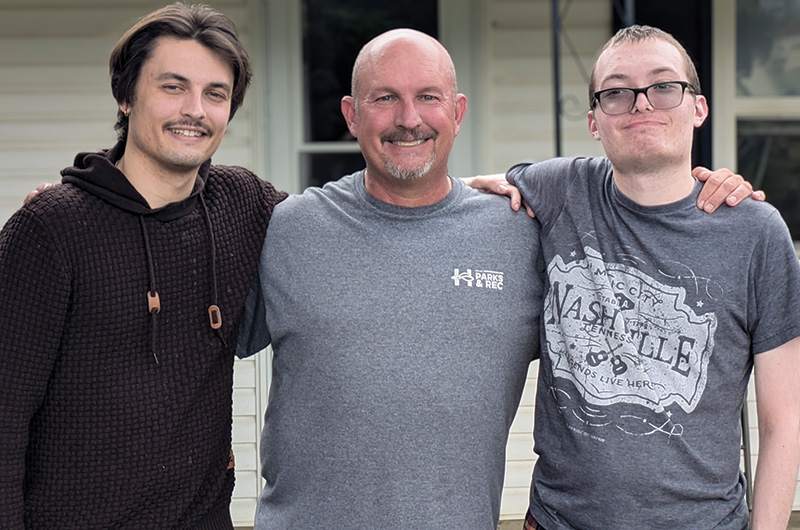
Fultz (center) with sons Lukas (left) and Jakob.
Road to recovery
Proctor, the friend who suggested Fultz seek out a therapist, says they’ve known each other since elementary school so she could just tell he was in a bad place. She can also tell that, now, the therapy has had positive results.
“Now when we talk, he’s positive and seems to be at peace about a lot of things in his life that before really weighed on him. When we talk, it’s about our families and the good things that are going on, not the struggles,” Proctor says.
She says she’s also sought therapy and believes in its benefits. “It’s helped me, it’s helped family members, it’s helped friends. But it’s hard. You have to do the work. It’s not an easy thing to do,” she says. “I had to really talk it out with somebody who wasn’t a friend, wasn’t family, somebody I could just talk to and could guide me and help me understand my own feelings.”
Proctor says she’s proud of Fultz’s willingness to share his mental health challenges so publicly.
“It took a lot of courage for Charlie to publicly write about what he was going through. It’s a real testament to his character that he wants to help others by saying, ‘Hey, look, this happened to me, and it might be happening to you, and there is help out there,’” she says.
Reaching others
Fultz says he wrote the article for GCM hoping that someone reading might benefit from his story. To his delight, he got a couple of calls right away — one from Paul Richmond, superintendent at The Meadows Golf Club in Litchfield, Maine, and six-year GCSAA member.
“Paul worked for me years ago, 22 or 23 years ago,” Fultz says. “Now he was going through some personal stuff and was really kind of beat up. He called and said, ‘What are the odds that I’m reading GCM, and there you are with an article about mental health and making sure you take care of yourself.’ He said, ‘Seeing your face and reading the article really helped him refocus and talk to some people.’ With somebody I’ve known so long, to know that it affected him, it really hit me pretty hard.”
For his part, Richmond says the timing of Fultz’s article couldn’t have been better. “The Lord works in mysterious ways and sometimes gives you what you need when you need it, whether you know you needed it or not,” Richmond says. “Like a lot of guys in the 40- or 50-year-old range, I’ve started to suffer from anxiety.”
He says he was having a particularly bad episode when he came across Fultz’s article.
“I started reading, and I had no idea about that stuff going on in his life. But reading that made me think about how we all have some sort of issues, and it made me slow down for a minute and enjoy life and stop being so caught up in my head. It helped,” Richmond says.
“I knew I had to reach out to him and let him know his article helped me and that I’m here to talk about whatever. I felt that it was important, you know, as men to be able to reach out to another man and say, ‘Hey, you put yourself out there like that, and it did help somebody.’ It helped me in this way, and I’m sure there are plenty of other guys who it helped who maybe don’t have a way to reach out to him.”
Continuing his effort to reach others with his mental health journey, Fultz was to speak at the 2026 GCSAA Conference and Trade Show in Orlando.
His Power Hour session — entitled “Well-Being on the Course: Real Talk, Real Tools, Real Recovery” — was to focus on how mental health, addiction and burnout can affect turf professionals.
Winning the award
Also at the Conference and Trade Show, Fultz was to receive the Feser Award officially. He will also have his name engraved on a plaque that is permanently displayed at GCSAA headquarters in Lawrence, Kan.
This is the second time Fultz has won the Feser Award. He won it in 2006 for his article on communications as a superintendent.
He also wrote an article in 2024 on addressing thatch and organic matter buildup.
The Leo Feser Award honors the late Leo Feser, a pioneering golf course superintendent and a charter member of GCSAA. Feser is credited with keeping the association’s official publication alive during the Great Depression. For three years, 1933-36, he wrote, edited, assembled and published each issue of The Greenkeepers’ Reporter — as the association’s magazine was known then — from his home in Wayzata, Minn. The award was first presented in 1956 and has been given annually since 1977.
Members of GCSAA’s GCM Communications and Publications Task Group select the winner of the award each year.
Phil Cauthon (pcauthon@gcsaa.org) is GCM’s managing editor.