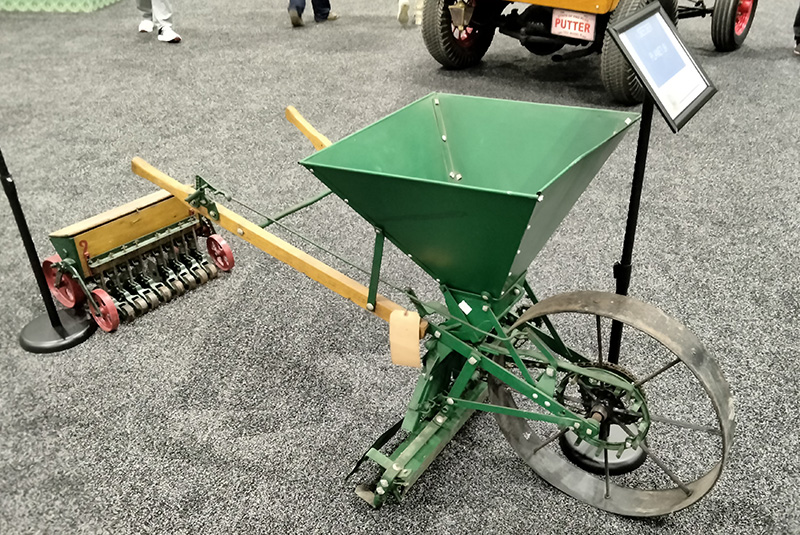
A seeder planter was among the historical equipment that Penn State University shared for the GCSAA Centennial Experience during the Conference and Trade Show in Orlando, Fla., this month. Other industry partners also loaned items to the exhibit. Photos by Howard Richman
Every ounce of this heavy load carries great significance and pride for Tom Bettle.
Although he did not attend the GCSAA Conference and Trade Show in February in Orlando, Fla., Bettle assisted in making sure his employers’ contribution was part of it. Bettle, turf research facility manager at the Joseph E. Valentine Turf Research Facility at Penn State University in University Park, Pa., joined GCSAA in ensuring the numerous artifacts — such as mowers and multiple other old-school pieces of equipment in golf course maintenance from years gone by — arrived at the GCSAA Centennial exhibit located on the trade show floor in the Orange County Convention Center.
The exhibit allowed attendees to take a trip through time and get an up-close look at 100 years of GCSAA history. A timeline and themed displays provided insight into the programs and services that have helped superintendents and their teams keep the game on course for the last century. Penn State — along with other industry partners — contributed by loaning their materials to the exhibit.
“To see some of the equipment when I was young working at the golf course like aerifiers with oil caps. …that stuff is priceless,” says Bettle, a 48-year GCSAA member who was a superintendent for more than 30 years at courses including Westmoreland Country Club in Export, Pa. He is currently president of the Pennsylvania Turfgrass Council.
How Penn State hauled the precious mementos is quite a story. Chase Straw, Ph.D., and assistant professor of turfgrass soils at Penn State was among the first to get the ball rolling. Bettle says Straw reached out to GCSAA, then Bettle worked with GCSAA’s Shelia Finney, senior director, member programs, to coordinate. GCSAA’s Jana Brown, director, conference events and meeting planning, connected Bettle and Finney. Brown did her part, securing the trucking company that could deal with the hefty equipment.
What started as one 53-foot truck ended up being two 26-foot tucks. “One of the trucks broke down on the way to our place, so we were issued another truck,” says Bettle, who was assisted at the university by Bill Myers, ag operations specialist. “Once we got that taken care of, no major issues.”
The trucks were loaded Jan. 27 and departed Pennsylvania Jan. 28, five days before the Conference and Trade Show. The goods showed up in time for the festivities that began Feb. 2.
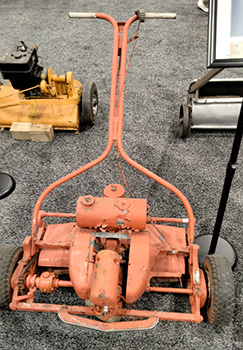
An antique mower loaned by Penn State as part of the Centennial Experience.
The Mascaro-Steiniger Turfgrass Museum, which is located at Penn State’s Landscape Management Research Center, houses turf equipment dating back to the early 1900s.
The museum, named after two turfgrass industry leaders, Thomas Mascaro and Eberhard Steiniger, opened in 1994. Agronomy professor emeritus Joseph Duich, who died in 2013, began the collection in the 1970s and added to it for almost 30 years. Mascaro was president of West Point Products, a turfgrass equipment manufacturer, for 55 years. In 1986, he and his son, John, founded Turf-Tec International, a company that designs diagnostic turfgrass instruments for golf course superintendents. Steiniger established the world-renowned Pine Valley Golf Club in New Jersey and was superintendent of the club for 57 years. Steiniger and Mascaro collaborated on inventing and testing more than 20 pieces of turfgrass equipment.
Many of the pieces on display at the Pennsylvania museum are Steiniger and Mascaro’s original inventions. The museum features 1920s and 1930s turf tractors, the first triplex greens mower, several turf rollers, a wheelbarrow seeder, and a special rake used on golf courses to pick up unsightly dirt trails left by worms without impaling the otherwise useful creatures.
Also exhibited is the horse-drawn soil scoop used to construct the course at the Pine Valley Golf Club. Of interest to homeowners is one of the first power lawn mowers, called a Lawn-Do-All.
Bettle says everything borrowed by Penn State for the GCSAA event was returned Feb. 10. Asked what he thinks Duich would have thought about the treasure trove of Penn State’s beloved relics that were valuable in so many ways all those decades ago, Bettle, the Duich student from the 1970s says, “He would’ve been very proud. He knew those two (Mascaro and Steiniger) very well. All are pioneers in the industry. They all attended GCSAA conferences. All would’ve been proud to see this. Real proud.”
Howard Richman is GCM's associate editor.