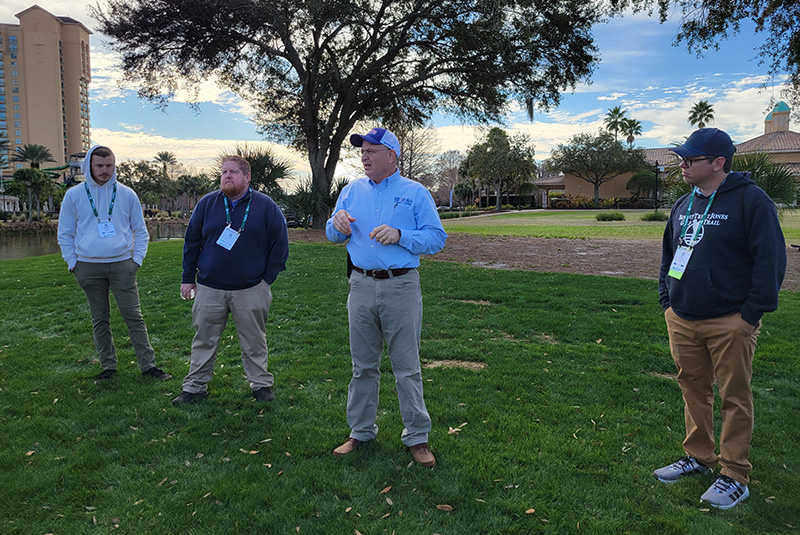
Bryan Unruh, Ph.D., presented on the value of GCSAA's Environmental BMPs with regard to water conservation at an Interactive Facility Tour during the 2026 GCSAA Conference and Trade Show in Orlando. Photo by Abby Olcese
Bryan Unruh, Ph.D., pointed beyond the line of trees. “Shingle Creek is the headwaters of the Florida Everglades. It’s right over there,” Unruh told the group of gathered turfgrass professionals. “What we do over here is going to have an impact on what happens over there,” he continued, indicating the turf and the pond behind him. “The same is true on your golf courses.”
Unruh, Associate Director at the University of Florida's West Florida Research and Education Center and Professor of Turfgrass Science, was one of several presenters at the Environmental Excellence at Grande Lakes Interactive Facility Tour presented by Helena Agri-Enterprises, LLC on Tuesday morning. A group of 100 attendees toured Ritz-Carlton Golf Club - Grande Lakes Orlando learning all about various tools to help keep their courses environmentally sustainable. Unruh’s portion of the experience discussed Environmental BMPs. Unruh knows those best management practices backwards and forwards. He helped develop Florida’s BMP certification process, and was part of GCSAA’s effort to develop and implement practices across the country.
“Total maximum daily load (the amount of a specific pollutant a water body can receive while meeting EPA water quality standards) is your pollution budget,” Unruh said. “Your basic management action plan is your spending plan. BMPs are your currency.”
Examples of how to generate that currency — practices that demonstrate the responsible use and care of natural resources — ranged from native plants and wildflowers to resource-saving tech to native wildlife conservation.
Brian Beckner, a former superintendent and GCSAA member, is now the owner of Native Bird Boxes, which creates and maintains species-specific bird boxes for clients in Florida, including Grande Lakes. “One of the reasons I left my job as a superintendent is that birds don’t talk back,” he joked.
Many native wildlife species call Grande Lakes home, including osprey, sandhill cranes, bald eagles, bobcats and a gopher tortoise named Johnny Mo. Beckner’s station was adjacent to the tortoise’s burrow, but due to the chilly morning weather, the guest of honor declined to make an appearance.
“If you want to get started with birds on your course, I recommend starting with a purple martin or bluebird trail,” Beckner said. “Those are easy to build and attract birds.”
Paul Sibley, GCSAA Class A superintendent at Walnut Creek Golf Preserve in Westminster, Colo., has had native bird conservation efforts on his course for the last ten years as a form of public outreach. “I like to educate people on our environmental efforts through Audubon and let them know that we do more than grow grass out here,” Sibley said. “It’s a good demonstration for people that see golf as damaging. It shows them what we’re really all about.”
Abby Olcese is GCM's online editor