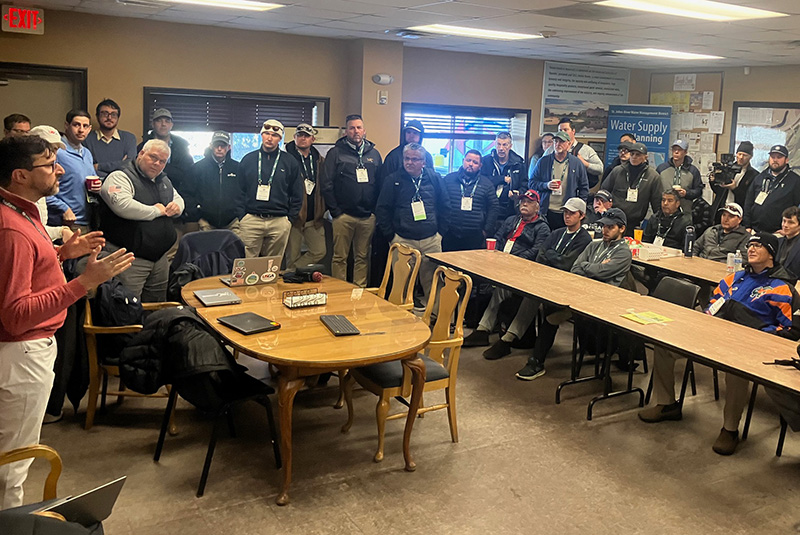
Matteo Serena, senior manager of Irrigation Research and Services for the USGA Green Section, presents on irrigation during an Interactive Facility Tour at the 2026 GCSAA Conference and Trade Show. Photo by Phil Cauthon
Things got off to a frigid start for the Interactive Facility Tour on water use at Shingle Creek Golf Club, with temperatures in the 20s to start the morning, a 16-year low for Orlando. What were to be outdoor presentations was shifted largely indoors.
The 50 superintendents on the tour were led into the maintenance shop’s break room for a series of slide presentations. The first was on irrigation auditing by Matteo Serena, senior manager of Irrigation Research and Services, USGA Green Section, and 15-year GCSAA member.
Serena said there were a number of reasons to conduct occasional irrigation audits, including reducing poor turfgrass quality, reducing wasted water, and increasing water distribution efficiency.
“Effective irrigation audits can help reduce overall water use, help identify wet and dry spots, reduce wasted water, help reduce inputs like fertilizers and chemicals, all of which saves money,” he said.
Serena walked through the details of performing an irrigation audit, from the various tools needed to the various audit methods such as the “catch can” method and a technique using a moisture meter to assess distribution uniformity.
Next was a presentation on the effects of using gypsum applications on sandy soils to manage salinity by Alejandra Siera and Marco Schiavon, assistant professors at the University of Florida. The pair had conducted a two-year experiment on soil plots where salt and gypsum were added to a series of plots to assess gypsum’s effect on salinity.
Siera said in general, gypsum had a positive effect on reducing salinity. “The salinity was lower on the plots where we applied gypsum,” Siera said. She said it also helped with moisture retention. “The plots where we applied gypsum had higher moisture readings, so we think gypsum helps with moisture retention as well,” she said.
Siera said there are other methods used to control salinity including a sulfur source plus lime, acidification, certain soil conditioners and microbial-based remediation. She said whatever the method used, less treatment is needed in years with higher precipitation.
The indoor presentations wrapped up with a brief presentation on Florida water laws by Deidre Irwin of St. John’s (Fla.) River Water Management.
By the end of the indoor presentations, the weather had yet to reach 40 but most of the attendees migrated outdoors for moisture meter demonstrations. USGA agronomist Brian Powell, CGCS, and 35-year USGAA member, and Colleen Shepard, USGA sales, wrapped up the day’s events with a demonstration of the USGA’s irrigation tools.