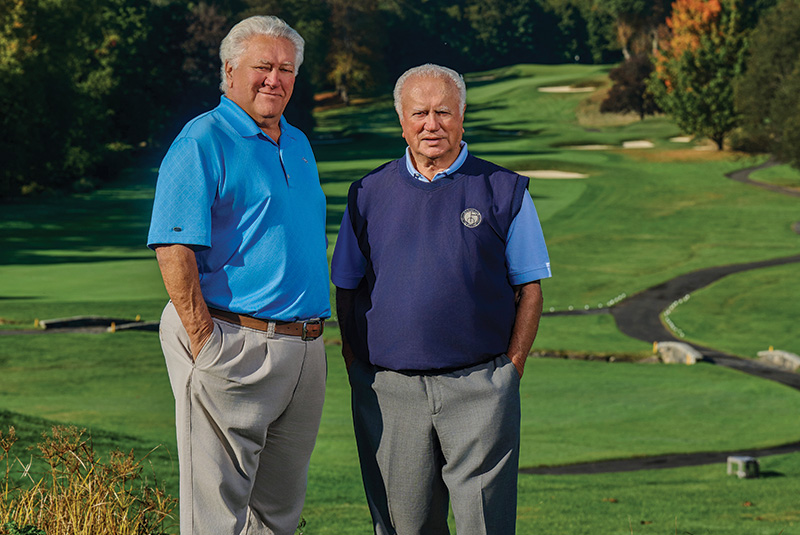
Brothers Joe, left, and Bob Alonzi on the grounds at Fenway Golf Club in Scarsdale, N.Y., where each took a turn as superintendent and where Bob’s son, Rob, is the current superintendent. Photos by Bennie Miglioriono
On paper, at least, it’s sometimes quite difficult to distinguish one Alonzi brother from the other.
Both big brother Bob and little Joe were born in the little Italian town of Picinisco, just southeast of Rome, and were school aged — Bob was 12, Joe, 6 — when the family came to America.
As they carved out their decades-long reputation in the golf course management industry, their careers followed a similar arc, moving up from one prestigious New York metropolitan-area course to the next.
During their legendary careers, they never lived more than a couple hours’ drive from one another, and, even now, a decade-plus into retirement, they live only a zip code or two away from each other in Connecticut and snowbird to the same Florida housing development each winter.
While both made several impressive steps up the career ladder, each also became most closely associated with a (to put it conservatively) top-100-type club — Bob at Winged Foot Golf Club and Joe at Westchester Country Club. Each hosted some big-time events — Bob held the 1984 U.S. Open and 1997 PGA Championship, among others, while Joe hosted 17 PGA Tour events and a Senior PGA Championship.
During their decades of service within the MetGCSA, each Alonzi served on that chapter’s board and as its president. Each earned the MetGCSA’s Sherwood A. Moore Award — Bob in 1991 and Joe nine years later — and each has a golf course superintendent son who has carved out his own reputation in the crucible that is the NYC metro area.
“We’re a lot alike,” concedes Joe, CGCS Retired, a 50-year association member. “He’s the smart one. I’m the handsome one. Of course, he’d tell you he’s the smart one and the handsome one.”
“We’ll let him have whichever one makes him feel better,” counters Bob, CGCS Retired, a 55-year association member.
As one of the few folks who had the opportunity to work for both put it: “Joe and Bob are much the same,” says Neil Laufenberg, GCSAA Class A superintendent at Innis Arden Golf Club in Greenwich, Conn., a 30-year association member and one of countless Alonzi intern/foreman/assistant proteges who went on to become successful superintendents. “But they’re very different.”
Maybe it’s a difference without a distinction, and here’s yet another example: Bob and Joe Alonzi are the winners of the 2026 Col. John Morley Award, the top honor given by GCSAA to its members. It’s the first time in the award’s history — even, prior to 2022, when it was called the Distinguished Service Award and open to non-GCSAA members and frequently was presented to multiple individuals — that it’s going to a pair of brothers. While it could be argued each has the bona fides to win the award individually, their combined body of work puts them in another league.
“Obviously, they’re both qualified,” says Jeff Scott, superintendent at Tamarack Country Club in Greenwich and 37-year association member who also worked for both Alonzis. “I sort of took it for granted they’d get it together. On the emotional side of things, those two are as close as you can get. The harassment goes back and forth, but the love and affection and dependence on one another — it’s a quiet relationship, but for all of us who know them, it’s very appropriate that they’ll get it together.”

Bob Alonzi, right, says the two brothers “always had each other’s back.”
Bob Alonzi
First on course
Big brother Bob was the first to find his way to the golf course.
As a teen, Bob Alonzi earned spending money by caddying at Tamarack CC and took an interest in the maintenance side of things. He caught the eye of then-superintendent Ted Jozwick, who steered the youngster toward an education in turfgrass management. Coincidentally, nearby Rutgers University was developing an offseason school to teach just that, and Alonzi graduated in 1961.
“At the time, there was some speculation whether I’d go to trade school or follow dad’s footsteps and be an apprentice in construction,” Alonzi says. “At that time, it wasn’t just assumed you were going to college because you came of age. I wasn’t a golfer at the time, but I enjoyed being outside. Working outdoors is what really intrigued me, and Ted Jozwick was just a wonderful gentleman. He took me under his wing and explained the possibilities. If I had just moved up to a foreman’s position, I would have been happy, but as the doors opened, I saw other opportunities.”
Drafted into the U.S. Army, Alonzi served from 1964 to ’66 before his discharge, and he returned to Tamarack as its foreman until one of those opportunities presented itself. He landed his first superintendent job at Rye (N.Y.) Golf Club in 1967.
Then it was off to Burning Tree Country Club in Greenwich, where he was superintendent from 1970-73, facilities manager from 1973-75 and general manager from 1975-78.
His next stop was Fairview CC, also in Greenwich, as superintendent from 1978-83 before he replaced another legend, Sherwood Moore, at Winged Foot in 1984.
“I wish everybody could relate to what I experienced,” Alonzi says. “You learn to appreciate what you have. My first job was with the city of Rye, N.Y. It was an opportunity that came my way because of Ted Jozwick, who was a consultant there. I was working with very minimal staff for very large usage. It was a daily-fee course. We used to get two, three, four flooded holes a few times a year.
“Dealing with that … that’s where all the experience started. Winged Foot wasn’t my first job, but the little jobs in between put me in position to achieve what I did there.”
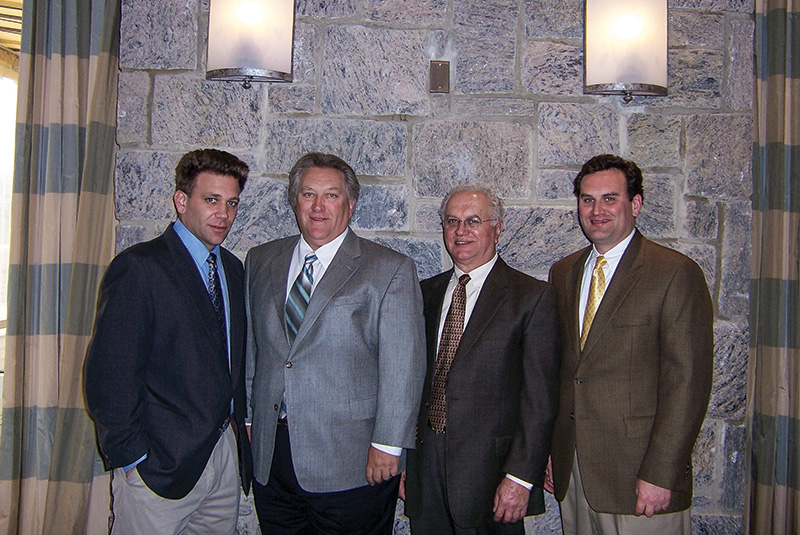
The four superintendent Alonzis, from left: Christopher, Joe, Bob and Robert. Photo courtesy of the MetGCSA
Building ‘The Legend’
One of those achievements came right away, in 1984, when Alonzi hosted the U.S. Open in conjunction with the retiring Moore.
“That was my first glamour position,” Alonzi says. “With Sherwood retiring and me moving into a better position, that was fun.”
Alonzi recalls that Winged Foot, in Mamaroneck, N.Y., with its pair of A.W. Tillinghast-designed courses that currently rank No. 13 (West Course) and No. 45 (East) on the Golf Digest list of top-100 U.S. courses, wasn’t the type of place that encouraged one to rest on one’s laurels.
“We really strived at all times to be the best of the best,” he says. “You had to be on your toes at all times. That’s where we started picking up clippings, coming up with solutions for faster, firmer greens. It was an ongoing chore, and at times I questioned the validity of it, but that’s where we are today.”
Another highlight came in 1997, when Winged Foot hosted the PGA Championship.
“On the second day of the PGA, a hurricane came through,” Alonzi says. “We worked through the night to remove the trees that impeded the ability to play the tournament. We had over 100 people running around the place so it would be playable at 8 o’clock in the morning. Those are the things you wish you didn’t have to experience but that made a big impact. We were able to come through with flying colors, and it was nice to be a part of history. I remember as (winner) Davis Love sank his last putt, a rainbow came up over the east side of the golf course.”
Alonzi, who by then had acquired the nickname “The Legend,” left Winged Foot in 1999 to become superintendent at Fenway Golf Club in Scarsdale, N.Y., before retiring from there in 2011. His successor, who is still there, was his son, GCSAA Class A superintendent Robert B. Alonzi, a 33-year association member.
“You know, I used to stress to young people coming through the system, just work hard and strive for the best, and opportunities will come your way,” Bob Alonzi says. “I got all my positions by virtue of people seeking me out because of the good conditions I was providing at my existing golf course. I always left with good recommendations from whoever I was working with.”
And here’s a fun father-son story, as recalled by Jeff Scott, who acknowledges it’s a “full-circle” conclusion that he’s superintendent at Tamarack, the place where the brothers Alonzi first crossed (cart) paths with the profession.
“Bob was here when all the trees were planted,” says Scott, who initially intended to become an arborist before Bob helped steer him into turfgrass. “He was here in the 60s, when the trend, unfortunately, was to take some really great golf courses designed by guys like Seth Raynor — we’re Charlie Banks here — and plant trees. Bob was told to plant an evergreen, a spruce tree or a white pine, every 50 feet between the fairways. The joke is, when I came here in 1997, Bob’s son, Robert Jr., was my first assistant. His son basically cut down every tree his father planted.”
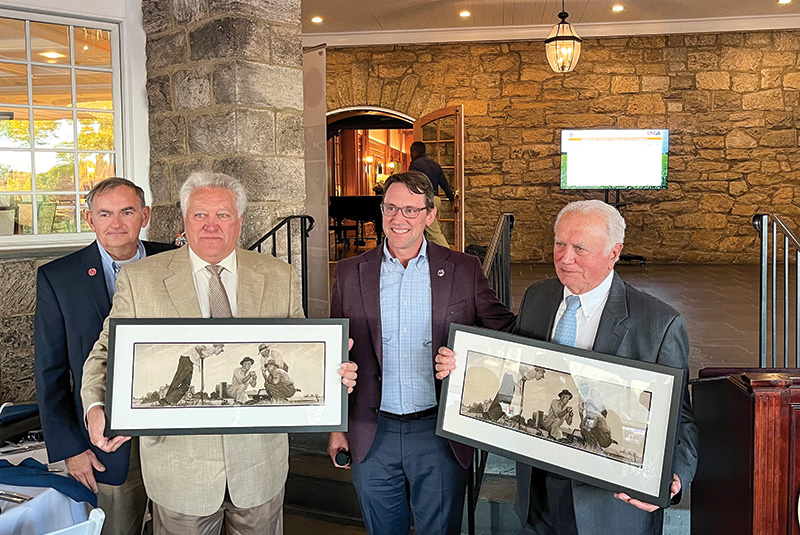
Joe (second from left) and Bob (right) receiving a UMass Alumni Turf Group award. Photo courtesy of Mike McCall
Joe Alonzi
‘I really didn’t like being indoors’
Like his big brother, Joe Alonzi fell into golf at Tamarack CC.
“Both our parents worked, and we needed a place for me to be in the summer,” Joe Alonzi says. “I was too much for my grandmother to handle, so I was made to go caddy. I’d go in the morning with Bob. I’d walk up to the caddy yard when he’d work on the grounds crew. Eventually, I did the same thing he did, worked on the grounds crew. I enjoyed caddying, but I really enjoyed working on the crew.”
The Alonzis’ parents, however, suggested Joe pursue “something else” for a career, so he enrolled at and graduated from the RCA Institute of Technology in 1971 with a degree in electrical engineering while still working summers at Tamarack. Joe went to work at Norden Industries, a division of United Aircraft in Norwalk, Conn., where he worked on the radar system for the F-111 jet.
“I really didn’t like being indoors,” he says. “I was in a little cubicle with a computer. I didn’t even have a window. It was tough.”
Yearning to return to an outside job, Joe fortunately had an in — big brother Bob by that time was superintendent at Burning Tree CC, and Bob hired his little brother.
Bob also “encouraged” Joe to pursue a turfgrass education if he were to choose to follow a similar path.
“He wasn’t easy to work for,” Joe says of his brother. “It took me a while to train him.”
Joe graduated from the Rutgers turfgrass program in 1973. A year later, he was hired as head superintendent at the Huntington Crescent Club in Huntington, N.Y. That post on Long Island put Joe a good 60 miles away from Bob — the farthest apart they’d ever be.
“I think moving to Long Island helped me. I wasn’t in his shadow as much,” Joe Alonzi says. “They called me ‘The Brother of the Legend.’ I never felt bad in any way coming up under his shadow, but I think it helped moving up here.”
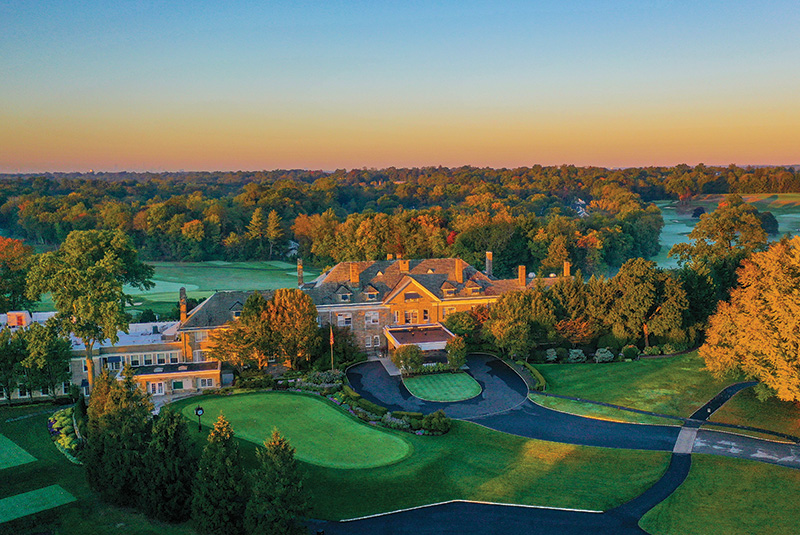
An elevated view of the A.W. Tillinghast-designed Fenway Golf Club. Photo by Bennie Miglioriono
Together again
The gulf narrowed considerably, when, on Jan. 1, 1984, both brothers moved — Bob to Winged Foot, Joe from Huntington Crescent to Fenway. The two courses lie about 2 miles apart.
“Our relationship got even better at that point,” Joe says. “We’d see each other all the time. We’d share equipment and talk nearly every day.”
After eight years at Fenway, another Tillinghast creation, Joe Alonzi left for Westchester Country Club just a few miles down the road. Westchester was an entirely different beast, featuring 45 holes of golf, tennis courts, a beach, barbershop, hotel.
“It’s one of the largest golf complexes in the Northeast,” Alonzi says. “Especially at tournament time, my days ran into night. My night ran into day. I’d just get a room and sleep there for a couple of weeks at a time. You had to be committed. And it didn’t really matter whether it was a big tournament or not. The members didn’t care if we had 45 holes or 18 holes or nine holes.”
After toiling at WCC through those 17 PGA Tour events and the Senior PGA Championship, Joe Alonzi retired in 2015. His replacement: David Dudones, a 27-year association member who still is the GCSAA Class A director of golf and grounds there.
Dudones was among the countless turfgrass pros working for one Alonzi brother who would volunteer to work for the other at tournament time. Dudones, for instance, worked with Bob for a couple of weeks during the PGA Championship.
“I’d have six to eight interns a year,” Joe Alonzi recalls. “Every Sunday morning, we’d work 5-9, then at 9 I’d have all the interns meet in the office and discuss whatever happened during the week, good, bad and indifferent. That was always a successful hour and a half. I remember one Sunday morning, I asked them what they wanted out of their careers. One guy looked me straight in the face and said, ‘I want your job.’”
That guy: Dudones.
“I remember Joe said, ‘Well, get the best education you can and get some good placements,’” Dudones says. “I decided to go to grad school after my undergrad, and he hired me back as an assistant.”
After landing his first head superintendent job at North Jersey Country Club in 2005, Dudones replaced Alonzi at Westchester in 2015.
“Big shoes to fill,” Dudones says. “But you know, both of them are great to bounce things off of. What’s impressive to me is to see the longevity they had at clubs at the level they were at. It’s easy to get spit out by some of these clubs, but the fact that both of them did what they did for so long at such high-level clubs, you almost scratch your head. It’s unbelievable the ability these guys had to adapt to ever-increasing standards and, more importantly, to deal with people and make connections with everyone from president of the club to the general manager to the lowest-level greenkeeper and not burn any bridges.”
“Joe and Bob in a lot of ways were the godfathers of that area,” adds Jared Viarengo, CGCS, director of grounds and club operations at Applebrook Golf Club in Malvern, Pa., and 31-year association member who interned and worked for Bob at Winged Foot and volunteered at tournament time for Joe at WCC. “It’s a prominent area when it comes to budgets and golf courses and expectations. You factor in the New York area in general … those people, they can be tough customers. To be at the top of your game for that many years as they did, it’s saying a lot. I think like a lot of guys, working with them was like winning the lottery. I was so honored to be able to work with them.”
“Both of them are extremely helpful and dedicated to the profession on every single level,” adds Tamarack CC’s Scott. “For those of us who were fortunate enough to have worked with them, or even just one of them, and there are quite a few of us, I think we all owe a big part of our success to them.”
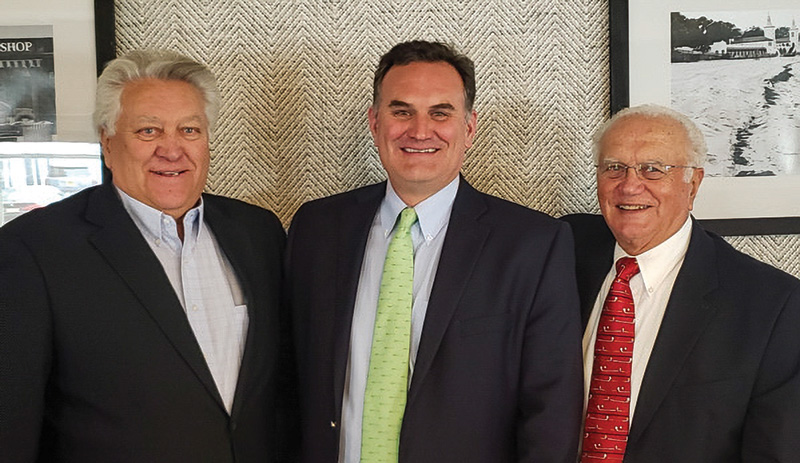
Fenway’s finest: From left, Joe, Robert Jr. and Bob Alonzi. Photo courtesy of the MetGCSA
Brotherly love
The Col. John Morley Award, named after the man who nearly 100 years ago started the organization that became GCSAA, is presented annually to “an individual/group (singular award) who has made an outstanding contribution to the advancement of the golf course superintendent’s profession. The contribution must be significant in both substance and duration, and may be, or have been, regional in nature.”
Though the Alonzis made their name exclusively in the NYC metro area, their reach goes far beyond that. Their superintendent tree reaches across the country and even beyond, into international borders.
How many folks worked with or for an Alonzi and eventually made a career in golf course management?
“Way too many to count,” Joe Alonzi says. “I’m so proud of all those superintendents out there who worked for me at one point or another. I take that as one of my greatest contributions to the industry. That’s how I’ve tried to give back to the industry, whether they learned from me how to do it right or how not to do it. That’s great, as long as they learned something from me.”
“Hopefully, my legacy will be that I was just a guy who had great opportunities,” counters Bob. “I shared everything I experienced. I tried to contribute to research. I think we’re all just one big family. This is the best profession in the world, and we’re all working toward a goal of perfection. It’s not achievable, but you’re always striving for it. I just tried to be approachable. I value the hundreds of friends I made in the industry. There’s a lot of unity there, and we all share.”
On this, the brothers agree: Neither would have gotten as far or lasted as long without the other.
“Because we’re brothers, because for a lot of time our golf courses were less than 5 miles apart, we shared a lot of things,” Bob says. “Not just at tournament time. We were always sharing ideas, comparing notes.
“Two heads are better than one, and we always had each other’s back.”
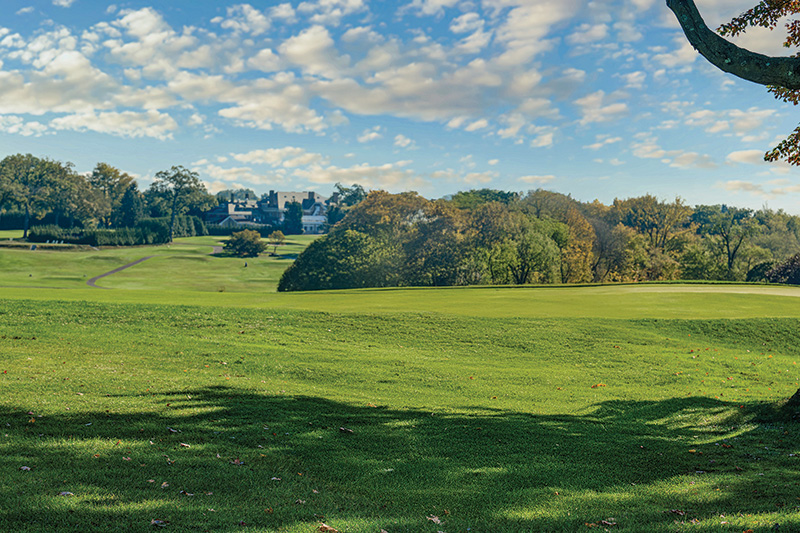
Joe Alonzi left Fenway for Westchester Country Club, while Bob retired from there before the club hired Bob’s son as superintendent. Photo by Bennie Miglioriono
Retired, but not really
The Alonzis are more than a decade into retirement, but they’re not completely out of the industry.
“After about three months into retirement, my wife, Judy, sat me down and said, ‘You’ve got to do something,’” says Joe, whose son, Christopher, is superintendent at the Summit Club at Armonk in Armonk, N.Y. “She said, ‘We’ve been married 40 years. In all those years, you’ve always been a golf course superintendent. You never took summer vacation. You were always at the club working. Now you want breakfast, lunch and dinner. It doesn’t work that way.’ I guess I was annoying her.”
So Joe Alonzi worked to build Biltmore Turf Industries (it comes from a serendipitous phone call from his lawyer who needed a name for the fledgling business; Joe, driving by Westchester CC, which is on Biltmore Avenue, suggested the moniker), a low-key supplier of bedknives, tires and batteries — “Just the stuff superintendents need,” Joe says. “It keeps me busy. It keeps me in the loop. I still see all the guys. It’s how I get to play golf at all these places.”
Some of that golf involves his big brother, who, at 83, still attends local and chapter educational offerings and remains current on his pesticide license.
The Brothers Alonzi play together three or so times a week when they’re home, as much as three times a week when they’re in Florida.
Joe, Bob grudgingly admits, is the better player.
“Probably. He’s younger and stronger, so he hits the ball a lot farther,” Bob says. “The stroke system does work. I’ve moved up to the forward tees. He’s in the middle tees, so he’s catching up in a way.
“That’s the only rivalry we have, is golf.”
Andrew Hartsock (ahartsock@gcsaa.org) is GCM’s editor-in-chief.