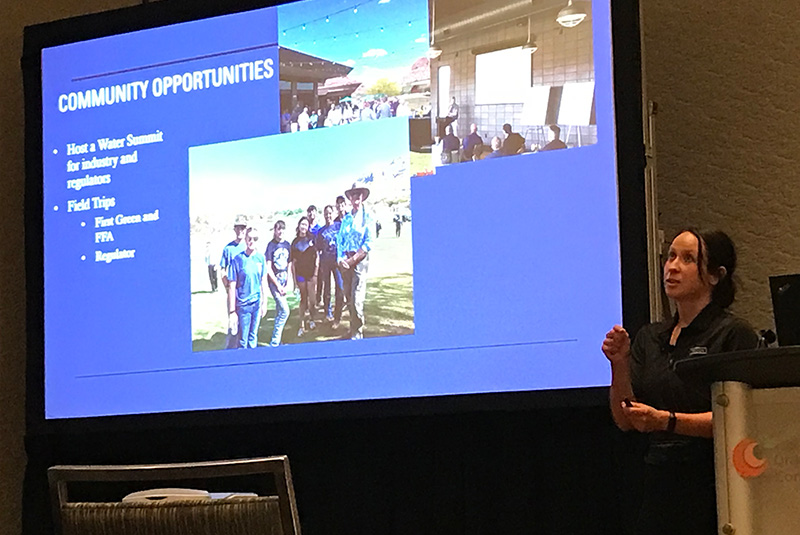
Bri Kenny, manager of environmental science at Troon Golf, discussed minimizing environmental impact from golf courses during an education session on Monday at the 2026 GCSAA Conference and Trade Show. Photo by Darrell J. Pehr
Superintendents gained insight on how their golf courses impact the environment — and steps they can take to manage that impact — during an educational session Monday at GCSAA’s Conference and Trade Show in Orlando.
Bri Kenny, manager of environmental science at Troon Golf, led participants through golf’s influence on water, land and fire, and gave examples of management practices from the hundreds of Troon-operated courses she deals with in her position.
In the area of water impacts, she urged superintendents to become fully aware of the watersheds that tie into their courses, including watershed boundaries, challenges and community watershed groups. Getting to know and work with such groups can be a big asset for a golf course, especially when an issue arises.
Kenny outlined various aspects of the water around a golf course, including water quality, aquatic life, algal blooms and the importance of being familiar with the Clean Water Act and its implications. She mentioned accidental fish kills and errant golf balls in a waterway as examples that a golf course may have to respond to.
As a proactive measure in the event of a water-related incident, Kenny recommended regular water quality testing of water that flows through a golf course. Then, should an issue arise, a golf course can show it was not the source of a contaminant by pointing to the water quality testing it had previously done.
Kenney spoke about water conservation, advising superintendents to track their water use, build relationships with water suppliers and water districts and prepare a drought management plan to prepare for possible water restrictions.
Golf courses are also sometimes wrongly thought to be “sterile,” monocultural environments, while the reality is that golf courses are usually important habitats that offer a rich variety of landscapes for plants and animals. They offer ecosystem functions, such as nutrient cycling and stormwater management as well as habitat, biodiversity and human-specific benefits.
Golf courses within urban and suburban landscapes generally have higher ecological value than those in rural areas, she noted.
She encouraged superintendents to map their water bodies and habitats, using a mapping company or doing it themselves. Superintendents also should consider habitat projects, such as reduction of invasive and ornamental vegetation and an increase of native species, while being mindful of preserved areas of the course and the timing of such projects with regard to the Migratory Bird Treaty Act that protects birds, nests, eggs and chicks. She noted that it’s best to avoid vegetation work from March through August.
An inventory of a course’s biodiversity is important, as well, which often can be accomplished with community involvement, such as the iNaturalist program, employees or interested golf members.
Fire, of course, can be a major threat to a golf course, and Kenny advised superintendents to be ware of high-risk areas, such as the perimeter, non-irrigated areas, untouched vegetative areas, accumulated biomass and hazardous material storage, which should be done in a way that makes it easier and safe for first responders.
Golf courses are often located in the Wildland-Urban Interface, an area of the highest wildfire risk.
“Golf courses have the most responsibility and opportunity for leadership in these zones,” she said, encouraging superintendents to get involved in Firewise training, perhaps through their GCSAA chapter.
Darrell J. Pehr is GCM's science editor