There are some technologies that I evaluate and immediately start making a mental list of reasons they may never work or are ahead of their time. Some tech seems to be solutions looking for a problem. Others are too expensive ever to see a return on investment.
GPS sprayers are not one of those. In fact, it is one of the easiest technologies to justify adoption. I don’t understand why they aren’t approaching 90% adoption on golf courses. There is little reason to not use this technology.
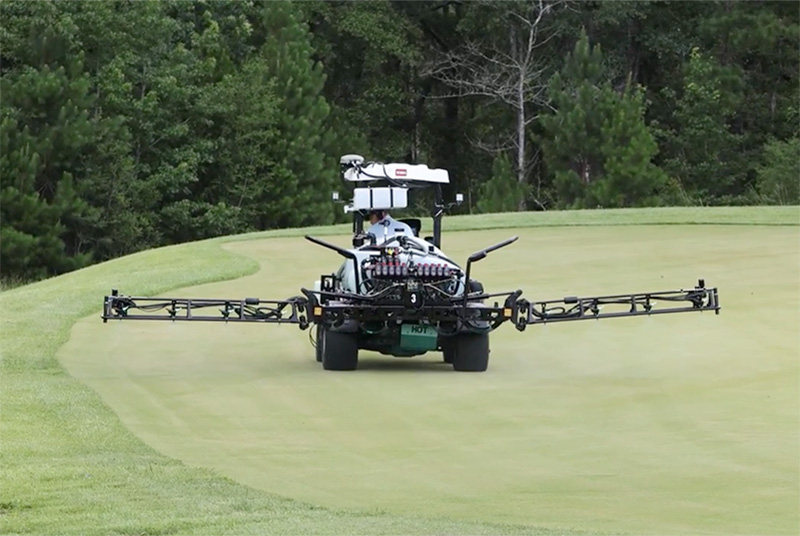
Global Positioning System-assisted sprayers integrate satellite-based positioning with onboard computers to control pesticide applications precisely. Before spraying, the treatment area is mapped, allowing the system to adjust nozzle operation automatically based on the sprayer’s location and the prescribed application plan. GPS guidance minimizes overlap and skips by maintaining accurate spray paths, while individual nozzle control shuts off application in areas that have already been treated or are outside the spray zone. The result is more uniform application coverage, reduced waste and improved application efficiency compared with conventional sprayers.
People rarely adopt new equipment simply because it is better. Most technologies follow an S-shaped adoption curve. Growth is slow at the beginning, then increases rapidly, followed by a plateau at the end. A handful of innovators buy the first machines. Early adopters prove they work. Then, somewhere around 15% to 20% market penetration, something interesting happens: Technology develops enough credibility that everyone begins to adopt it. The adoption curve then goes exponential.
GPS sprayers should be in the exponential phase. One reason is that the return on investment is easy to understand. Spraying herbicides on greens requires precision to avoid overlap and contact with turfgrass that may differ in collars or within greens complexes. Overlaps and overspray can cause unintended injury.
The environmental and economic benefits are equally compelling. Spray application overlap is wasted product, labor, fuel and unnecessary product entering the environment. Multiply a few percent overlap across hundreds of acres and dozens of applications each year, and the savings become real. And GPS sprayers fit within a much larger movement toward precision turfgrass management. GPS-guided sprayers is one technology making that philosophy practical rather than theoretical (1).
Floyd et al. (2024) working with Chase Straw, Ph.D., at Texas A&M (now at Penn State) evaluated applications on sports fields using sprayers with varying levels of GPS technology and operators with different levels of experience. Their results showed that GPS-guided sprayers consistently reduced application errors, regardless of operator experience. In other words, the technology didn’t just make experienced applicators a little better — it helped make every application more consistent regardless of the sprayer experience. That’s exactly what good technology should do.
That is the hallmark of truly useful technology. It doesn’t replace good managers. It allows good managers to spend more time making decisions that matter. GPS sprayers won’t diagnose the disease, choose the correct pesticide, determine the proper rate or decide whether the application should have been made. They reduce the potential for error.
The one negative is cost. GPS sprayers are typically 20%-50% more expensive than conventional sprayers. It does take a lot of sprayed acreage to cover the cost. But it is also difficult to put a price on less injury risk and greater confidence in less-experienced spray operators.
As autonomous equipment, artificial intelligence and precision turf management develop, I try to maintain healthy skepticism. Some innovations will prove revolutionary. Others will quietly disappear. GPS sprayers won’t be one of those. In fact, they will only improve as they are implemented across different sprayer systems, including autonomous sprayers. This technology just makes sense.
Flagstick in.
Literature cited:
- Carlson, M.G., R.E. Gaussoin and L.A. Puntel. 2022. A review of precision management for golf course turfgrass. Crop, Forage & Turfgrass Management 8(2):e20183 (https://doi.org/10.1002/cft2.20183).
- Floyd, W.W., M.R. Muesse, H.N. Tucker, O.E. Alabi, J.O. Winger and C.M. Straw. 2024. Assessing application errors on sports fields across varying levels of sprayer technology and operator experience. Crop, Forage & Turfgrass Management 10(2):e20301 (https://doi.org/10.1002/cft2.20301).
Scott McElroy, Ph.D., is a professor of turfgrass management and weed science in the Department of Crop, Soil & Environmental Sciences at Auburn University, Auburn, Ala. He is a 19-year member of GCSAA.