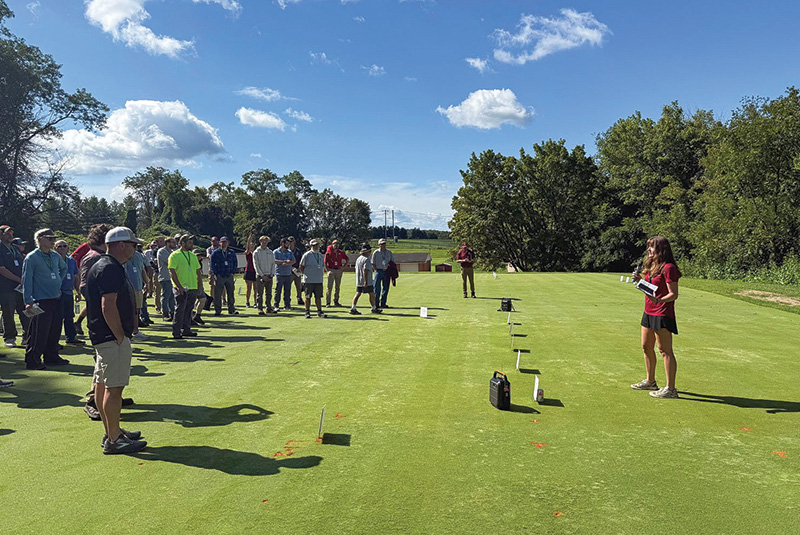
Doctoral student Elisabeth Kitchin (at right) updates the turfgrass industry during the annual Virginia Tech Turfgrass Research Field Day. Photo courtesy of David McCall
$1.1 million Virginia Turfgrass Foundation endowment expands graduate education and research
A $1.1 million endowment established by the Virginia Turfgrass Foundation is creating lasting opportunities for graduate students in Virginia Tech’s School of Plant and Environmental Sciences, strengthening cutting-edge turfgrass research while advancing sustainable solutions for the turfgrass industry. The endowment is a milestone in the partnership between Virginia Tech and the Virginia Turfgrass Foundation. Established in 1988, the foundation promotes the benefits of natural grass and works exclusively with the Virginia Tech Turfgrass Team in funding research focused on achieving the highest possible quality turfgrass with the fewest required management inputs. While the foundation has supported turfgrass research for nearly 30 years, leaders from both organizations came together in 2017 with a renewed vision: to build a permanent, impactful funding model that could meaningfully support graduate education. That vision led foundation leaders and faculty members to explore how to maximize donor dollars for long-term impact. The foundation focused on building a true endowment — a permanent fund designed to generate annual support rather than provide short-term funding. Much of this funding came from the Virginia Tech Turfgrass Research Classic Golf Tournament, which has raised more than $500,000. Additional contributions from industry partners and supporters helped grow the fund.
The first student supported by the foundation was Elisabeth Kitchin, whose master’s degree research set the standard for what the endowment could accomplish. Now a doctoral student, Kitchin’s research focuses on precision turfgrass management, including the use of machine learning models to identify turfgrass diseases such as dollar spot. She and endowment-supported student Sam Kreinberg, the first official graduate research assistant funded under the new long-term endowment structure, both focus on precision irrigation management. Kreinberg joined the turfgrass program in fall 2025 after completing his master’s degree at the University of Arkansas. His research integrates advanced technology and data-driven tools to help turfgrass managers make more-informed decisions.
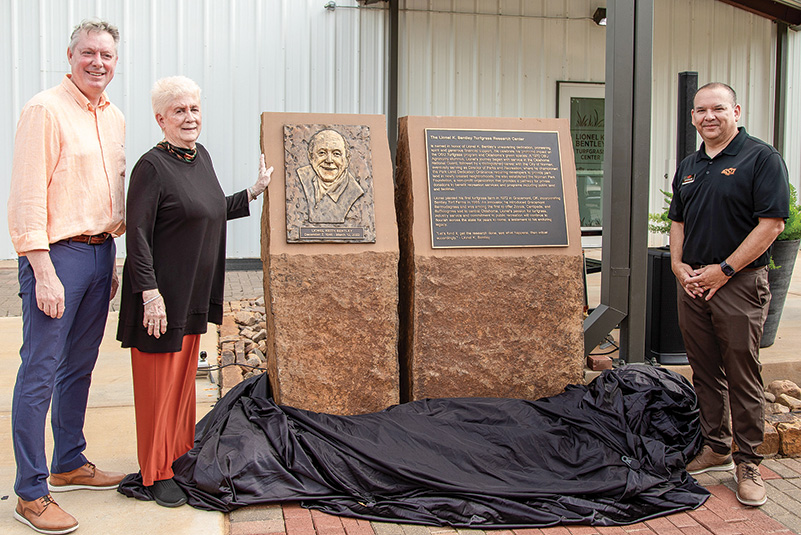
From left, Jayson Lusk, Lou Bentley and Justin Quetone Moss unveil a sculpture of Lionel K. Bentley during the grand opening of the Lionel K. Bentley Turfgrass Center at Oklahoma State University. Photo by Bryanna Freer, OSU Foundation
OSU Agriculture unveils Turfgrass Center, named for Oklahoma turfgrass pioneer
Supporters of Oklahoma State University Agriculture recently celebrated the grand opening of the Lionel K. Bentley Turfgrass Center. “The Turfgrass Center represents a major step forward for OSU’s turfgrass research, teaching and Extension programs,” said Jayson Lusk, vice president and dean of OSU Agriculture. “It provides a centralized space where faculty, students and industry partners can come together to collaborate, learn and advance the science of turfgrass management.” The center, located on a 100-acre facility, is named in honor of the late Lionel Bentley of Washington, Okla. It will specialize in ornamental and recreational turfgrass research, creating adaptive turfgrasses and developing eco-friendly pest management solutions.
Bentley graduated from OSU in 1970 with a bachelor’s degree in agronomy with a focus on turf management. In 1984, he retired from the City of Norman as director of the Parks and Recreation Department to pursue Bentley Turf Farms, a full-service turf establishment and erosion-control company. Bentley was known as a turfgrass sod pioneer in Oklahoma, offering customers U-3 bermudagrass, Tifway bermudagrass and his own Gracemont bermudagrass. Bentley’s wife, Lou, made the gift in his memory. She said it was rewarding to observe his passion for turfgrass, including his ongoing research and experimentation, as well as his continued association with the OSU turfgrass program. The facility marks a milestone for the OSU Department of Horticulture and Landscape Architecture as it continues to expand opportunities in turfgrass education and research, said Justin Quetone Moss, head of the department. The turfgrass industry contributes more than $1 billion per year to the Oklahoma economy. OSU turfgrass scientists have contributed 11 turfgrass varieties used on golf greens and fairways, residential yards, sports fields and in commercial production.
Darrell J. Pehr (dpehr@gcsaa.org) is GCM’s science editor.