
Regrassing efforts at Willow Springs Golf Course in San Antonio, Texas, included tees, fairways, greens, collars and approaches, regrassed with drought-tolerant paspalum. Photos courtesy of Adrian Munoz
From water conservation and energy efficiency to responsible fertilizer use and habitat protection, golf courses have many opportunities to reduce their environmental impact. However, implementing sustainable practices is only part of the challenge.
Communicating the reasoning and value behind efforts effectively to staff, golfers, club leadership, and the surrounding community is equally important. For golf course leaders, sustainability should be viewed as more than an environmental initiative. It is an opportunity to demonstrate responsible leadership, improve course management practices, and build stronger relationships with the people who use and support the facility.
One of the most important areas of sustainability is water management. Golf courses can consume significant amounts of water, particularly during periods of drought or extreme heat. Superintendents can address this challenge through irrigation audits, improved scheduling, weather-based technology, drought-tolerant turf selections, and careful monitoring of soil moisture. These practices can reduce water use while maintaining appropriate playing conditions.
The challenge is making sure golfers understand why these decisions are being made.
A golfer may see brown or dormant turf and assume the course is not being maintained properly. A superintendent sees the same turf and may recognize it as a response to water conservation. Without communication, the two perspectives can easily conflict.
This is where leadership becomes important. Golf course leaders should explain the reasoning behind maintenance decisions rather than simply announcing them. Short articles in newsletters, signs around the clubhouse, social media updates, or conversations with members can help explain how water conservation benefits both the golf course and the surrounding community.
The same principle applies to other sustainable practices. Reducing pesticide applications through integrated pest management, allowing selected areas of the property to grow as natural habitat, recycling organic materials, planting native vegetation, or reducing mowing in appropriate areas can all provide environmental benefits. However, these practices may look different from what golfers traditionally expect a golf course to look like. Communication can turn uncertainty into understanding.
Staff communication is equally important. Employees need to understand not only what sustainable practices are being implemented, but why they matter. When employees understand the larger goal, they are more likely to take ownership of the program and identify additional opportunities for improvement.
For example, a mechanic who understands the importance of energy efficiency may identify equipment that is consuming excessive fuel. A member of the irrigation team may recognize an opportunity to improve water distribution. A grounds employee may notice an area where mowing can be reduced without affecting playability. Sustainability therefore becomes a team effort rather than a superintendent's responsibility alone.
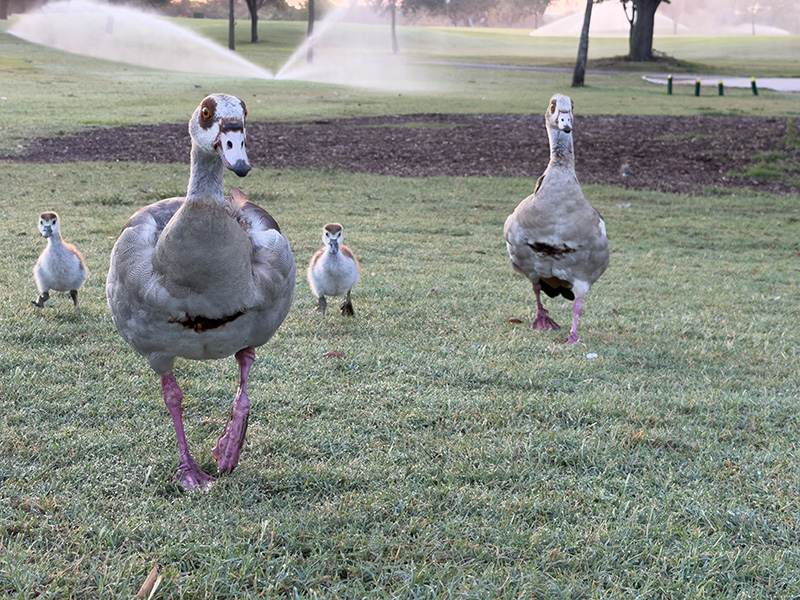
Geese, along with turtles and fish, are among the wildlife that live in the irrigation ponds along the Alamo City Golf Trail.
Leadership also means measuring results. Golf courses should establish realistic goals and track progress whenever possible. Water consumption, fuel use, energy consumption, fertilizer applications, recycling rates, and other measurable factors can provide valuable information. Sharing those results with club leadership and golfers demonstrates that sustainability is not simply a marketing message — it is an ongoing management process.
Perhaps most importantly, sustainability should be approached as a long-term commitment rather than a short-term trend. Golf courses are constantly balancing environmental responsibility, financial considerations, golfer expectations, and agronomic needs. There will rarely be a perfect solution to every challenge.
Effective leaders recognize that progress is often incremental. A golf course may not be able to eliminate its environmental footprint, but it can continually look for ways to reduce it. It can conserve another million gallons of water, reduce unnecessary chemical applications, improve habitat, lower fuel consumption, or educate another group of golfers about the importance of responsible course management.
The future of golf’s sustainability will depend not only on the practices implemented on the property, but also on how effectively those practices are communicated. When superintendents and their teams explain the purpose behind their decisions, measure their results, and invite others to participate, sustainability becomes part of the culture of the golf course.
Ultimately, good sustainability leadership is about more than protecting resources. It is about creating a golf course that can remain healthy, playable, financially responsible, and environmentally sound for generations to come.
Adrian Munoz is a spray technician at the Alamo City Golf Trail in San Antonio, TX