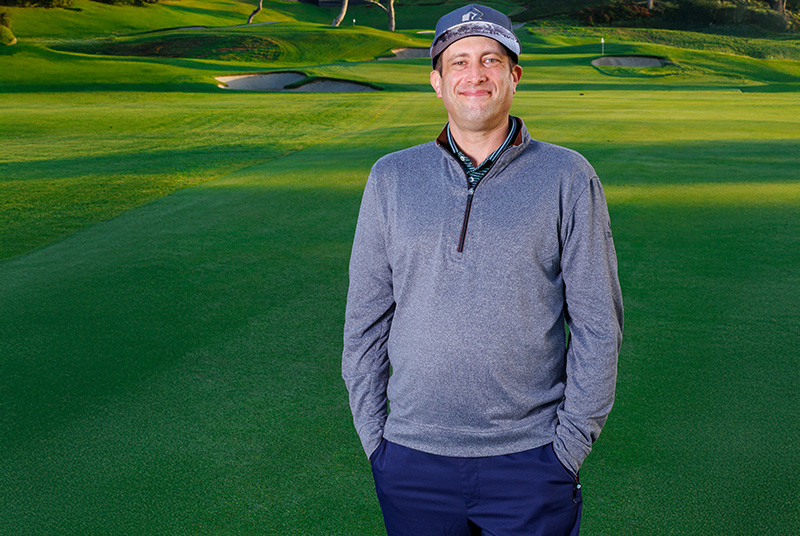
Superintendent Marshall Dick is ready to host the U.S. Women's Open this month. Photos by Mpu Dinani
Typically, Riviera Country Club is a name you hear associated with the Genesis Invitational, not the U.S. Women’s Open. But as Marshall Dick, superintendent at the Pacific Palisades, Calif., club will tell you, the last two years have been nothing if not full of change.
“One thing that we’ve always learned throughout these years is to expect the unexpected and be ready to adapt and roll with the punches,” says Dick, a six-year GCSAA member.
This year will be the first time Riviera CC has hosted the U.S. Women’s Open, which comes following the 2026 Genesis Invitational. Ahead of that event, the club lengthened the fourth and 18th holes. The fourth hole features a new tee that can now play over 270 yards. The alterations, buildup, teardown and rebuilding for the Women’s Open presented by Ally have dominated a busy season that started last December and hasn’t quit yet.
“We’re lucky that we have a really tenured staff, and everyone is very committed to what we do,” Dick says. “There’s a lot of excitement, and everyone genuinely wants to be here and be part of it. It doesn’t take a whole lot of effort to get everyone excited.”
Matthew Morton is the director of agronomy at El Niguel Country Club in Laguna Niguel, Calif., and a former superintendent at Riviera CC, where he still serves in a consultant capacity. He knows as well as anyone that Dick has what it takes to run a good tournament — he helped Dick take over as superintendent in 2020.
“Leading a team at Riviera takes a tremendous amount of focus, and your mind as a manager is always on hosting professional events,” says Morton, a 26-year GCSAA member. “Day to day, the course is almost in tournament condition, and that’s a bit different from most of the country in that it’s 365 days a year. Marshall is a Los Angeles guy, and he’s got a great feel for tournament agronomy, especially in this city. He’s very focused and attached, always watching and leading with a careful eye.”
Another important part of the Riviera team is Tyler Shuman, an assistant and a one-year GCSAA member who just passed 10 years with the club.
Shuman says that maintaining the standards that come with high visibility means the team, with support from the club’s ownership, has an intense focus on doing its job well.
“The skills I’ve learned here are incredible,” Shuman says. “It’s a lot of hands-on work as far as hand-watering and doing tasks some other courses may not get the opportunity to do.”
Another benefit of the job is variety. Every tournament is different, and every year means new conditions that ensure the only true constant is change, even when systems are put in place to manage those factors.
“We’ve had hot years in February, and we’ve had rainy years like we just had,” Shuman says. “There’s always something new that keeps it fun and exciting. I love how much the course has changed over the years. It’s continuing to evolve into what it is today, and it’s never stayed the same.”

Staff maintaining steep bunker faces.
‘A little bit of pandemonium’
One curveball that doesn’t necessarily fit the description of “fun and exciting” but certainly presented learning opportunities was the 2025 Palisades fire, which forced a relocation of the Genesis Invitational from its longtime home at Riviera to Torrey Pines. Dick says that while the course didn’t sustain much damage, the fire still created plenty of chaos — or, as Dick refers to it, “a little bit of pandemonium.”
“We didn’t have any actual fire damage, but that whole week we had 80 mph sustained winds, and we ended up losing about five large old-growth eucalyptus trees,” Dick says. “On top of that, we weren’t able to do any maintenance for two weeks, which is the longest that’s ever gone on for, because we couldn’t have our staff at the club.”
Shuman likens the experience to working during the COVID-19 pandemic.
“Everything was shut down, but a few of us still managed to come in to work even though it was a restricted zone,” Shuman says. “We were trying to protect the golf course any way we could.”
In the days after reopening, the club provided a safe space for some members who had lost their homes in the fire.
“We were really just trying to help our members who lost their homes, trying to be a place for them to come,” Dick says. “We opened up some rooms in the clubhouse that members could work out of. A few members were staying in the hotel as well. Our main focus was helping the community and our membership once we were able to reopen.”
The fire provided more than just a lesson in fortitude. Shuman says it helped the team be better prepared in the event it ever happens again. For instance, when the fire caused electrical outages, the crew learned how to maintain the course without power.
“We learned that we could still water without power, because the power kept turning on and off,” Shuman says. “If something like this happened in the future, we’d have a backup plan in terms of generators to keep parts of the club still running.”
Shuman says they’re still actively discussing how to prepare for similar weather events.
“It was an eye-opening experience,” Shuman says. “We were just talking about replacing our water filters, and what happens if we have a fire. Just little things you didn’t think about before that you think about now.”
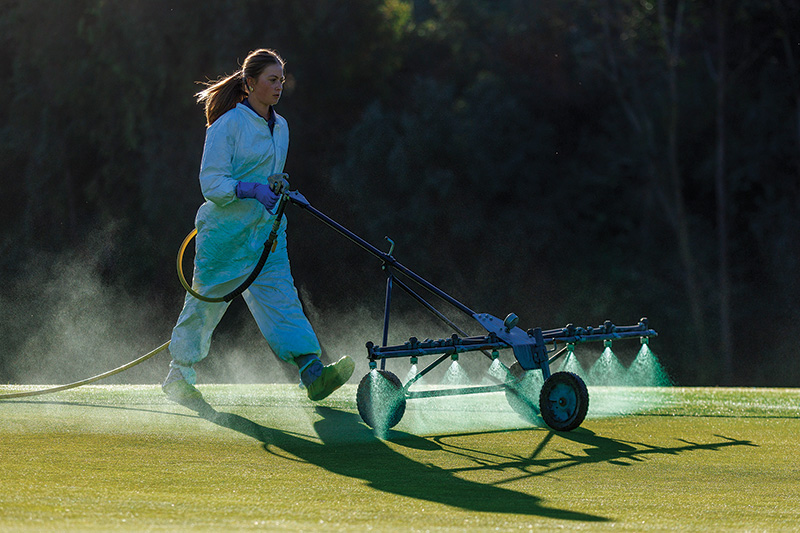
Alexa Moncada, senior agronomist, spraying the 13th green.
Welcoming women volunteers
As in previous years, this year’s volunteer corps at the U.S. Women’s Open will include a crew of women volunteers. This continues a tradition that started at the 2021 Open at the Olympic Club in San Francisco, organized in part by Kimberly Gard, territory manager at Syngenta. This year’s crew will include 25 women volunteers.
“There are a lot of women out there in the industry, but very few of them work even within a half hour of another woman or maybe have never met another woman at their local chapter events,” says Gard, a 14-year GCSAA member. “This brings them together in one space where they’re doing what they’re passionate about, and it’s a cool bonding experience to be at these events.”
For most seasoned tournament volunteers — these women included — long hours are a given. But for this group, Gard says, that time working together often becomes something more: an opportunity to experience professional solidarity and make lasting connections.
“We’re living together from 3 in the morning to 9 at night. It’s like boot camp,” Gard says. “It’s a whole other ballgame to retain women in this industry, and they’re more likely to stay if they have experiences like this. People who have strong networks of peers, the more connected they are the more resilient they are and able to handle the ups and downs.”
The volunteer involvement is also part of an effort not just to reach and connect more women in the turfgrass industry, but to bring more into the profession. “If half of your workforce is women across the nation but we’re only tapping into 3 or 4 percent, we’re not casting our net wide enough to cover the labor gap,” Gard says. “That’s an untapped labor pool. That’s where I think our group fits in the most, is trying to promote women in turfgrass management, whether on the course or sports field.”
As a result, Gard says she’s passionate about creating opportunities for women to gain professional connections and mentorship, as well as external visibility for people who may not have known about career opportunities in the field.
“We’re trying to showcase that there are a lot of very dynamic women who are passionate about the industry. There are certainly other women out there who would love this as a career, but they don’t even know about it,” Gard says. “It’s about creating a network of women who can support people in whatever their career journey is, and answer questions kind of in a safe space where people might not feel OK asking a question to someone else.”
Morton says he finds it encouraging for the future of the profession.
“The fact that more women are getting into golf is fantastic. It’s needed, quite honestly,” Morton says. “I grew up working with my mom in the backyard garden, and she taught me the fundamentals of agronomy. She was my first teacher. I think more women working on the course is great for the continued growth of the game.”
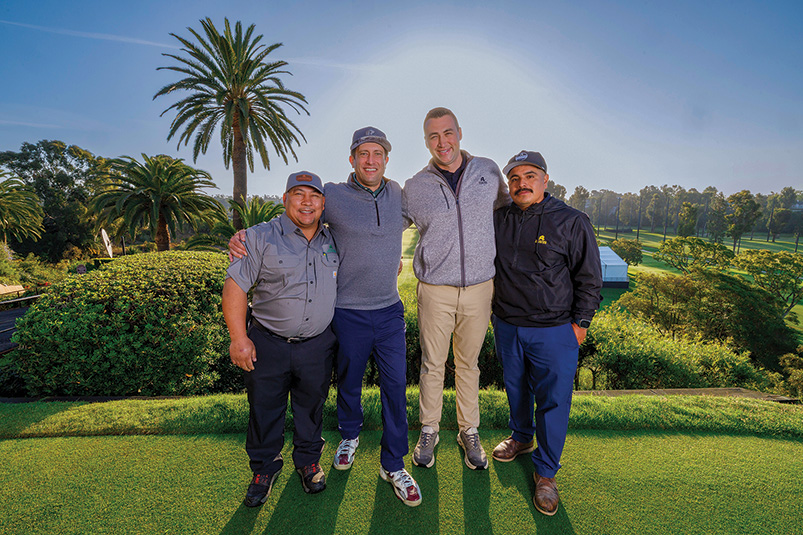
From left, Omar Rua, Marshall Dick, Tyler Shuman and Fabian Pacheco on Riviera CC’s No. 1 tee.
The fruits of their labor
Shuman, who’s more experienced with working with the PGA on tournament preparations, says he’s looking forward to the unique challenges of working on the U.S. Women’s Open and the standards required by the USGA.
“The USGA has a different way they go about tournament setup and what kind of course conditions they’d like to present,’’ he says. “The Women’s Open may be little more intense, you could say. I’m looking forward to seeing how it compares to the PGA Tour events.”
The turf will be different than it was for the Genesis Invitational, but the quality, as always, will be high. “It’s a different time of year, so the moisture numbers we hold greens at in February are different than what we will hold them at in June,” Shuman says. “It’ll be interesting to see how the course reacts.”
To help the Riviera crew prepare, Shuman says, the club did a trial run for preparation last year. “It was kind of fun to see what we could do with our staff,” Shuman says. “Now we’re incorporating the Women in Turfgrass group, and we’ll see how special we can present Riviera in June. It’ll be a fun challenge.”
The results of all that effort will get extra public attention as the event is broadcast on TV.
“It’s a great training tool for our staff because all the work we put in is highlighted on TV, and they can see everything,” Shuman says. “I love being associated with such a cool property that’s so well respected.”
Gard agrees the visibility is a morale booster, but it also has a second purpose: attracting new groups to a potential career in turfgrass management. It’s part of a trend she sees in expanding public knowledge of what careers in turf can be.
“Our whole purpose is a motto from sports turf, ‘See it, be it,’” Gard says. “Golf course maintenance is a hidden profession. Lots of people play the game, but they don’t think about who sets up the course. I like to think that through collective activities, whether it’s seeing women working a big tournament, or GCSAA’s involvement with First Green and partnering with FFA over the years, that we’re introducing the profession to new people.”
Of course, all of that is part of the real goal: a job well done.
“It always makes me feel good when we can be of service to the core of why we’re there,” Gard says, “which is to help the host team provide the best playing conditions for the best women players in the world.”
Dick says he finds that commitment and representation encouraging, not just for the tournament, but for encouraging the next generation of turfgrass professionals. He may be a little biased, though, since he has a personal connection.
“I have a daughter, so that’s something I feel good about encouraging,” Dick says. “She’s just now finishing fifth grade, but she’s very interested in science and life sciences especially, so she gets a kick out of coming to the golf course.”
Abby Olcese is GCMOnline's editor.