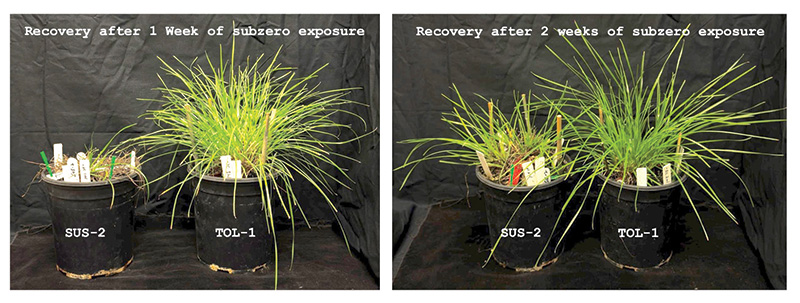
Photo courtesy of Iowa State
How perennial ryegrass recovers after a deep freeze may matter more for its survival
Every spring after a harsh winter, turfgrass managers face the same question: Will their grasses come back? A hard winter with deep-freezing temperatures can leave lawns, sports fields and golf courses looking bleak. But what actually determines whether the grass recovers? The answer, it turns out, may have less to do with surviving the freeze itself and more to do with what the plant does afterward. In our current research on perennial ryegrass, conducted as part of the WinterTurf project, we’ve been looking closely at the recovery phase that follows freezing temperatures. Most winter stress research focuses on what happens during the cold event, which is certainly important. But we took this a step further by examining what happens during recovery after a freezing event. To do this, we compared two types of perennial ryegrass: one more tolerant of freezing conditions and the other more susceptible. We exposed both to varying lengths of subzero temperatures (28.4 F/minus 2 C for one or two weeks), then tracked their recovery under nonfreezing, cold-acclimation conditions (39.2 F/4 C).
We were trying to answer a key question: Is recovery from freezing simply a gradual return to normal (i.e., an attenuation of stress responses), or is it a biologically distinct process? Our results suggest the latter. When we examined gene expression during recovery, we found that the genes switching on and off were largely distinct from those active during the freezing stress itself. This suggests that recovery is a separate biological phase involving a unique set of molecular processes. More importantly, gene expression patterns differed between the freezing-susceptible plant type and the freezing-tolerant type. This difference matters practically because if recovery is a separate biological process or trait, it can be a target for plant breeding and selection. This may lead to improved grass cultivars that are better at bouncing back after a hard winter, regardless of their initial freezing tolerance. A better understanding of the trait of recovery is a step toward developing turfgrasses that not only survive winter but also come back strong in spring.
Note: This project is supported by the U.S. Department of Agriculture, National Institute of Food and Agriculture, Specialty Crop Research Initiative under award number 2021-51181-35861.
— Kavi Raj Acharya (kacharya@iastate.edu) and Shui-zhang Fei (sfei@iastate.edu), Iowa State University, Ames
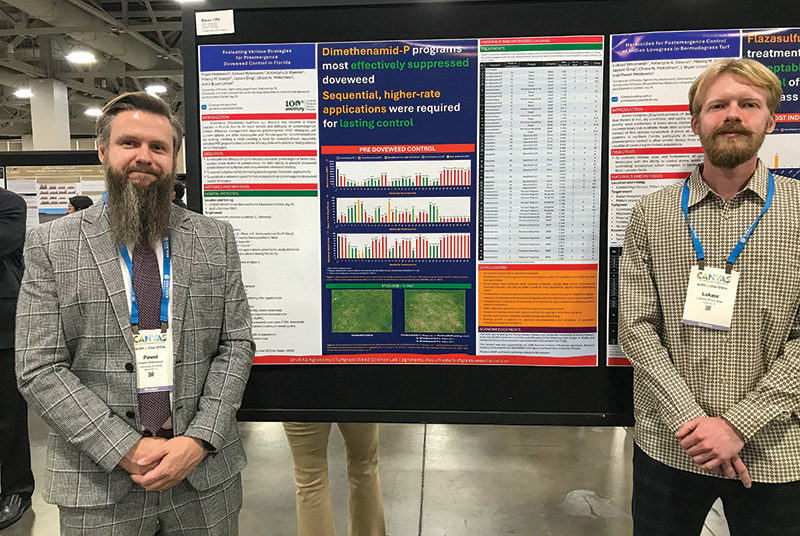
Pawel Petelewicz, left, and Lukasz Wnorowski. Photo by Darrell J. Pehr
Evaluating various strategies for preemergence doveweed control in Florida
In recent years, doveweed [Murdannia nudiflora (L.) Brenan] has become a pressing concern in Florida and nearby regions due to its rapid expansion and extremely challenging postemergence eradication. Preemergence (PRE) control is a key to effective management of this species; however, up-to-date recommendations for the state are lacking. A field study was conducted from April to October 2025 at the West Florida Research and Education Center in Jay, Fla., to evaluate multiple commercially available PRE herbicides, applied alone or in combination, compared with a non-treated control, for their ability to prevent doveweed establishment and ensure turfgrass safety in Tifway hybrid bermudagrass [Cynodon dactylon (L.) Pers. × C. transvaalensis Burtt Davy] with documented infestation history. Herbicides tested included various rates and combinations of dimethenamid-P, pendimethalin, indaziflam and S-metolachlor.
The most effective suppression was achieved with dimethenamid-P at 0.98 pounds active ingredient per acre (1.10 kilogram active ingredient per hectare) + pendimethalin at 0.87 pounds active ingredient per acre (0.98 kilograms active ingredient per hectare) followed by two sequential dimethenamid-P applications at 0.98 pounds active ingredient per acre, which produced <700 AUPC units, >115 days ≤10% weed cover, and a maximum of 20% cover at 126 days, compared to >6,950 AUPC units, <17 days ≤10% weed cover, and a maximum of 90% cover in non-treated. Several other treatments provided comparable control to the best performer, including all sequential dimethenamid-P applications, most indaziflam programs applied once or initiated at ≥0.44 pounds active ingredient per acre (0.049 kilograms active ingredient per hectare) and all sequential S-metolachlor treatments. Pendimethalin alone was ineffective but occasionally enhanced dimethenamid-P efficacy, though inconsistently.
— Pawel Petelewicz (petelewicz.pawel@ufl.edu), and Lukasz Wnorowski, University of Florida, Gainesville
Darrell J. Pehr (dpehr@gcsaa.org) is GCM’s science editor.