The winter of 2026 produced that special kind of coldness that penetrates through the layers of coats, hats and gloves. It was definitely “chicken soup weather.”
For plants to survive cold weather conditions, particularly for turfgrasses, they require a cold acclimation process also referred to as “hardening.” From a plant physiology point of view, these processes involve changes to cellular water status, fatty acid composition and carbohydrate metabolism and allocation. This is a plant’s way of making “anti-freeze” in preparation for a cold winter. Autumn weather can vary year to year and does not always provide optimal conditions for those cold-preparation processes to occur, thus leaving turfgrass tissues susceptible to winter-induced injury.
For those courses that must maintain annual bluegrass (Poa annua), cold weather can be a challenge. Annual bluegrass is a turfgrass species prone to cold temperature-induced damage, particularly from ice encasement. Therefore, research was conducted at Michigan State University (East Lansing) to determine if soil moisture has an influence on annual bluegrass’s ability to achieve successful cold acclimation and recovery from ice encasement.
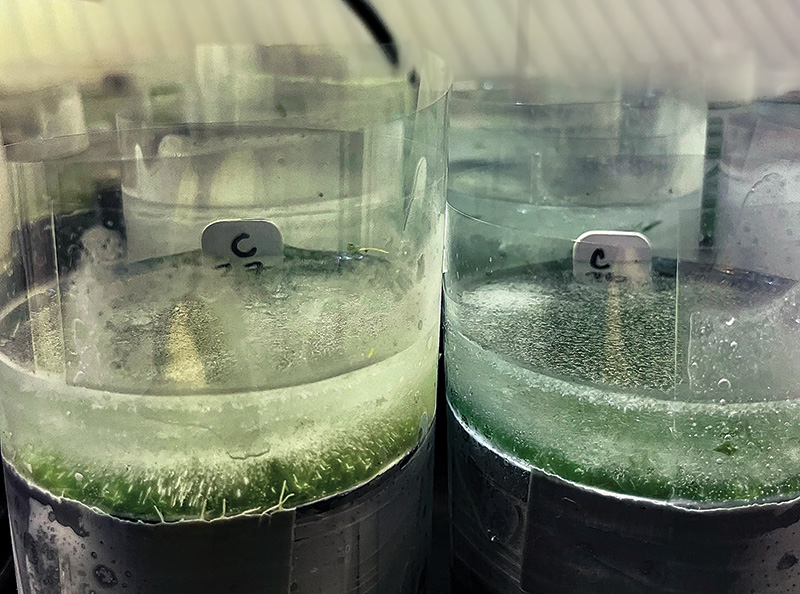
Mature annual bluegrass sod plugs were obtained from a putting green at the Hancock Turfgrass Research Center in East Lansing. In the greenhouse, a sod piece was placed onto a sandy loam root-zone mix within a plastic container of 2.4-inch (6-centimeter) diameter × 13.8-inch (35-centimeter) depth to allow for adequate root growth. The turf established and grew for 60 days to cover the diameter of the container and was fertilized, watered and maintained at 0.50-inch (1.3-centimeter) height-of-cut. All containers and experimental treatment combinations were randomly arranged with eight replications, and the study was conducted twice over two consecutive years.
All containers were moved to a growth chamber for a cold acclimation of approximately 40 days at 50 F (10 C). During the cold-acclimation period, the root zones were maintained at 8%, 12% and 20% volumetric water content at 1.5-inch (3.8-centimeter) depth.
After cold acclimation, plants were encased in ice by misting at 27 F (minus 3 C) until a 1.0-inch (2.5-centimeter) ice layer was formed. On Day 0 (no ice encasement exposure) and then after 40 and 80 days “on ice,” plants were analyzed for recovery (i.e., percent green turf canopy). On those assessment days, leaf, crown and root tissues were also analyzed for carbohydrate content.
As expected, prolonged freezing conditions and ice encasement significantly reduced leaf and crown tissue carbohydrates (i.e., the anti-freeze) compared with plants not exposed. However, total nonstructural carbohydrates of roots were 144% higher, and water-soluble carbohydrates of roots were 138% higher in those plants maintained at 8% soil moisture, compared to plants maintained at 12% and 20% soil moisture. Total nonstructural carbohydrates include glucose, fructose, sucrose and starch that act as a “food pantry” that plants utilize for growth but also for protection from unfavorable environmental conditions. Water-soluble carbohydrates include glucose, fructose, sucrose and fructans that function as readily available energy sources and also as osmoprotectants (the “hot chicken soup”).
Also, low soil moisture during the cold-acclimation period enhanced turf recovery after exposure to the cold temperature and ice encasement conditions. Specifically, when soil moisture was 8% prior to 40 days of ice encasement, annual bluegrass green canopy cover after a 36-day recovery period was 72% higher compared to annual bluegrass at soil moisture contents of 12% or 20%.
Researchers concluded that annual bluegrass putting greens could be more resilient to cold weather through preventive measures such as reducing water inputs during the autumn cold-acclimation period and improving root-zone drainage to reduce turf loss due to ice encasement. Other strategies include core or solid-tine cultivation during autumn and snow removal to promote drier soil conditions.
These preventative measures should be used in conjunction with measuring soil moisture. Therefore, consider water-management practices for putting greens that will support uniform and consistent soil moisture during the autumn and early winter to help facilitate a successful winter survival and spring green-up.
Source: Gendjar, M., and E. Merewitz. 2023. Leaf, root, and crown tissue physiology of annual bluegrass after cold acclimation at varying soil moisture levels and ice encasement. Journal of the American Society for Horticultural Science 148(3):99-107.
Mike Fidanza, Ph.D., is a professor of plant and soil science in the Division of Science, Berks Campus, at Pennsylvania State University in Reading, Pa. He is a 24-year member of GCSAA.