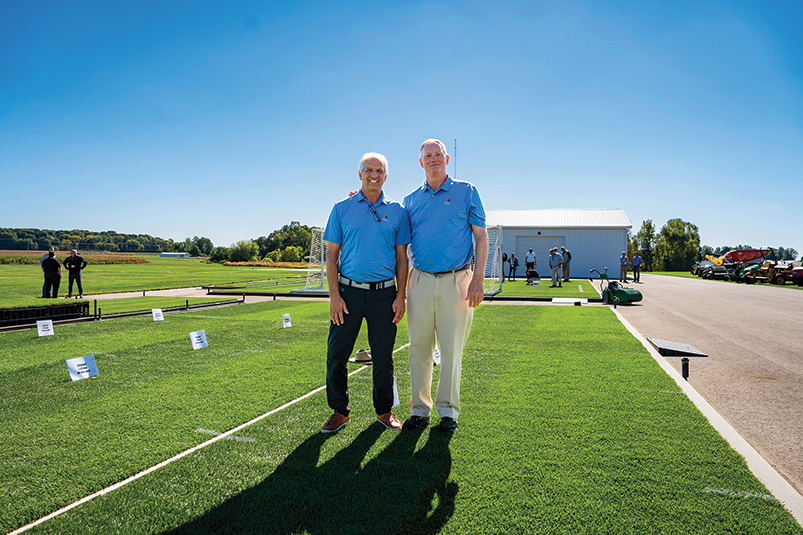
John Sorochan, Ph.D., and John “Trey” Rogers III, Ph.D. Photo courtesy of Michigan State University
If there was ever a chance to show the world the benefits of natural grass over synthetic turf, the 2026 FIFA World Cup will be pretty hard to beat.
Known as the world’s most-watched sporting event, the every-four-year World Cup soccer competition drew an audience of around 5 billion in 2022, with 1.5 billion watching Argentina beat France in the final match. This year’s World Cup is expected to draw an even larger audience, so a big chunk of the world’s population will see what a perfect surface natural grass is for sporting events.
But what does this have to do with golf? Well, turfgrass is our passion, and a group of researchers from universities that have excellent turfgrass programs have played a key role in establishing a proper turfgrass system to meet the stringent standards of FIFA and soccer fans alike.
At Michigan State University, the team is led by longtime turfgrass researcher John “Trey” Rogers III, a professor in MSU’s College of Agriculture and Natural Resources. The team there includes assistant professor Jackie Lyn Guevara and research assistants Ryan Bearss and Evan Rogers, all in MSU’s Department of Plant, Soil and Microbial Sciences.
At the University of Tennessee-Knoxville, John Sorochan, Ph.D., distinguished professor of turfgrass science and management, is leading the team. Jim Brosnan, Ph.D., a plant sciences professor and director of the UT Weed Diagnostics Center, has also been working on FIFA research with graduate students. Brosnan’s research focuses on controlling unique and problematic turfgrass weeds, particularly those resistant to herbicides.
Rogers and Sorochan were tapped by FIFA as co-principal investigators on a grant to grow turfgrass for the World Cup, including all practice and game fields. The challenges for the team have been planning, installing and maintaining top-notch turfgrass that performs consistently across multiple venues in multiple climates.
FIFA World Cup competition happens in June and July, with 48 teams playing in 104 games at 16 stadiums in Canada, Mexico and the U.S. Each stadium presented a unique set of challenges for turfgrass experts. Five are domed, making adequate lighting a big concern. All the stadiums will see multiple days of play, requiring the turf to hold up to the stresses of traffic not often seen on a golf course in such a short time.
Eight of the stadiums required the new field be installed over an existing artificial surface. As golf course superintendents know all too well, differences in climate call for differences in turfgrass, whether warm-season or cool-season, with each variety’s specific requirements needing to be addressed, such as irrigation and maintenance practices. Each soccer pitch must provide the same playing conditions, making the installation and maintenance of the pitches even more critical.
Eleven of the stadiums are in the U.S., with two in Canada and three in Mexico. Some highlights:
At BC Place in Vancouver, Canada, an artificial turf surface was replaced with sod for the domed stadium that was grown on plastic at a sod farm, then installed in the stadium over 8 inches (20 centimeters) of sand. The installation included a drainage layer and a system that can circulate water in and out of the turfgrass. Kentucky bluegrass and a perennial ryegrass mixture with hybrid reinforced fibers was used.
At Estadio BBVA in Monterrey, Mexico, the stadium has historically used bermudagrass. In 2025, a pitch was installed that uses a different variety of bermudagrass, researched by UT experts, that is stitched and reinforced with synthetic fibers. Growing healthy bermudagrass is particularly difficult in this stadium because the overhangs provided for spectators create shade patterns, making the use of grow lights necessary even in summer.
At MetLife Stadium in East Rutherford, N.J., a temporary pitch was laid over the artificial turf of the open-air stadium, which will host eight matches including the FIFA World Cup championship match. Bermudagrass was installed on a foundation of aluminum concert flooring, gravel and sand.
Of course, while fans will focus on the heroics of the players doing all they can to bring the glory of a World Cup home to their country, it seems that this will be an excellent chance to shine some light on the benefits of natural grass as a surface for elite sporting events.
And, starting next month, billions of people will get a glimpse of the hard work of two stellar U.S. turfgrass programs.
“Sharing our evidence-based research for the World Cup 2026 and with others from around the world means everything to me,” Sorochan said. “Knowing that a fifth of the world is watching something you have been a part of — it’s hard to imagine the emotion that I’m going to feel.”
Darrell J. Pehr is GCM’s science editor.