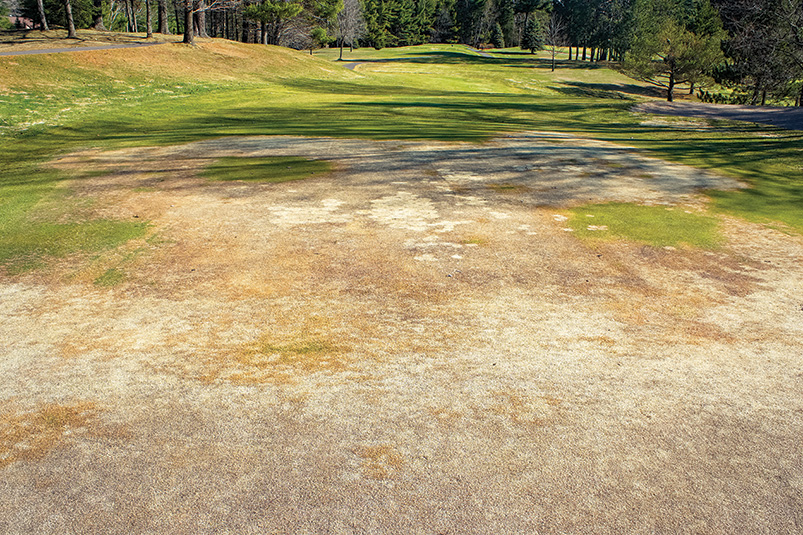
Prolonged ice cover can decimate putting green turf, leading to long and costly recoveries.
Editor’s note: This article is reprinted with permission from the March 20, 2026, issue of the USGA Green Section Record. Copyright USGA. All rights reserved. The original article can be accessed at: https://bit.ly/4lW6iiI.
As golf courses in cold climates lay dormant and sometimes covered in snow, superintendents can’t help but wonder what might be happening inside the turfgrass plants they depend on. Is snow protecting the grass from wild temperature swings and severe cold temperature damage, or is it providing ideal conditions for damaging snow mold disease? Is the smooth ice sheet that glistens on the golf green merely a temporary worry, or are gas levels at the soil surface becoming toxic for the plants? Will spring play come quickly and bring extra revenue to the course, or will damaged turf need time and inputs to recover before a single golfer hits a ball? Ultimately, winter damage of turfgrass is an economic challenge, one that all golf courses in cold climates could face at some point. We know winter injury is costly, and there is published evidence on its economic impact in Nordic countries, but until recently, there wasn’t a research-based estimate of how much it really costs courses in North America (2). Our research team conducted a study to fill this knowledge gap (1).
We surveyed 96 golf course superintendents across the northern U.S. and Canada, where winter injury to cool-season turfgrass often poses a problem. Superintendents completed a series of detailed questions about the types of winter injury they see most often, which grasses and areas of the course are hit the hardest by winter injury, how long ice cover lasts, how often opening is delayed the following spring, how much they spend to prevent and repair winter injury damage and how much revenue is lost when courses can’t open due to winter injury.
The superintendents in our sample had an average of 16 to 20 years of experience and had been at their current course for an average of approximately 12 years, so their responses reflect significant experience managing winter injury.
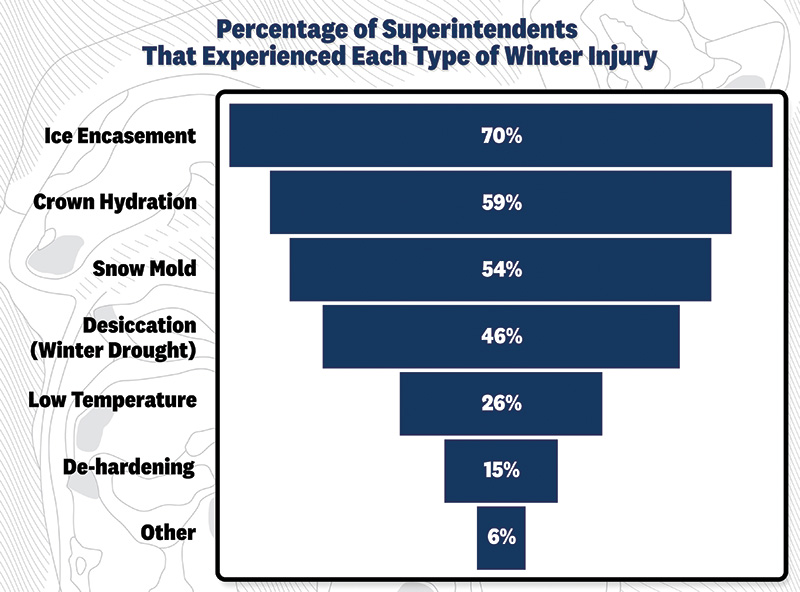
Figure 1. Ice encasement was the most reported cause of winter injury according to a survey of nearly 100 U.S. and Canadian golf course superintendents.
What are the most prevalent types of winter injury?
The predominant cause of winter injury in our survey was ice encasement, reported by 70% of respondents (Figure 1). For about 60% of the sample, crown hydration was thought to be a significant contributor to winter injury, followed by snow mold at 54% and desiccation at 46%. The least-reported causes were low temperature (26%) and de-hardening (15%). While some injuries, such as snow mold, are relatively easy to confirm, the reason for some cases of winter injury reported by the superintendent might not be as definitive. For instance, it may be difficult to distinguish between damage caused by ice encasement or crown hydration, especially when the damage incurred is under ice. In cases like these, the reported causes reflect the superintendents’ best judgment based on their field experiences. The total of all the individual percentages in Figure 1 also indicates that many superintendents are facing multiple winter injury mechanisms simultaneously.
Among the different grass species, annual bluegrass (Poa annua) was reported as the most susceptible to almost every type of winter injury, followed by perennial ryegrass (Lolium perenne). Tall fescue (Festuca arundinacea) and fine fescue (Festuca spp.) were identified as the least-affected grass types but were also the least commonly used species.
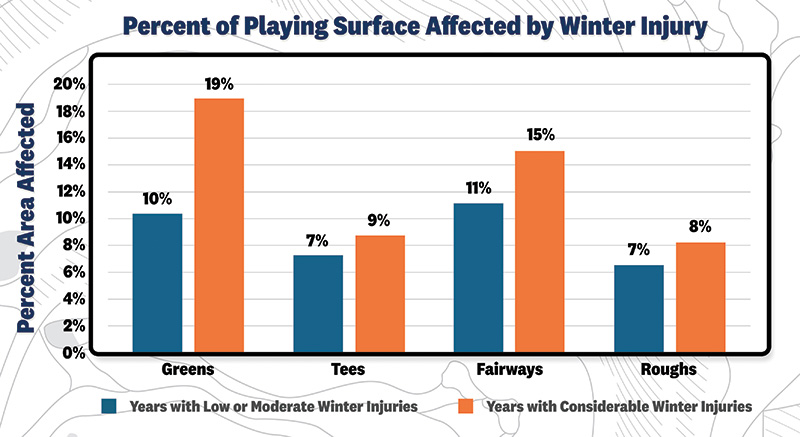
Figure 2. This figure shows the weighted average of the percent of area (in acres) affected by winter injury reported by the U.S. and Canadian golf course superintendents who participated in the survey (n=96). In years with significant occurrence of winter injury, greens are the most affected part of the golf course, followed by fairways.
How much turfgrass is lost due to winter injury?
We were also interested in which parts of the golf course received the most winter damage (Figure 2). Superintendents reported that during winters with low to moderate winter injury, 10.4% of total surface area on greens and 11.1% on fairways were damaged due to winter injury, and these numbers increased to 19.0% and 15.1%, respectively, in years with considerable winter injury. Winter injury was reported to affect, on average, about 6.5% to 7.2% of tee and rough surface area, and the damage can go up to 8.8% and 8.2%, respectively, during severe winter injury years. For a typical 18-hole facility, these numbers represent a significant amount of turfgrass that needs to recover or be reestablished — often in the most visible and heavily played areas of the course.
How does winter injury affect golf courses opening on time?
Over the average career length of the superintendents in our study (18 years), with 12 of those years being at their current facility, a typical golf course experienced winter-related injury in four of those years. In years marked by low to moderate winter injury, golf courses encountered delays in opening averaging up to 2.3 weeks, which increased to three weeks in years with considerable winter injury. In severe years, 22%-25% of courses reported delays of four to five weeks and about 4% reported delays of six to seven weeks.
To deal with delayed openings, about 31% of courses have used temporary greens while recovery efforts took place on the regular greens. In years with considerable winter injury, temporary greens had to be used for an average of three to four weeks. In some cases of extreme winter injury, superintendents reported using temporary greens for eight weeks or more. Temporary greens can allow golf courses to open earlier than otherwise possible when the primary greens are affected by winter injury, though this solution provides substandard playing quality and, in most cases, will result in reduced revenue from discounted green fees and/or golfers choosing to play elsewhere.
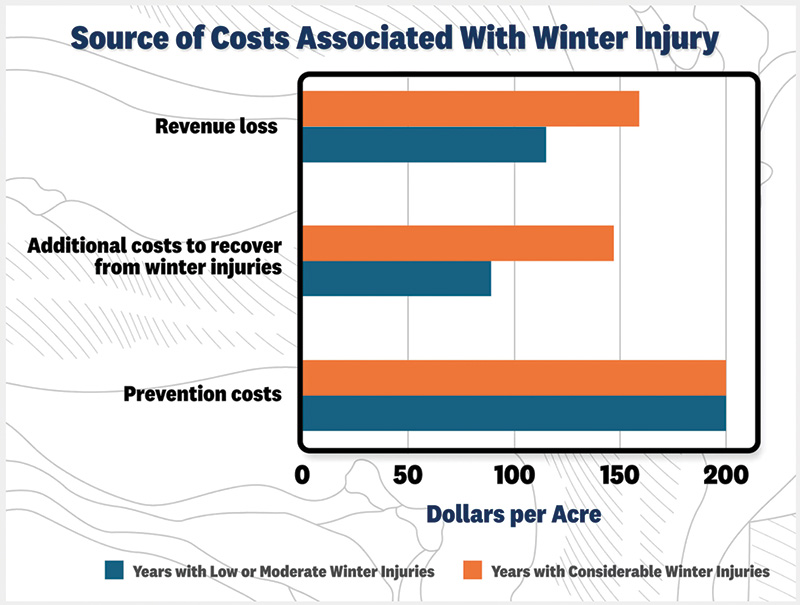
Figure 3. This chart shows the distribution of costs and revenue losses per acre from winter injury in years with low to moderate damage and years with considerable damage, as reported by 96 golf course superintendents in North America. The highest cost came from preventing winter injury, with lost revenue due to delayed openings (or temporary greens) second.
What does winter injury cost a golf course?
Three primary sources of financial costs are related to winter injury: expenses related to preventing winter injury, costs of inputs to recover from winter injury and revenue losses due to delays in opening. The survey results showed that, on average, the costs of preventing winter injury amounted to $12,000 to $18,000 per year per golf course, while additional costs of inputs to recover from winter injury were between $6,000 and $9,000 per year per golf course. Costs included labor, equipment, fertilizers, seed and weed control.
We asked golf course superintendents to report two types of revenue loss due to delayed openings: the annual revenue loss due to delays in golf course openings in years with low to moderate winter injury and the revenue loss in years with considerable winter injury. The average annual revenue loss in years with low to moderate winter injury ranged from $3,000 to $6,000, while in those years with considerable winter injury, the loss was higher and ranged from $6,000 to $9,000. About 50% of the superintendents reported no revenue loss due to delayed openings, and 26% reported revenue losses of less than $6,000. Only 3% of the golf courses reported revenue losses exceeding $75,000.
On average, the cost of preventing winter injury was approximately $200 per acre, with a median of $121 per acre, although some golf courses spent over $3,000 per acre (Figure 3). The average cost to recover in years with low to moderate winter injury was about $89 per acre. The costs went up to $147 per acre in years with considerable winter injury.
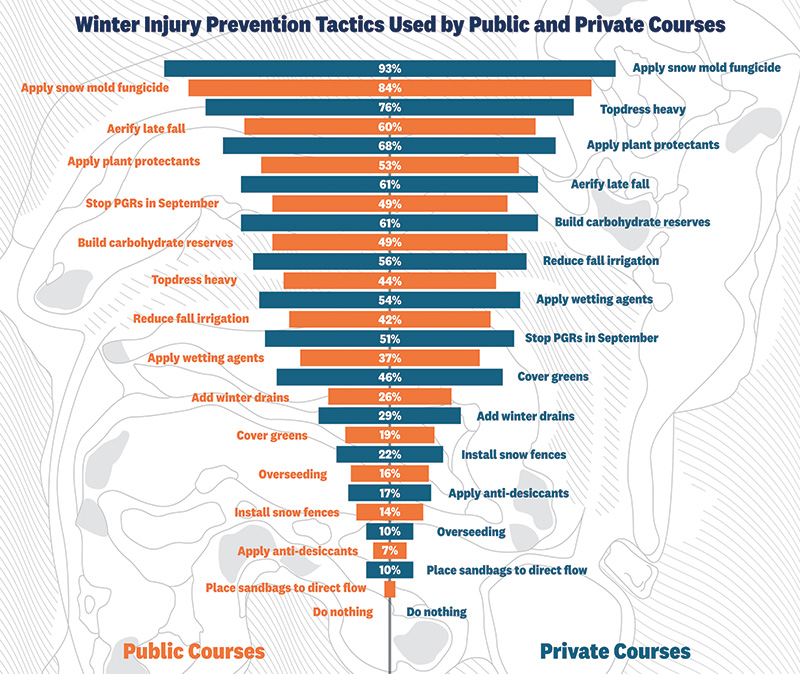
Figure 4. Management practices implemented to prevent winter injury varied slightly between public and private golf course superintendents in North America, based on survey data with U.S. and Canadian golf course superintendents. Two notable differences are with applying heavy sand topdressing and covering greens, which private courses reported doing significantly more often than public courses. Although the frequency of each strategy varied somewhat, the strategies themselves were generally consistent across both public and private courses. (Sample size: Public=43; Private=41)
How do superintendents attempt to reduce the risk of winter injury?
The three most prevalent management practices used by the superintendents of public golf courses in this survey to safeguard against winter injury were applying preventive snow mold fungicides, aerifying in late fall and applying plant protectants other than snow mold fungicides (Figure 4). These three management practices were also ranked among the top ones used by the superintendents of private golf courses, though a heavy sand topdressing on greens was the second-most-common practice on private courses (Figure 4). Unsurprisingly, almost all participants in the survey, irrespective of what type of facility they worked at, applied snow mold fungicides. The superintendents at private courses exhibited a greater inclination toward practices that were thought to build carbohydrate reserves, and they were more likely to reduce irrigation in the fall. The superintendents of private courses also demonstrated higher adoption of protective measures such as the use of covers for greens (46%) and directing the flow of water with sandbags (10%) and other practices that were used less on public courses. Possible reasons for the differences between preventive practices used at public and private courses include cost and labor considerations or different opening and closing schedules that influence the use of putting green covers.
Practical considerations for superintendents
This study identified economic costs of winter injury on golf courses in North America — highlighting the value of preventive management strategies. The cost of repairs and lost revenue associated with winter injury can be sizable, which helps justify investments like installing drainage and improving growing environments, and encourages courses to take preventive turf health measures prior to winter that give key playing surfaces the best chance of survival. The potential costs of winter injury may also help justify converting high-value playing surfaces to grasses that are less susceptible to common forms of winter damage. As is almost always the case, an ounce of prevention is likely to be much better than a pound of cure.
The research says
- A survey conducted with 96 golf course superintendents in the northern United States and Canada identified ice encasement, crown hydration, desiccation and snow mold as the main causes of winter injury.
- Winter injury was reported to occur roughly one out of every three seasons over the tenure of participating superintendents, and golf course openings were delayed by two to three weeks following winter injury.
- When winter injury damage occurred in a typical year, it affected about 10% of the total area on greens and fairways. In years with more severe damage, up to 20% of the total area on greens and 15% on fairways was affected.
- The average annual cost per course was estimated at $12,000 to $18,000 for winter injury prevention, $6,000 to $9,000 for recovery from winter injury and $3,000 to $9,000 in lost revenue due to delayed opening.
Literature cited
- Kvalbein, A., W.M. Waalen, L. Bjørnstad, T.S. Aamlid and T. Espevig. 2017. Winter injuries on golf greens in the Nordic countries: Survey of causes and economic consequences. International Turfgrass Society Research Journal 13(1), 604-609 (https://doi.org/10.2134/itsrj2016.09.0826).
- Yue, C., U. Parasuram, E. Watkins, D. Soldat, P. Koch, K. Frank and M. DaCosta. 2025. The economic cost of winter injuries on golf courses in North America. HortScience 60(8), 1389-1397 (https://doi.org/10.21273/HORTSCI18673-25).
Chengyan Yue, Ph.D., and Eric Watkins, Ph.D., are professors in the Department of Horticultural Science at the University of Minnesota, Saint Paul, and Paul Koch, Ph.D., is a professor in the Department of Plant Pathology at the University of Wisconsin, Madison.