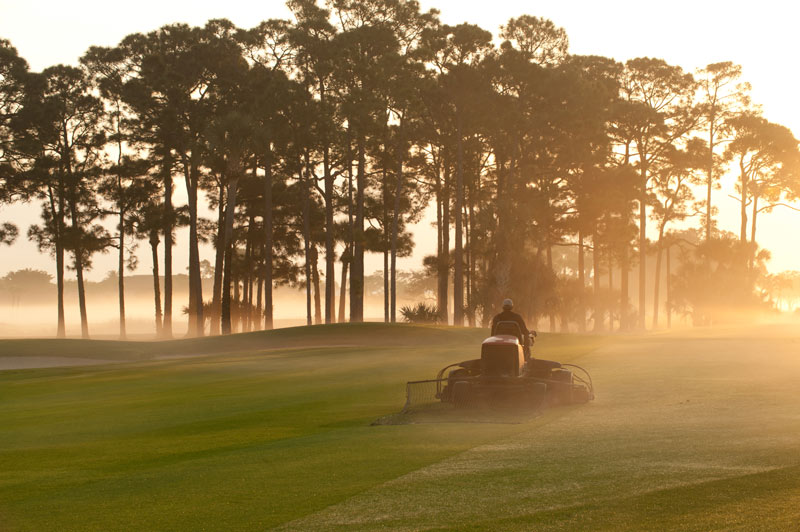
The U.S. departments of Labor and Homeland Security recently announced that 15,000 more seasonal workers will be allowed into the country in 2018 under the H-2B visa program. Photo by Montana Pritchard
Few public policy issues inspire as much heated conversation as immigration, and the golf industry perennially finds itself smack-dab in the middle of the debate.
Golf is a big employer of temporary immigrant laborers who arrive in the U.S. under the H-2B visa program for temporary nonagricultural jobs. Golf course operators typically hire these seasonal workers to staff their grounds crews, though some are also recruited to work in other areas, such as food and beverage.
The golf industry has experienced a slow, steady contraction over the past decade, with more courses closing than opening each year. But the demand for temporary workers is as strong as ever.
The industry’s lobbyists say the labor shortage is growing more acute as the U.S. labor market tightens. On June 1, the U.S. Department of Labor announced the unemployment rate had fallen to 3.8 percent, an 18-year low. The Labor Department also noted that wages for non-supervisor employees rose 2.8 percent over the past year, the biggest gain since 2009.
“It is more difficult now due to a very healthy economy and a much tighter labor supply,” says Robert Helland, director of congressional and federal affairs for GCSAA.
The federal government issues 66,000 H-2B visas annually — 33,000 in the first half of the fiscal year, which starts Oct. 1, and the rest six months later. On May 31, the Department of Labor and Department of Homeland Security finalized approval of an additional 15,000 H-2B visas through the end of fiscal year 2018.
The visas last up to one year and are used by numerous seasonal industries, including hotels and theme parks. Golf industry lobbyists aren’t clear exactly how many are requested by course operators, but they know the process is time-consuming and they can’t get as many visas as they need.
Issuance of the visas also routinely gets delayed because of Congress’ inability to enact budgets in a timely manner.
“It’s an annual budget issue,” says Ronnie Miles, director of advocacy for the National Golf Course Owners Association. “So if a budget doesn’t come out until mid-year, you’re obviously only left with a partial year to utilize those H-2B visas.”
Shortage of temporary workers nationwide
The shortage of these temporary workers is being felt across the country, though Helland says his sense is that the problem is most acute in lightly populated northern regions.
“They really have a short time frame to hire people, and they’re somewhat more remote from a bigger labor population, so they’re really hurting to get people to work on their courses,” Helland says.
Before recruiting H-2B workers, employers must prove that “There are not enough U.S. workers who are able, willing, qualified and available to do the temporary work,” and that it “will not adversely affect the wages and working conditions” of U.S. workers, according to U.S. Citizenship and Immigration Services guidelines.
“So businesses have to recruit for these positions at least 30 to 60 days out because it takes 60 to 90 days to get a visa application approved,” Miles says. “It’s a lot of work for an employer who’s going to use an H-2B worker, so they would not spend that amount of time and effort and resources unless they had a real solid need.”
Miles would like to see the federal government reinstate the “returning worker exemption,” which was ended in fiscal year 2017. That program, started in December 2015, allowed for the return of temporary workers who had previously been in the U.S. on H-2B visas. They did not count against the 66,000-visa cap and would increase the total number of H-2B visas to 136,000, Miles says.
There seems, however, to be little hope of a legislative solution in the current political environment. Any issues related to immigration are political dynamite.
“The real question is, respectfully, the misconceptions about the program in Congress,” Helland says. “I think there are a lot of people who see this as taking American jobs, which is not the case.”
He points to a 2011 American Enterprise Institute (AEI) study that found that each 100 H-2B workers helped create 464 additional jobs. AEI acknowledged that it’s finding “may be surprising” and contrary to other research.
The think tank looked at how the number of H-2B visas approved in each state corresponded to the employment rate for U.S. residents. AEI acknowledged that “the results may be biased upward,” because the study can’t fully account for temporary workers being “drawn to areas experiencing strong economic growth and high employment.”
“We want people to see that this is not taking jobs from Americans, but creating them or sustaining them, and these are jobs that are not being filled in a booming economy,” Helland says.