Editor's note: The following article was supplied by EarthWorks. All product claims, research cited and other information are directly from the company.
Biological Soil Management (BSM) is an investment in your soil, your property and your career that pays big dividends. For over 30 years EarthWorks has promoted the concepts of BSM that lead to sustainable reduction of fertilizers and other inputs. In the same period, among our users we’ve seen careers flourish while the level of anxiety associated with managing turf has diminished.
The turf industry is in a constant state of change. Labor issues are an ever-worsening problem, water costs are rising and budgets aren’t keeping up with the economy. Turf managers are expected to do more with less, and yet they still manage to get it done with style. Where does it end? How can we make your job easier? We hear a lot about reducing fertility inputs. Can that approach help buffer these big issues?
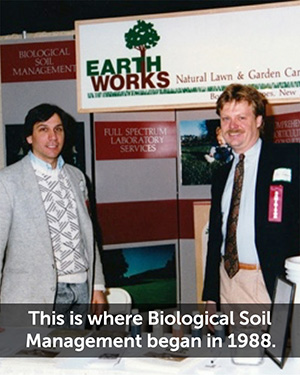
By following Biological Soil Management practices, your labor requirements will moderate, your plant’s roots will be stronger and deeper, water usage will be significantly reduced and thatch won’t develop. Most of all, Mother Nature will play a major role in fertilizing your turf — the only sustainable way to reduce inputs.
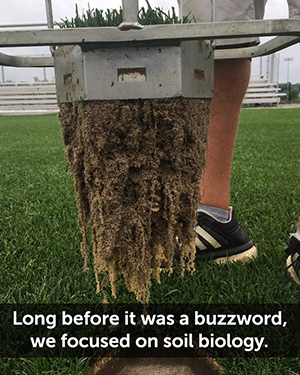
All soils are a home for a host of biological life. We know very little about how many different species of soil microbes there are in any given soil. We don’t completely understand how they communicate, their interactions with each other or their relationships with the plant material they depend on for so much. What we do know is that we can affect their populations positively or negatively depending on how we manage the soil. Through research and observation, we’ve discovered that as we improve soil biology, plants perform better, recover more readily and experience less stress.
Any good book on soil science refers to the “three-legged stool,” which describes how soil works. The legs represent chemistry, physics and biology respectively and should ideally be of equal length. When one of these legs falls short, the system breaks down and the soil cannot work as designed. However, most conventional agronomic models focus is on chemistry, and often, within the chemical leg little more than pH is discussed. Along with pH the common practice in both sports turf and conventional agriculture is to prioritize nitrogen, with potassium ignored and phosphorous discouraged. This differs from studies going back only a few years where nitrogen, phosphorous and potassium were considered equals.
The proven Biological Soil Management concept is that all three legs of the stool must be held in equal esteem. BSM describes how chemistry affects physics which affects biology.Ultimately, soil biology is the primary focus of how soil works. By balancing the chemical environment, (a concept that may not work as well on low CEC soils as it does on higher CEC soils), and feeding the soil multiple forms of available carbon (carbon-based fertility) a proliferation of microorganisms occurs in the soil. We know soil biology helps break down and mobilize nutrients from mineral forms to available forms that plants need. We also know that as biology proliferates in the soil, it digests ligneous forms of carbon such as root systems, creating humus — another form of available food for microbes.
With high CEC soils, the concept of balancing soil chemistry is well documented in the works of Dr. William Albrecht (The Albrecht Papers vol. 1-13), Jerry Brunetti (Farm as Ecosystem) and longtime soil consultant Bill McKibben (The Art of Balancing Soil Nutrients). By bringing the levels of calcium and magnesium into 6:1 balance, with calcium being approximately 70% of the soil colloid, the clay particles are moved apart. Air and water can move through the soil more freely, thus significantly improving the environment for soil biology. With chemistry and physics addressed, carbon-based fertility can provide both the mineral and carbon base that benefits all soil biology.
On lower CEC soils, chemistry and physics are clearly addressed by different means. Calcium and magnesium have less influence of the soil physically but remain important minerals in building cell structure and helping with photosynthesis. However, in these low CEC soils biology tends to be even more challenged because organic matter is inherently lower and the mineral base needed to promote microbial activity and supply sustainable nutrients to the plant are simply not there. On these soils, the BSM model focuses on soluble soil testing data (water-soluble paste extracts) as its driving force. The use of both rock minerals and carbon-based amendments is extremely important to keep the activity of soil microorganisms working at full power. The use of carbon rich soluble liquid nutrient products not only can “foliar” feed the plant, but when that liquid (as much as 80%) rolls past the leaf into the soil, there is a powerhouse of energy and mineral that both microbe and plant can utilize.
The carbon to nitrogen ratio
The lessons of nitrification, and the carbon to nitrogen ratio are a testimony to the value of Biological Soil Management. As nitrogen breaks down from its molecular forms to plant available nitrate forms — a process completely driven by microorganisms — available forms of carbon found in the soil are used as energy to power those microbes. The overuse of synthetic nitrogen pushes microbes hard as they consume the available forms of carbon (humus) for energy. This process burns out the already limited carbon in the soil, depleting the microbial food supply.
Because there is less carbon, more nitrogen is needed to get the same level of nitrate to the plant needed to produce chlorophyll molecules. Because there is less energy in the soil, microbial activity slows down, creating a vicious cycle. The result is an inefficient, expensive and soil-damaging process. More importantly, this leaves your soil with limited carbon (microbial food energy), affecting all three legs of our three-legged stool. Synthetic nitrogen isn’t a bad thing — quite the contrary — but carbon fertility is on the rise in our industry because there is such a strong case for balancing nitrogen with carbon.
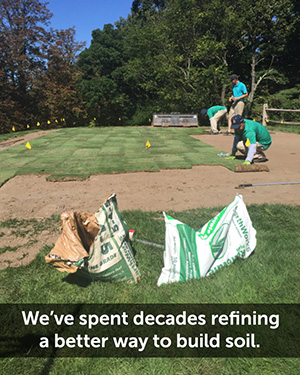
When too much synthetic nitrogen is used, the available forms of carbon in the soil are used up so microbial activity is slowed down. The roots continue to grow and extensive ligneous material (thatch) is left behind. Microbes cannot easily digest these long chained ligneous carbons very easily. That would be like us chewing on a wooden pencil for lunch, a pencil is made up of carbon and can represent energy but it would take days for that carbon to be digested by our bodies to where it could be used as a source of energy. The same happens in the soil when microbes lose their available forms of carbon or food. Biological Soil Management focuses on creating the physical environment where soil biology can proliferate and through the small but frequent application of carbon-based fertilizers microbes feed and mobilize minerals to the plant.
Carbon-based fertility
One of the most important steps in Biological Soil Management is feeding soil microbes. It is imperative we use available forms of carbon-based fertilizers and rock minerals to re-mineralize the soil with the nutrients plants have taken up. Research shows turf soils are predominately dominated by very simple biological life – in a word, bacteria. The same research shows the bacteria need ample amounts of highly available and predigested carbon sources like composts, simple sugars, fish and kelp meal so they can quickly reproduce to do their job of digesting roots. When there is available carbon in the soil, microbes proliferate, releasing ammonium nitrogen and producing even levels of fertility.

There is much talk of reducing fertility inputs in the turf industry today, and BSM is a champion of this concept. In fact, many advocates of this approach enjoy significant reduction in not just nitrogen, but all levels of fertility. More significantly, they see their fertility level off to a point where there are no highs and lows in the fertility or growth of their turf. No longer are they faced with the sudden need to rush out with the next round of fertilizer. They also report thatch reduction, better water holding capacity and healthier plants with less disease and weed concerns. Reducing nutrients should be a goal of any turf manager. But without the support of Biological Soil Management and carbon-based fertility, your fertility program is prone to living on a razors edge, making your job more difficult and stressful.
Biological Soil Management is an agronomic philosophy where all the focus is on soil biology. Soil testing is performed to indicate the correct level of nutrients you need and the correct balance of those nutrients. It illustrates the optimum approach to open up your soil and create an environment where a teaming microbial population has the best opportunity to proliferate. Carbon-based fertility is your most potent tool to feed the microbes, which in turn create a high degree of sustainability. It allows you to effectively minimize inputs, taking the highs and lows out of your program. By balancing the chemistry and feeding your soil with available carbon, a deeper respect is afforded to the soil and to you who are responsible for managing it.
If you’d like to learn more about how Biological Soil Management can help you sustainably reduce inputs while creating more trouble-free and appealing turf, subscribe to receive periodic reports and product information: http://www.earthworksturf.com/earthworks-white-papers/
Joel Simmons is the president of EarthWorks