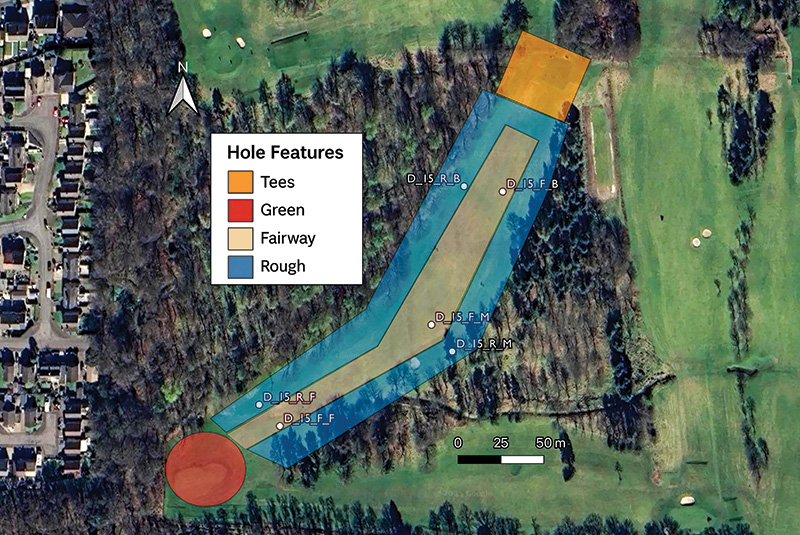
Figure 1. A map showing the front, middle and back sampling locations along a hole at Dunnikier Park Golf Course, Scotland. For example, D_15_F_M is code for the sampling location of a sample taken at Dunnikier, hole 15, in the fairway and in the middle of the hole.
This research aims to develop a soil testing methodology that enables more turfgrass researchers, agronomists and superintendents to quantify golf course soil carbon sequestration rates. From our testing on two golf courses in Scotland, we find that 36 soil cores taken across an 18-hole golf course provide a high confidence estimate of the golf course soil carbon stock, which, if measured every five years, will provide high-resolution soil carbon sequestration rate estimates.
However, our research finds that if golf course managers aim to reduce their net climate impact, it is important that they work to reduce carbon emissions associated with maintenance. In this article, we introduce the carbon cycle as it relates to golf courses; describe the results of our latest study; share a golf course-specific soil sampling protocol for determining golf course soil carbon stocks and eventually sequestration rates; and provide guidance on reducing golf course carbon emissions. We also discuss the evolving perceptions of organic matter in golf course management and its contributions to overall soil health.
An introduction to golf course carbon cycling
A recent USGA Green Section survey of superintendents, assistants, agronomists and turf researchers found that extreme weather and/or climate ranked third out of the top 10 major concerns facing the golf industry (4). The second highest future concern was the lack of qualified/skilled labor, while the top concern was water supply constraints and/or cost. This top concern is arguably related to climate change in many instances across the U.S., where hotter and drier weather will continue to put increasing pressure on water resources. As such, two of the top three concerns facing the future of the golf industry are either directly or indirectly related to climate change.
In 2024, global carbon emissions from human activity were approximately 43 billion metric tons (t) of CO2. (Conversion note: 1 metric ton, or 1,000 kilograms, is roughly 2,204.6 pounds). Of these 43 billion t, half remained in the atmosphere. However, the other half of what humans emit to the atmosphere is absorbed by the Earth’s oceans and land surface (in 2024, 29% was absorbed by the oceans, and 21% was absorbed by the Earth’s land surface).
Albeit a small part, golf courses are part of the land surface that absorbs CO2 from the atmosphere. As the flora on golf courses photosynthesize, CO2 is assimilated from the atmosphere into plant cells and ultimately results in the conversion of CO2 into carbon-containing sugars that the plant uses for its own metabolism or for building cell walls that support plant structure. Eventually, though, the plant tissue dies as the grass is cut or leaves fall to the ground. This plant matter is then broken down by microbes and is eventually converted to organic matter, which itself is approximately 60% carbon. Thus, the carbon that is in organic matter originated in the atmosphere, and that process of taking carbon from the atmosphere and storing it the soil, or elsewhere in the Earth system, is called carbon sequestration. Carbon sequestration is often emphasized because increasing it on a planetary scale will help reduce the amount of CO2 in the atmosphere and potentially limit the effects of climate change.
For golf course management specifically, the accumulation of organic matter in golf course soils is representative of carbon sequestration. Of course, excessive accumulation of organic matter in golf course soils can negatively affect surface performance. However, organic matter provides a multitude of soil and plant benefits, which are equally important for superintendents to keep in mind (for further discussion, see the section titled “Changing perceptions of soil organic matter in golf course management”).
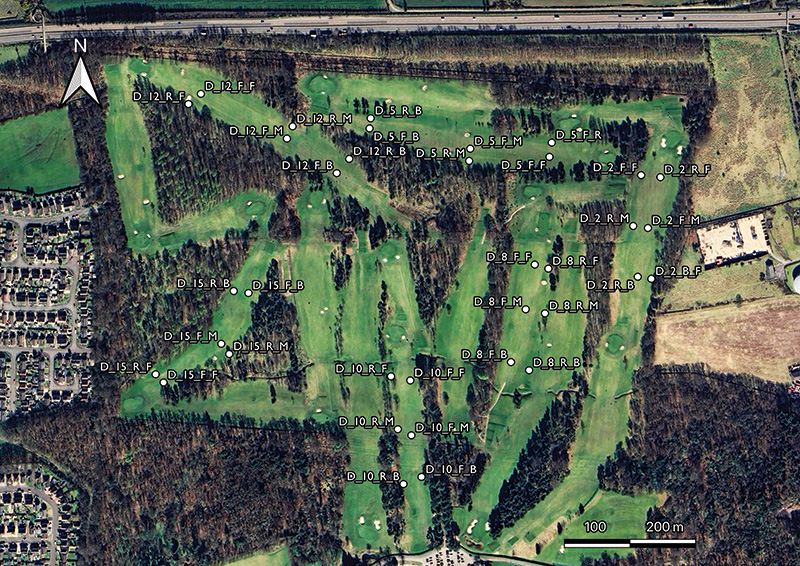
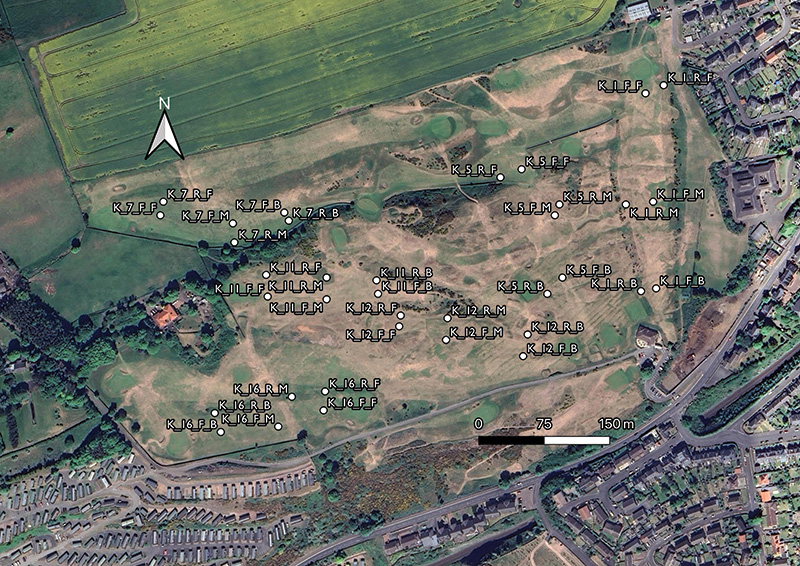
Figure 2. Maps showing all sampling locations at Dunnikier Park Golf Course (top) and Kinghorn Golf Club (bottom). For example, K_16_R_F is code for the sampling location at Kinghorn on hole 16, in the rough at the front of the hole (near the green).
In terms of climate impact, the question for the golf industry becomes, how much carbon do golf courses sequester, and are golf course carbon sequestration rates high enough to offset the carbon emissions associated with golf course maintenance? The best data on turfgrass carbon sequestration rates comes from a 2023 meta-analysis (a study of studies) (5). The rate of turfgrass carbon sequestration depends on many factors, including the previous land use and soil type. However, on average, when turfgrass surfaces are first established, the carbon sequestration rate is high for the first 10 years (on average 5 t CO2 per hectare per year or 102 pounds CO2 per 1,000 square feet), but then slowly declines to near zero 50 years after establishment. For a golf course with 95 acres of turf (which is the average size of a U.S. golf course), the average amount of carbon that is sequestered in the first 10 years is approximately 1,900 t CO2. This is the weight of approximately 50 fully loaded semi-trucks. In the next 40 years, the golf course will sequester approximately an additional 3,800 t CO2 or an additional 100 semi-trucks. After this period, carbon sequestration declines to near zero.
The high initial rates of carbon sequestration on golf courses are largely because golf courses are commonly built on agricultural soils that are carbon poor. The soil tilling associated with many types of agriculture decreases the soil carbon content, whereas turfgrass systems, except for aeration on greens and occasionally on tees and fairways, often entails little soil disturbance. The lack of soil disturbance and the input of turfgrass clippings to a soil that is often carbon poor upon turf establishment means that the golf course soils accumulate carbon quite quickly at first. However, carbon does not accumulate in soils forever.
Soil can be thought of as a sponge, with nooks and crannies where carbon can be stored as organic matter. However, there comes a point when the sponge fills up, and the soil has little more storage capacity for additional organic matter.
However, the values for carbon sequestration we cite above are average values across many different studies, and in some cases golf courses will sequester more or less carbon than these average values. Superintendents have often asked us, “How much carbon does my golf course sequester?” The only way to know the answer to this question with high confidence on a specific golf course is to take soil carbon samples on the golf course to determine what is called the soil carbon stock and then to measure the soil carbon stock over time and analyze how the stock changes. If the soil carbon stock goes up over time, the golf course is sequestering carbon from the atmosphere, and if the soil carbon stock goes down over time, the soils of the golf course are emitting carbon to the atmosphere. The soil carbon stock itself is calculated by multiplying the bulk density of the soil by the organic matter content by the depth to which the measurements are made. Soil carbon stocks are usually expressed as the weight of carbon in the soil to an 11.8-inch (30-centimeter) depth.
Calculating the soil carbon stock of a golf course is relatively complex, and as such, our research focuses on making the process practical and scalable. Together with the R&A, we wrote an initial soil carbon stock sampling protocol, which you can find on the R&A’s Golf Course 2030 website in the Climate section (https://www.randa.org/golf-course-2030-projects-climate). The goal of this research was to conduct a field test of this protocol to continue to make the protocol clearer and as accessible as possible. To this end, we sampled two golf courses in Fife, Scotland, and conducted statistical analyses on the resulting soil carbon stock data to determine where soil cores need to be taken and in what quantity to determine with a high degree of accuracy the carbon stock of a golf course.
An abbreviated methodology to calculate the soil carbon stock of your course
- Select six holes across the course, preferably par 4s and par 5s.
- On each hole selected, take one soil core in the front, middle and back of the hole in the fairway and rough as depicted in Figure 1 (six cores per hole).
- Take soil cores of approximately 2-inch (5-centimeter) diameter to 11.8-inch depth.
- Cut off the thatch and mat layer (the 0-inch elevation should be at the base of the thatch and mat layer — this is because the carbon stored in the thatch/mat layer can be quickly released back to the atmosphere as CO2, and thus it is not counted as part of the carbon stock).
- Either at a local university laboratory or at a commercial soil testing facility dry and sieve the soils to 2 mm. Weigh both the fine fraction (<2 mm) and the coarse fraction (>2 mm) and calculate the bulk density of the fine fraction and the coarse fraction content.
- Test the fine fraction for its soil organic carbon (SOC) content.
- Calculate the soil carbon stock with the formula given in this article.
- Repeat the process in five years and calculate the difference in carbon stocks from the first to the second sampling.
Our research methodology
To test our soil carbon stock sampling protocol, we selected two golf courses that were nearby to each other but that had different soil textures: Dunnikier Park Golf Course and Kinghorn Golf Club near Kirkcaldy, Scotland.
At both golf courses, 2-inch (5-centimeter) diameter soil cores were taken to a depth of 11.8 inches. The thatch mat layer was discarded, and the zero point (0-inch elevation) was set at the top of the soil profile, which was commonly 0.8-2 inches (2-5 centimeters) below the turfgrass surface.
Soil cores were taken on six holes across each golf course. On each hole, three sampling locations were located along the length of the fairway and rough. At each sampling location, two soil cores were taken. As such, 12 soil cores were taken per hole (six sampling locations per hole and two soil cores per sampling location) (Figure 2).
Each soil core was divided into three depth increments: 0-3.94 inches (0-10 centimeters), 3.94-7.87 inches (10-20 centimeters) and 7.87-11.81 inches (20-30 centimeters). Once the soil cores were brought back to the lab, each segment was sieved to remove rocks greater than 0.079 inch (2 millimeters) in diameter and then was tested for bulk density and soil organic carbon content. The soil carbon stock of each soil core was calculated using the following formula:
Carbon stock=Depth*SOC*Bulk density*(1-CF)*C
where SOC is the soil organic carbon content, CF is the coarse fragment content and C is the conversion factor (the value of this factor depends on the units being used). We used depth in meters (m) and bulk density in t per cubic meter and a conversion factor of 10,000 square meters per hectare. SOC and CF are both percentages with values less than 1.
Statistical analyses of the data were then conducted to determine if there were significant differences in the carbon stock of soil cores taken at the same sampling location, along the length of a hole, between the fairway and rough, or between holes on the golf course. Based on all the soil cores collected we estimated the average carbon stock of the whole golf course by averaging the carbon stock of each individual soil core.
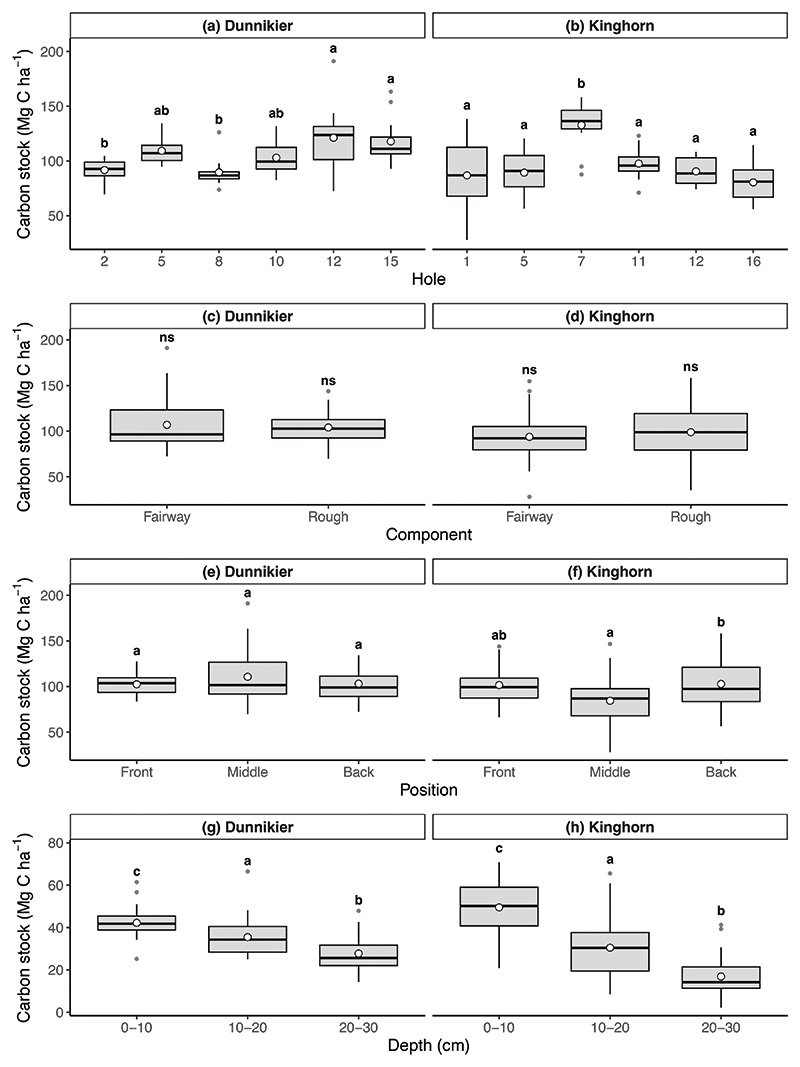
Figure 3. Carbon stock of Dunnikier and Kinghorn by hole, component, position and depth. Carbon stock units are megagrams C per hectare. One megagram is equivalent to a metric ton (t). Different letters indicate statistically significant difference in means.
Results of the study, updated sampling protocol for golf courses
One of our primary questions going into the study was the degree to which carbon stocks on golf courses vary over small spatial scales. One of the first statistical tests we ran was to determine if the two soil cores that we took at each sampling location — soil cores taken 78.7 inches (2 meters) apart from one another — had significantly different carbon stocks. Fortunately, taking two samples side by side did not increase the accuracy of our carbon stock estimates, meaning that taking two soil cores at each sampling location will not be necessary in the future. We will soon be revising the soil testing guidelines to reduce the recommended sampling requirement from two cores per sampling location to only one core per sampling location.
Surprisingly, unlike previous studies that have found carbon stock differences between fairway and rough, at Dunnikier and Kinghorn, there were no differences in the carbon stock between the fairways and roughs. This may be because the management inputs to both fairways and roughs are both lower and more alike on these two Scottish golf courses than average input levels in the U.S. The aeration of fairways on some U.S. golf courses, which has the effect of reducing soil carbon stocks, could cause differences in the carbon of fairways and roughs in the U.S. As such, in the updated soil sampling protocol, we still recommend sampling both fairways and roughs.
At Dunnikier, there was no difference in the carbon stock of samples taken in the front, middle or back portion of a hole, while at Kinghorn there were small differences between these three hole positions. As such, in the updated protocol, we will maintain the number of samples that are taken along the length of the hole.
The highest degree of variation that we found in carbon stock was across the different holes of the two golf courses. At Dunnikier, the average carbon stock of each hole fell into two statistical categories that were all significantly different from one another. At Kinghorn, which had a greater range of soil textures, hole 7, which had a silt soil texture, had a significantly higher soil carbon stock than the other five holes, which had a sandy silt loam texture. These results reinforce the effect that different soil textures and different landscape positions across a golf course can have on soil carbon stocks.
Finally, we found significant differences in the soil carbon stock with depth, which is consistent with previous research. This finding reinforces the need to sample to an 11.8-inch depth.
The golf-course-wide average soil carbon stock of Dunnikier was 2,151 pounds C per 1,000 square feet (105 t C per hectare) and of Kinghorn was 1,966 pounds C per 1,000 square feet (96 t C per hectare) (Figure 3). We plan to sample the golf courses again in five years to test the soil carbon stocks of the golf courses, which will allow us to determine the soil carbon sequestration rate. While there are other methods of estimating carbon sequestration rates (e.g., chronosequences), the only way to determine high confidence carbon sequestration rates is to sample at two points in time separated by at least five years. This type of sampling is called longitudinal sampling and can also be referred to as repeated measures sampling.
Golf course carbon sequestration, emissions and the resulting carbon balance
According to the best available data, an average 18-hole golf course constructed on previously agricultural land has a total carbon sequestration capacity of approximately 6,000 t CO2, the majority of which takes place in the first 50 years after establishment. However, golf courses also emit CO2 by burning fuels, using electricity and using materials that themselves cause emissions in their production. Best estimates of golf course CO2 emissions state the average U.S. golf course emits about 150 t CO2 every year, which means that after 50 years, the average golf course will have emitted 7,500 t CO2, which is significantly more than its total sequestration capacity of 6,000 t CO2. The carbon balance (emissions minus sequestration) of the average golf course is then plus-1,500 t CO2 after 50 years of continuous operation. Further, as the golf course ages past 50 years, the carbon balance will only grow as the emissions continue but the sequestration capacity of the golf course is mostly exhausted.
It is important to note that these carbon balance numbers are averages, and the numbers for your course may be different. Perhaps your golf course was built on land that was previously forested. In this case, previous research indicates that your golf course will likely not sequester any carbon at all, as the soils are already carbon saturated. Or perhaps your golf course uses solar panels to charge an all-electric maintenance fleet, in which case the carbon emissions of maintenance will be lower than the estimates stated here.
The most effective step for superintendents to take to reduce the carbon emissions associated with their maintenance operations is to burn less fuel. Fuel burn is responsible for the majority of carbon emissions at nearly all golf courses. Electrifying the maintenance fleet where possible is the most effective long-term option for reducing carbon emissions. Secondarily, it is also important to source electricity from a low-carbon source. Many power companies offer the option to purchase low-carbon electricity. Alternatively, installing solar panels on the roof of the maintenance building is commonly an effective solution to generate low-carbon electricity. While it is less important than reducing fuel burn or sourcing electricity from a low-carbon source, the efficient use of water, sand and agrochemical inputs will also lower the golf course’s overall carbon footprint.
Changing perceptions of soil organic matter in golf course management
Historically, organic matter accumulation on golf course greens, tees and fairways has been treated as being detrimental to high-quality turf. However, in recent years, the perception of organic matter accumulation has started to change (3). The development of the OM246 method by Micah Woods (7) and recent standardization work for putting green surface organic matter testing by the USGA (2) has sped the development of new ways of thinking about organic matter accumulation and turf performance on greens. It is generally accepted now that there is no “magic” organic matter level and that each golf course, through testing in a standardized manner, needs to define what it deems as an optimal organic matter level. Traditionally, superintendents have focused on lowering organic matter levels, but some agronomists now recommend that it would be wise for superintendents to reverse this thinking and target the highest organic matter level at which the turfgrass surface performs optimally in terms of firmness, speed and water retention (7). We suggest that superintendents extend this thinking beyond greens to fairways and tees as well.
In addition to the carbon sequestration that organic matter accumulation in golf course soils represents, organic matter is widely used as a soil health indicator because it integrates the long-term physical, biological and chemical processes that themselves determine how soils function and respond to management. Physically, organic matter promotes the formation of stable aggregates by binding mineral particles together, which improves pore structure, lowers bulk density, reduces irrigation requirements and increases resistance to compaction under routine traffic and maintenance operations. These aggregates support better aeration, infiltration and root development, allowing soils to recover more quickly following mechanical stress. Biologically, organic matter serves as the primary energy source for soil microbes and fungi, whose activity and byproducts further stabilize soil structure and protect pore networks.
Chemically, higher organic matter content increases cation exchange capacity, improving nutrient retention and buffering against leaching losses, which contributes to more consistent turf nutrition. Because organic matter reflects the cumulative effects of root turnover, organic inputs and disturbance over time, it provides insight into soil stability and resilience that short-term performance metrics cannot capture. Taken together, these findings reinforce that organic matter is best understood not as a standalone solution but as an integrative indicator of soil health that reflects whether the underlying soil system is functioning well.
For golf course managers, tracking organic matter over time helps distinguish short-term surface performance from the underlying condition of the soil profile that ultimately supports consistent, resilient turf performance. Organic matter levels should be interpreted relative to other metrics such as firmness and uniformity, but the wide range of benefits of organic matter, in addition to the climate benefits, describe why golf course superintendents would be wise to not constantly chase lower organic matter levels through heavy aeration programs.
Minimizing nitrogen fertilization decreases the need for mowing, topdressing and aeration and as a result lessens both carbon emissions and maintenance costs. This strategy combined with organic matter management guided by surface performance data will, in many circumstances, sequester more carbon and result in healthier soils that support higher turf performance.
Recommendations for organic matter and soil carbon testing
If you would like to test organic matter levels in your greens to optimize putting green performance, we recommend following the USGA standard method (2). If you would like to measure the carbon stock of your golf course in a manner that allows for the quantification of a golf-course-wide soil carbon sequestration rate, you can find our most updated soil carbon sampling protocol in the Climate section of the R&A’s Golf Course 2030 website (https://www.randa.org/golf-course-2030-projects-climate). To calculate the carbon emissions of your facility, there are an increasing number of sustainability apps and programs that are designed to calculate your carbon footprint (e.g., GEO Foundation’s OnCourse program). If you’d like to do the calculations yourself, you can refer to the carbon emission coefficients in Bekken et al. (1) or enlist a local environmental consulting company to help you. Once the carbon sequestration rate and carbon emission rate of your golf course is known, you will become fully aware of the climate impact of your golf facility and can work toward making your facility more climate friendly.
Climate-friendly golf courses will not solve climate change, but all sectors of society need to contribute if we are to mitigate the worst effects of a changing climate. And beyond the climate benefits of soil carbon testing, rethinking our relationship with organic matter not only on greens but across the entire golf course will be beneficial to the everyday practical management of golf course turfgrass surfaces.
The research says
- The most effective step for superintendents to take to reduce the carbon emissions associated with their maintenance operations is to burn less fuel. Fuel burn is responsible for the majority of carbon emissions at nearly all golf courses.
- Electrifying the maintenance fleet where possible is the most effective long-term option for reducing carbon emissions.
- It is important to source electricity from a low carbon source. Many power companies offer the option to purchase low carbon electricity. Alternatively, installing solar panels on the roof of the maintenance building is commonly an effective solution to generate low carbon electricity.
- While it is less important than reducing fuel burn or sourcing electricity from a low carbon source, the efficient use of water, sand and agrochemical inputs will also lower the golf course’s overall carbon footprint.
Literature cited
- Bekken, M., D. Soldat. 2021. Estimated energy use and greenhouse gas emissions associated with golf course turfgrass maintenance in the Northern USA. International Turfgrass Society Research Journal 14(1):58-75 (https://doi.org/10.1002/its2.61).
- Gaussoin, R., D. Linde, J. Murphy, D. Soldat and B. Whitlark. 2024. A standard method for measuring putting green surface organic matter. USGA Green Section Record 62(2) (https://www.usga.org/content/usga/home-page/course-care/green-section-record/62/issue-02/a-standard-method-for-measuring-putting-green-surface-organic-ma.html).
- Hartwiger, C. 2024. Are you managing putting green organic matter or is it managing you? USGA Green Section Record 62(22) (https://www.usga.org/content/usga/home-page/course-care/green-section-record/62/issue-22/are-you-managing-putting-green-organic-matter-or-is-it-managing-.html).
- Merrick, B. 2025. A survey of current and future challenges facing the golf course maintenance industry. USGA Green Section Record 63(2) (https://www.usga.org/content/usga/home-page/course-care/green-section-record/63/issue-02/what-are-the-biggest-challenges-facing-the-golf-course-maintenan.html).
- Phillips, C., R. Wang, C. Mattox, T.L.E. Trammell, J. Young and A. Kowalewski. High soil carbon sequestration rates persist several decades in turfgrass systems: A meta-analysis. Science of the Total Environment 858(3) (https://doi.org/10.1016/j.scitotenv.2022.159974).
- Woods, M. 2021. OM246. Asian Turfgrass Center blog (https://www.asianturfgrass.com/project/om246/).
- Woods, M. 2024. Maximum soil organic matter, not minimum, should be the goal. Asian Turfgrass Center blog (https://www.asianturfgrass.com/post/max-om-in-soil-as-a-goal/).
Michael Bekken (michael.bekken@nibio.no), Ph.D., is a research scientist in the turfgrass research group at the Norwegian Institute of Bioeconomy (NIBIO). George Fitch (georgefitch9@gmail.com), M.S., is a former golf course superintendent and recent graduate of the University of Edinburgh’s soil science master’s program.