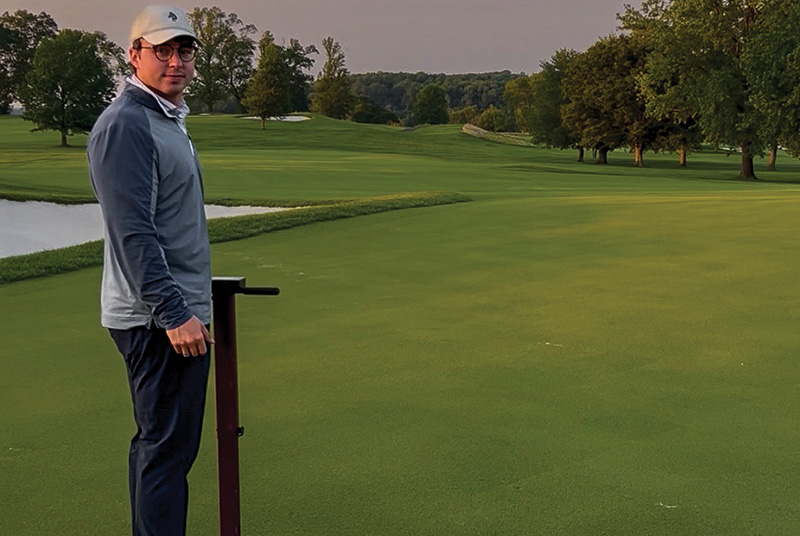
Tanner Hotchkiss is assistant superintendent at Philadelphia Country Club in Haverton, Pa. Photos courtesy of Tanner Hotchkiss
I got my start in golf course management at 18, between college semesters, as a seasonal la-borer at The Links at Hiawatha Landing in Apalachin, N.Y., an upscale public course tied closely to my family. My father once worked there, and it’s where my grandfather spent the years from 1994 until his passing in 2018.
Under the guidance of superintendent Tim Rose and Dennis, his assistant superintendent, I spent four seasons not just learning equipment and maintenance practices, but absorbing the values, discipline and pride that define the profession.
Their patience and willingness to teach allowed me to build a strong foundation, showing me early on how impactful committed mentorship can be in shaping both skills and confidence.
When life brought my wife and me to Philadelphia, I transitioned to the private club environment at Llanerch Country Club in the suburb of Haverton, Pa., under Brendan Byrne and his assistant team — Matt, Dan and A.J. With their encouragement, I realized this was more than a job; it was the career I wanted to pursue.
Once I shared that goal, they invested in my growth, giving me opportunities over three years to take ownership of irrigation repairs, plant protectant applications and daily course operations. After I advanced into the second assistant role, their trust and guidance pushed me to further my education and earn my Professional Golf Turf Management certificate at Rutgers University, where I have met more mentors and fantastic colleagues.
Yet despite that progress, I realized something essential was still missing: true, intentional mentorship. I understood how rare it can be in this industry, but I also knew it was exactly what I needed to take the next step in my career. When I saw an opening for an assistant superintendent at Philadelphia Country Club, during a full restoration and regrassing project, I sensed that this opportunity, and the mentorship I was seeking, might finally align.
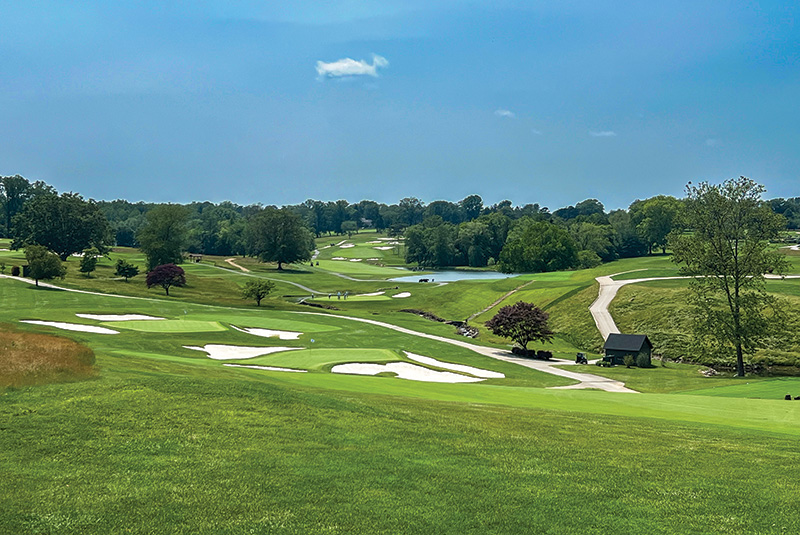
Hotchkiss describes the view looking down the 16th fairway in top photo as one of the course’s “most beautiful vistas.”
In golf course management, agronomic knowledge, problem-solving and attention to detail form the backbone of our daily work. The most defining factor in a superintendent’s career isn’t just what we learn; it’s also who we learn it from. For me, that person has been my mentor, Mike McNulty, a 40-year GCSAA member whose impact on my development at Philadelphia Country Club has shaped how I lead, how I think and how I hope to mentor others in the future.
From the beginning, Mike and I built a relationship rooted in trust. He gave me real autonomy — room to make decisions, explore ideas and find solutions through experience. He listened to every idea I brought for-ward, not just to evaluate it but to understand how I was thinking. It felt as if I was learning on an accelerated track, which is exactly what I had longed for.
Just as valuable were the moments when he corrected me, not with judgment, but with clarity and purpose. Those conversations kept me aligned with the standards of our property and our profession. They reminded me that mentorship isn’t about telling someone they’re right. It’s about preparing them to be responsible leaders who can make the right call when it matters most.
Mike entrusted me with responsibility in proportion to my ambition. He allowed me to take on as much as I was ready to handle, challenging me without overwhelming me. That balance taught me what truly earned confidence feels like and showed me how em-powering responsibility can be for someone still growing into their role.
How to pursue mentorship
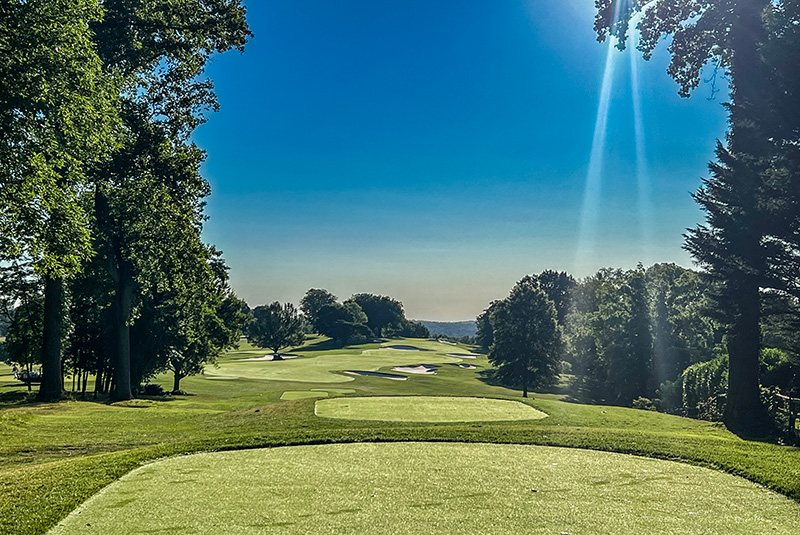
Here’s a look down the Philadelphia Country Club’s par-5 No. 3 hole, which served as the 18th hole for the 1939 U.S. Open. Hotchkiss offers this fun fact about No. 3: From the tee, all bunkers are visible, but from the green looking back to the tee, none are.
Experiences like this don’t happen by accident. They happen when both mentor and mentee are intentional. That’s why I believe our industry benefits when young professionals actively seek out the right kind of mentorship and when leaders create the conditions that allow people to thrive. Based on my journey, here’s what I believe others should pursue:
- Seek mentors who empower, not just instruct. Look for leaders who give you ownership, let you try new ideas and push you to think, not just execute.
- Bring your curiosity forward. The more ideas you share, even imperfect ones, the more your mentor can understand how you process challenges. Growth happens in those conversations.
- Be open to correction. A mentor who holds you to a high standard is investing in you. Feedback isn’t criticism. It’s refinement.
- Ask for responsibility instead of waiting to be given it. The more you’re willing to take on, the faster you grow. Responsibility builds confidence, vision and leadership instincts.
- Choose environments that match your ambition. Some clubs prioritize structure. Others prioritize development. Find a place where the culture matches the trajectory you want.
Mentorship is one of the most powerful forces in golf course management, not only in developing assistant superintendents, but for sustaining the future of our profession. I’ve been fortunate to experience that firsthand with Mike McNulty, and I hope this encourages others to seek out the kind of mentorship that challenges, supports and ultimately transforms them.
Tanner Hotchkiss is assistant superintendent at Philadelphia Country Club. He is a four-year GCSAA member.