Reel mower setup is one of the few maintenance decisions that has an immediate and visible impact on surface smoothness, ball roll, and turf stress. While height of cut often receives the most attention, the geometry of the cutting unit and the frequency of clip are just as influential in determining overall quality of cut.
In day-to-day operations, many cutting issues that are often blamed on turf conditions, weather or operator technique can be traced to the interaction between the reel, bedknife and clip rate. Small changes in blade count, reel speed or ground speed can significantly alter how grass is presented to the cutting edge, how cleanly it is sheared and how uniform the finished surface appears.
Field observations consistently show that reel mower performance is not strictly a mechanical concern but an agronomic one. Reel geometry establishes the cutting potential of the unit, while kinematic variables such as frequency of clip determine how that potential is expressed on the turf surface. When these elements are aligned, turf responds with improved uniformity and playability. When they are not, symptoms such as marcelling, streaking and premature component wear often follow.
Patrick Higdon is an assistant superintendent at at Deering Bay Yacht & Country Club in Coral Gables, Fla. and a student in turfgrass science at Penn State University. Photos courtesy of Patrick Higdon

This article is not intended to present formal research but rather to share applied observations informed by turfgrass literature and daily maintenance experience. The goal is to clarify how reel geometry, frequency of clip and bedknife setup work together and how understanding those relationships can help turf managers make practical, confident adjustments in the field (1, 2).
Reel geometry: What the cutting unit actually controls
At its core, a reel mower functions as a precision shearing system. Rotating helical blades pass over a stationary bedknife, creating a cut that cleanly severs leaf tissue. When the reel and bedknife are sharp and properly adjusted, this action reduces stress on the plant. However, even minor imperfections can translate into poor quality of cut and increased disease susceptibility.
Reel geometry defines how effectively this shearing action occurs. Factors such as blade count, helix angle and reel diameter establish the baseline capability of the cutting unit. These characteristics are largely fixed once a reel is selected and influence how aggressively the mower cuts, how often leaf tissue is contacted and how efficiently clippings are conveyed away from the cutting zone (1).
Blade count plays an important role in matching a cutting unit to its intended application. Lower blade counts are better suited for higher heights of cut and lower mowing frequencies where bulk clipping removal is required. Higher blade counts increase cutting frequency and are more appropriate for dense turf maintained at lower heights, such as putting greens, where surface smoothness and uniformity are prioritized (2).
While reel geometry establishes cutting potential, it does not guarantee quality results on its own. That potential is only realized when geometry is paired with appropriate operating parameters. This is where kinematic variables, most notably frequency of clip, become critical. Geometry defines what the cutting unit can do. Frequency of clip determines how that capability is expressed on the turf surface.
Frequency of clip: Where theory meets reality
Throughout this article, frequency of clip and clip rate are used interchangeably to describe the distance between successive shear points as the reel advances across the turf surface.
Unlike reel geometry, which is largely fixed, frequency of clip is a dynamic variable turf managers can adjust through reel speed and ground speed. Because of this flexibility, it is also one of the most commonly mismanaged aspects of reel mower setup.
In simple terms, frequency of clip determines how often leaf tissue is cut as the mower moves forward. Increasing reel speed or reducing ground speed tightens clip spacing, while decreasing reel speed or increasing ground speed lengthens it. These changes have a direct effect on surface smoothness, visual uniformity and ball roll consistency.
Setting proper clip-to-cut and reel-to-bedknife calibration can help an operator best match a cutting unit to its intended application.
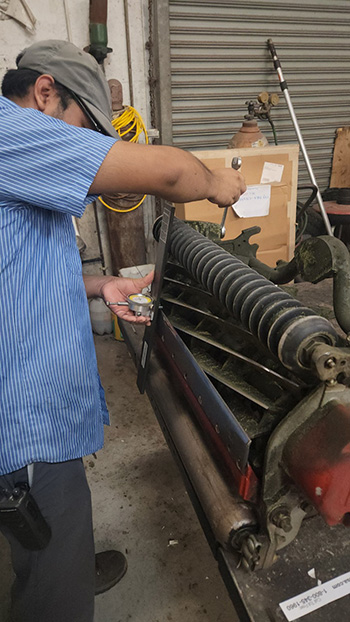
Field experience shows frequency of clip should approximate or fall below height of cut to achieve the best surface quality. When clip spacing exceeds height of cut, leaf blades are bent forward and severed less frequently, producing a wavy appearance commonly referred to as marcelling. Tightening clip rate supports the turf canopy more evenly and produces a smoother, more uniform playing surface (1, 6).
It is important to distinguish between the agronomic role of height of cut and the performance role of frequency of clip. Height of cut remains the primary driver of plant stress, carbohydrate reserves and overall turf health. Frequency of clip primarily affects surface aesthetics and playability. Adjusting clip rate cannot compensate for an excessively low height of cut, but it can significantly improve surface quality when used appropriately within a sound agronomic framework (2).
Mismanagement of frequency of clip often presents itself through recognizable visual symptoms. Marcelling patterns indicate a clip rate that’s too long for the current height of cut. Overlap marks and accelerated wear near reel edges suggest overly aggressive operating parameters. Recognizing these cues allows managers to make targeted adjustments before more serious issues develop.
Understanding frequency of clip as a controllable kinematic variable bridges the gap between cutting unit design and real-world performance. Reel geometry establishes potential. Frequency of clip determines how that potential is realized.
Bedknife setup and contact strategy
While reel geometry and frequency of clip often receive the most attention, bedknife setup plays an equally important role in determining quality of cut. The bedknife is responsible for presenting leaf tissue to the reel blades. Small changes in its position or adjustment can significantly influence cutting consistency and turf response.
Bedknife setup affects how grass is lifted and supported at the point of cut. A properly adjusted bedknife presents the leaf blade upright to the reel, allowing for a clean shearing action. If the bedknife is set too aggressively or unevenly, grass may be pushed forward or ruffled before being cut, resulting in a frayed appearance and reduced uniformity.
A common debate in reel mower setup is the choice between contact and no-contact adjustment. Contact settings provide consistent shearing across the width of the cutting unit and can compensate for minor imperfections in reel or bedknife geometry. This consistency comes at the cost of increased friction, accelerated wear and higher energy demand. No-contact settings reduce wear and extend component life but require tighter tolerances and more frequent verification to maintain consistent quality of cut (5).
Regardless of contact strategy, consistent clearance across the bedknife is essential. Uneven clearance can lead to streaking, missed cuts and localized turf stress. Simple field checks, like performing a paper test across the full width of the cutting unit, can effectively verify adjustment and identify issues before surface quality is affected.
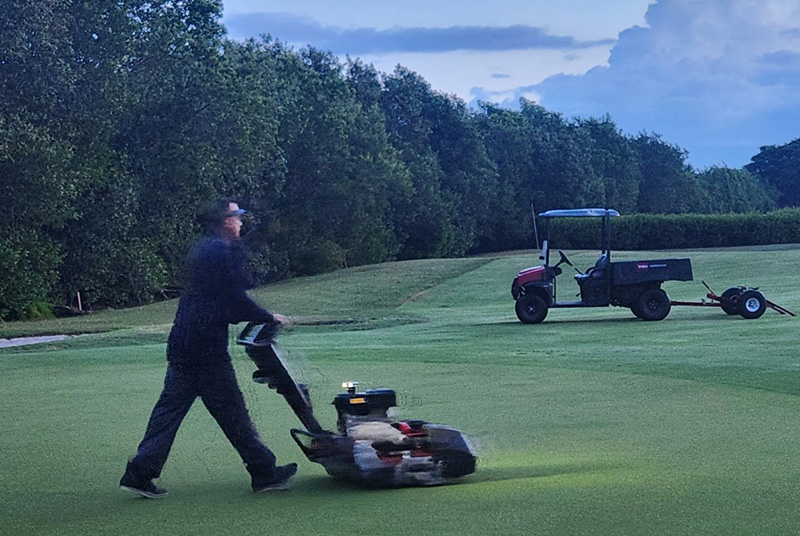
Greens mowing at dawn
Maintenance geometry and component longevity
Even the best reel geometry and bedknife setup will only perform as intended if cutting components are properly maintained. Maintenance geometry — particularly grinding practices and relief angle selection — directly affects quality of cut and component longevity. Decisions made in the shop often determine how field adjustments hold up over time.
Routine backlapping is commonly used to maintain sharp cutting edges and restore light contact between the reel and bedknife. While effective for polishing edges and extending service intervals, backlapping does not correct geometric wear or restore true cylindrical shape. Periodic full grinding remains necessary to reestablish proper reel geometry and consistent cutting performance (4).
Relief angle selection plays a key role in balancing durability and performance. Larger relief angles can extend the time between grinding cycles but may be more susceptible to impact damage in debris-prone environments. Smaller relief angles offer greater edge durability but typically require more frequent grinding to maintain sharpness and consistency.
Bedknife relief angles present similar tradeoffs. Aggressive relief may improve initial cutting performance but can shorten bedknife life under heavy use. More conservative relief angles tend to provide longer service life with slightly increased friction. Selecting appropriate relief angles should account for mowing frequency, turf density, debris load and available maintenance resources rather than relying on a single universal specification (3).
Effective maintenance geometry is not about maximizing sharpness at all costs. It is about maintaining cutting units within a stable operating window that supports consistent quality of cut while controlling labor, downtime and replacement costs.
Diagnosing quality of cut issues in the field
Quality of cut issues often become visible before they affect playability or turf health metrics. Accurate diagnosis allows turf managers to make targeted adjustments rather than relying on trial and error. Many common symptoms can be traced back to the interaction between reel geometry, frequency of clip, bedknife setup and maintenance condition.
Torn or frayed leaf tips are frequently associated with dull cutting edges or improper reel-to-bedknife adjustment. Addressing this issue typically requires sharpening or grinding rather than adjustment alone.
Marcelling patterns, characterized by a wavy or ribbed appearance, are commonly linked to excessive clip spacing relative to height of cut. Tightening clip rate through reel speed or ground speed adjustments often resolves this issue without altering height of cut.
Streaking across the mowing swath can indicate uneven reel-to-bedknife clearance or inconsistent bedknife wear. These symptoms are often more pronounced under no-contact settings when tolerances drift. Routine paper testing across the full width of the cutting unit can help identify problem areas.
Overlap marks and accelerated wear near reel edges may indicate overly aggressive operating parameters. Excessive reel speed, tight clip rates or extended contact settings can place additional stress on overlap zones. In these cases, small reductions in reel speed or adjustments to contact strategy may restore balance without sacrificing surface quality.
Effective diagnosis should follow a logical progression. Dynamic variables such as frequency of clip and ground speed should be evaluated first, followed by cutting unit adjustment and maintenance condition. Component replacement should be reserved for situations where geometric integrity can no longer be maintained through adjustment and grinding.
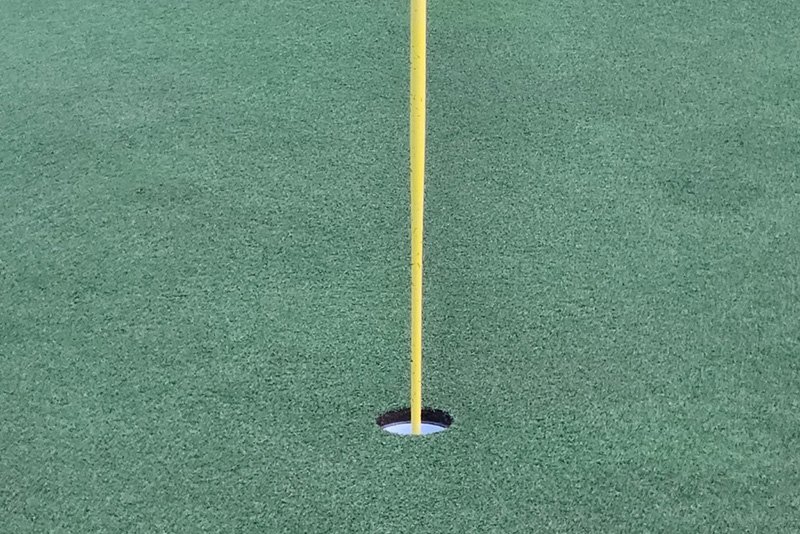
Closeup of a putting surface with a consistent quality of cut
Bringing geometry, kinematics and maintenance together
High-quality reel mower performance is rarely the result of a single adjustment. It is achieved through the integration of cutting unit geometry, operating parameters and maintenance practices working as a unified system. Reel geometry establishes potential. Frequency of clip determines expression. Bedknife setup and maintenance geometry sustain performance over time.
Understanding these relationships allows turf managers to move from reactive adjustments toward more intentional decision making. By matching reel design to turf intent, verifying effective height of cut, fine tuning frequency of clip and maintaining precise cutting geometry, managers can improve surface consistency while reducing unnecessary mechanical wear and labor demands.
Precision reel mower setup should be viewed as a core agronomic discipline rather than a purely mechanical task. When geometry, kinematics and maintenance are aligned, turf responds with improved uniformity, playability and resilience. These outcomes support daily presentation goals while protecting long-term turf health and operational efficiency.
Literature cited
- Beard, J. B. (2002). Turf Management for Golf Courses (2nd ed.). Ann Arbor Press.
- Christians, N. E., Patton, A. J., and Law, Q. D. (2017). Fundamentals of Turfgrass Management (5th ed.). Wiley.
- John Deere Golf. (2021). PrecisionCut reel mower setup and maintenance manual.
- Toro University Technical Services. (2020). Reel cutting unit fundamentals and adjustment guidelines.
- USGA Green Section. (2019). Reel mower setup for optimal turf performance. USGA Green Section Record, 57(12).
- USGA Green Section. (2022). Quality of cut. Measuring the invisible variable. USGA Green Section Record, 60(3).
Patrick Higdon is an assistant superintendent at Deering Bay Yacht & Country Club in Coral Gables, Fla., a student in turfgrass science at Penn State University and a three-year GCSAA member.