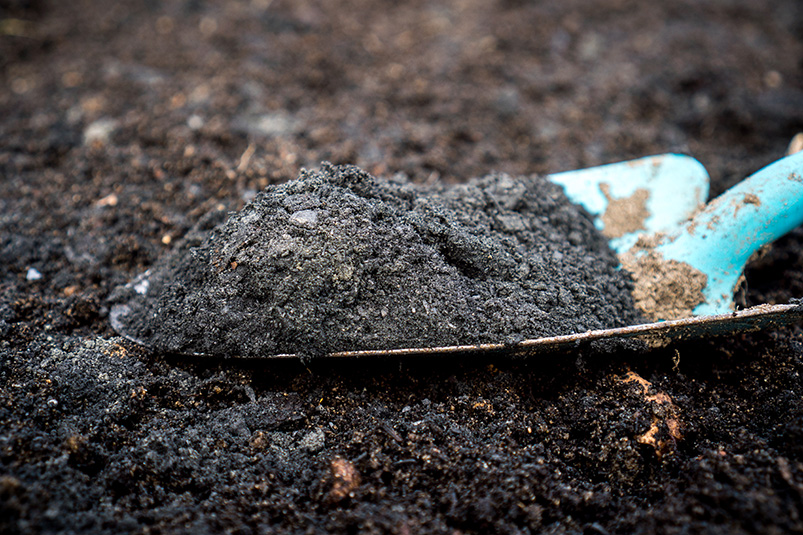
Root zone specifications for golf course greens consist mostly of sand to provide sufficient drainage and reduce compaction. Since sand is not very good with water or nutrient retention needed for turfgrasses, an organic amendment such as peat moss is added to increase those water- and nutrient-retention properties. Biochar is an organic amendment that has gained attention in recent years, particularly with carbon sequestration in soils.
What is biochar? Biochar is produced by heating biomass in a low- or no-oxygen environment. The biomass includes materials such as agricultural or forest waste, crop residues, wood chips, manures, organic and food waste, seaweed, construction debris and more. The heating process is called pyrolysis, which is the process of decomposing carbon-rich material at 570 to 1,650 F (300 to 900 C). The wood-fired pizza oven in my cousin’s restaurant operates from 750 to 900 F (400 to 485 C). Because there is no significant oxygen present during the pyrolysis reaction, the materials do not burn, and the intense heat breaks down the biomass. The result is a charcoal-like biochar.
With sand-based root zones, could biochar be a suitable alternative to peat moss? Researchers with the U.S. Dept. of Agriculture partnered with Dan Dinelli, golf course superintendent and 44-year GCSAA member in Illinois, to investigate this possibility.
Three products were evaluated: a commercially produced biochar; biochar produced from tree trunks (Paulownia tomentosa); and biochar made from grapevines (Vitis riparia). Calcareous sand meeting USGA specifications was used to assemble the root zones into large plastic tubes. The root zone mixes consisted of 100% sand, 1% biochar/99% sand, 5% biochar/95% sand, 10% biochar/90% sand and 15% peat/85% sand. Pure Distinction creeping bentgrass (Agrostis stoloniferous) was seeded onto each mix in a replicated and randomized experimental design. The turf was fertilized, irrigated and grown for five weeks, then the chemical and physical analysis of the root zones and also turf growth were evaluated.
What did the research reveal? The average bulk density of the root zones was considered similar: sand 104 pounds per cubic foot (1.66 grams per cubic centimeter), peat/sand 98 pounds per cubic foot (1.57 grams per cubic centimeter) and all biochars 94 pounds per cubic foot (1.51 grams per cubic centimeter). The average pH of root zones: sand 7.7, peat/sand 7.0, and all biochar-amended sand root zones ranged from 8.2-8.9. Sand root zones amended with biochar averaged 1%-4% higher compaction versus sand, but 2%-4% lower compaction versus peat/sand. Sand root zones amended with biochar averaged 9%-18% higher porosity compared to sand, and 1%-7% higher porosity compared to peat/sand.
With a root zone of 1% biochar/99% sand, water retention was similar compared to a 100% sand root zone. With root zones consisting of 5% biochar/95% sand or 10% biochar/90% sand, water retention averaged 37% to 237% higher compared to a 100% sand. With root zones of 1% biochar/99% sand, 5% biochar/95% sand or 10% biochar/90% sand, water retention ranged from 22% to 75% lower compared to peat/sand. Sand root zones amended with biochar averaged 41%-135% more nutrient retention compared to sand, and biochar-amended sand root zones averaged 15%-91% more nutrient retention compared to peat/sand.
Sand root zones amended with biochar averaged 20% more turf growth compared to a sand root zone. Sand amended with biochar averaged 65%-120% greater root length compared to sand alone. In this part of study, there was no comparison to a peat/sand root zone.
Biochar is considered a stable, carbon-rich form of charcoal. Soil health benefits reported include improving soil aeration due to its porous, sponge-like structure which provides an ideal habitat for beneficial soil microorganisms and carbon sequestration, improving nutrient retention and plant nutrient availability and also improving water retention. A potential advantage of using biochar instead of other organic amendments is its resistance to microbial decomposition and potential longevity in soil. Of note, biochar is also gaining attention for its potential as an ingredient within engineered materials, such as cement.
More research is needed to further explore the opportunities for biochar, which is something to think about the next time you’re enjoying a pizza fresh from the oven.
Source: Vaughn, S.F., F.D. Dinelli, B. Tisserat, N. Joshee, M.M. Vaughan and S.C. Peterson. 2015. Creeping bentgrass growth in sand-based root zones with or without biochar. Scientia Horticulturae 197:592-596.
Mike Fidanza, Ph.D., is a professor of plant and soil science in the Division of Science, Berks Campus, at Pennsylvania State University in Reading, Pa. He is a 25-year member of GCSAA.