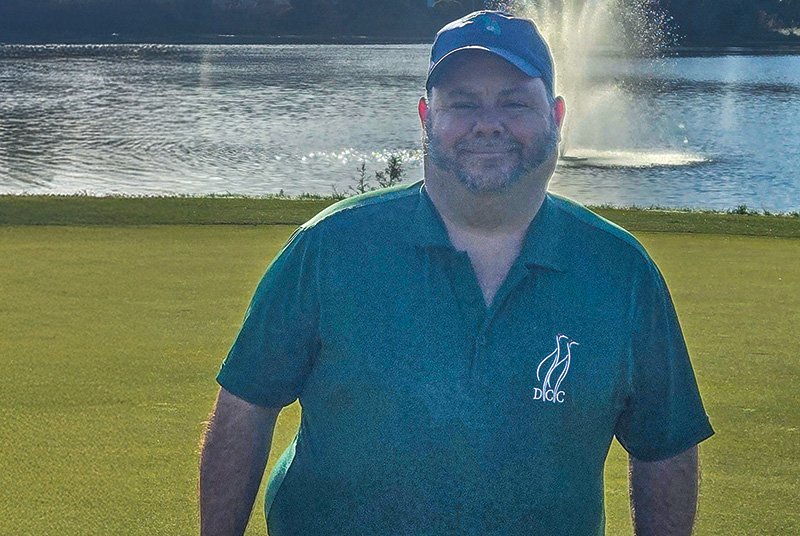
Christopher Zinna on the 18th green, with the course’s spring-fed irrigation lake in the background. Photos courtesy of Christopher Zinna
It’s crazy to think that one year ago my life was totally different. I was playing loads of golf, hitting the water in my boat, traveling and just enjoying the everyday life of being a golf course superintendent. With not a care in the world, I went about my days working and enjoying the endless Florida sunshine.
Then one Wednesday morning, things felt different. It was unusually warm for December in central Florida, and I was on an equipment run with my mechanic. Once at our destination, I was feeling a little woozy, a little off. I didn’t think much of it, but once we returned to the course, the feeling didn’t go away. Being a superintendent in Florida, I was no stranger to the feeling of dehydration, and that’s exactly what I was feeling. I decided I needed to drink some water and hydrate myself. I felt a little better and ate lunch at the clubhouse and finished the day. After I got home, I still didn’t feel right, so I drank more and more water. By the time dinner rolled around, I had made some spaghetti, and halfway through eating it, off to the bathroom I went, throwing up everything I just ate.
Something was definitely wrong, so I decided to take a shower and get myself ready for a trip to the emergency room. Once in the shower, I could not maintain my balance and stand up on my own. I grabbed a stool so I could sit down and finish. I was able to get dressed and call an Uber to get me to the ER, which was just five minutes down the road. As I was walking out to the Uber, I couldn’t help but lean to the right as I walked. Luckily, I was walking past my truck, as I couldn’t stand straight up, and I fell into my truck. I was able to get into the Uber and to the ER. My Uber driver saw me fall on my way to his car and had to help me into the ER, as I could not walk straight.
Once in the ER, they put me right into a wheelchair, as I couldn’t stand up, and they said they knew exactly what happened. They believed I had had a stroke. I was only 42 years old and rarely got sick. “How could this be,” I asked? They got me to a room and began taking my vitals. They were off the charts. Systolic blood pressure: 227, when it should be 120. Blood sugar: over 600 when it should be around 100. My cholesterol also tested crazy high. It was the trifecta, and I was lucky to catch it when I did to limit the damage, something that only happened because my assistant three years earlier was not as lucky.
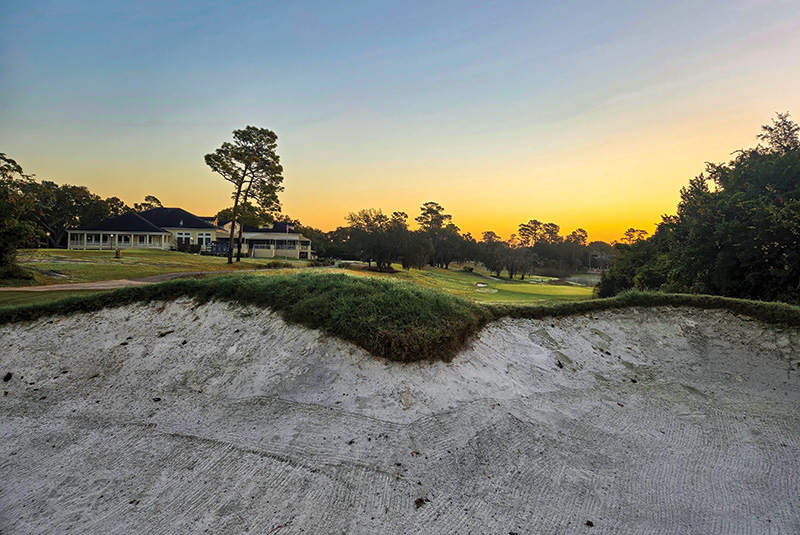
A view of the approach shot to the 18th green at DeBary (Fla.) Golf & Country Club, where Zinna serves as superintendent.
He had worked as my assistant for four years, never missing a day or even coming in late. Then one Monday morning, he no-called, no-showed, and after a couple of tries to get hold of him and getting nothing, I called his best friend, an industry salesman, to head over to his house, as I didn’t know where he lived. Upon getting to my assistant’s house, the salesman found him barely hanging on to life, lying in the middle of the floor, chicken nuggets burnt to a crisp in the oven. He had had a stroke. He lived by himself, and he had the preceding weekend off. We still don’t know when he had the stroke, since it could have happened any time during the weekend. He’s still working on regaining movement on his right side, and his speech is slowly coming back to where you can understand him. Unfortunately, he’ll never work again.
The thought of my assistant’s stroke went through my mind when I threw up the second time. That’s what I was scared of. If I went to bed, would I have woken up? I live alone. There’s nobody here to know that I’m hurting, just like my assistant. Even if it turned out to be nothing, I was going to the ER just to make sure.
I was quickly diagnosed with a stroke at the ER, but it wouldn’t be until five days of in-patient hospital action later that a battery of tests finally confirmed the culprit. Cat scan at the ER — negative. Ultrasound on the heart and neck — negative. CT scan with contrast — negative. They finally did an MRI, and it was the only test that proved that I’d had a stroke. The blood clot happened in the front-right side of the brain, and didn’t allow enough blood to get back to the cerebellum, which is where the stroke happened. The cerebellum controls movement and balance, and when a stroke happens there, it affects the same side of the body, which is why I was leaning and falling to the right.
The author on the 15th green.
Thanks to insulin and blood pressure medication, I was able to get things under control quickly, and I felt relatively well and woke up at 4:30 a.m. each day, texting a to-do list to my assistant. Five days later, I got out on a Sunday and was back at work the next day. Initially, the mornings were a little rocky. For the first half hour or so, the vision in my right eye would be kind of shaky and take a while to come around. As a precaution in that first week back, I only drove during daylight hours. Work-wise, my greatest obstacle was fatigue. I’m still dealing with it.
I am the king of naps. I’m taking a two- or three-hour nap every day after work. It’s not the mind. It’s my body telling me: Dude, you’re just not going to move.
As an avid golfer taking as much advantage of working in this industry as I could, I found my golf game didn’t come around as quickly as getting back to work had. I was a 2 handicap, and suddenly I couldn’t even swing a club. I would get to the top of my swing, and I would fall over. I had no balance. If I wasn’t swinging a club, then I was OK, so I didn’t even try to hit a golf ball for over a month.
My first round came at the 37th Annual Stuart Leventhal, CGCS, Turfgrass Research Tournament, a month after getting out of the hospital. I hit some good shots and some not-so-good shots, but it felt great getting out and playing the game that I love and being around other superintendents again. I had no clue what I put myself through for one round of golf. I woke up the next morning and felt fine, but my body wouldn’t move. I didn’t make it into work that day and couldn’t even get out of bed until late that afternoon. Lesson learned: Do not push it.
Three weeks later, I teed it up in the GCSAA National Championships in San Diego. I was the defending fourball champion, so I wanted to try to defend. I played in the fourball, then lined up for two more rounds in the national championship, both of which were cart-path only. That much golf and that much walking let me know I still had a way to go to get back to 100%. Part way through the final day of the championship, I had to withdraw when I hit a drive down the middle of the fairway but had no idea where it went. The previous hole, I stood over a putt and couldn’t see the putter or the golf ball. I could feel myself making a stroke, and when I stood up, I could focus on the golf course, but when I bent over, I couldn’t see the golf ball. I wasn’t going to push myself to finish this time.
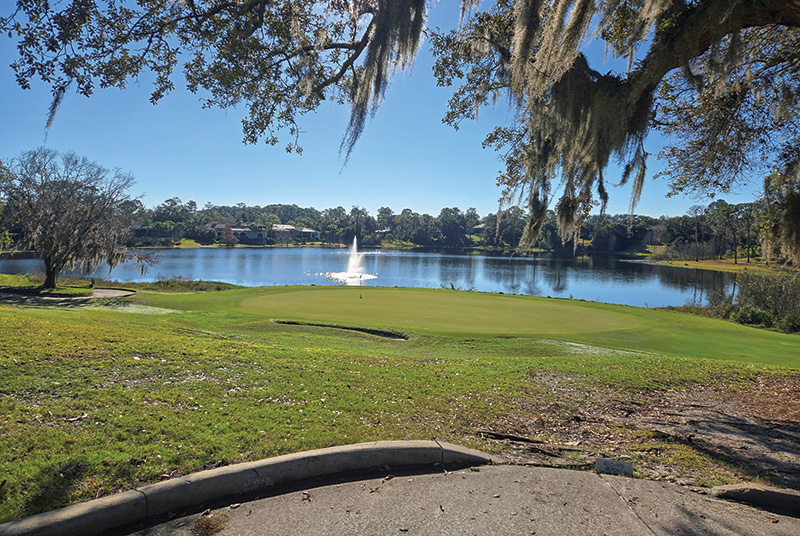
Another view of DeBary’s 18th green, this one from the cart path on the hill near the clubhouse.
Just over the one-year mark from my stroke, my biggest concern is for my peers and the men and women who work for them. The very nature of the work lends itself to scenarios that induce similar symptoms from a far-more-benign source, like dehydration and low/high blood sugar.
Those can happen often in our line of work because we’re outside so much. As superintendents, we’re on the go all day, and we forget to drink and forget to eat. All of a sudden, it’s the end of the day, and you realize you haven’t had anything to eat.
The doctors told me I should have come in when I first had the dizziness. But I didn’t think anything of it because I’d had that feeling before, the feeling of being dehydrated.
I’m pretty young to suffer a stroke. Most strike older people, especially those 65 and up, but the risk increases significantly each decade from the age of 45. I knew I was carrying more weight than is ideal and that my diet was also questionable — not so much because of what I ate but how I ate. Jumping from one task to the other, I too often skipped meals during the day, then I would get home and just binge eat. That’s not good.
Today, I am 20 pounds lighter, carrying protein bars around in my golf cart and making sure to eat more often but less at any one time. After being diagnosed with Type 2 diabetes during my hospital stay, I was put on all kinds of medicine. I also use insulin twice a day.
I thought for sure they would put me on the crazy weight-loss medication, too, but they didn’t want to lower my blood sugar too quickly because my body could go into shock. So, it’s taking a while, but I’m getting there. At my six-month checkup, I was taken off all the medicine except the insulin, which I still use.
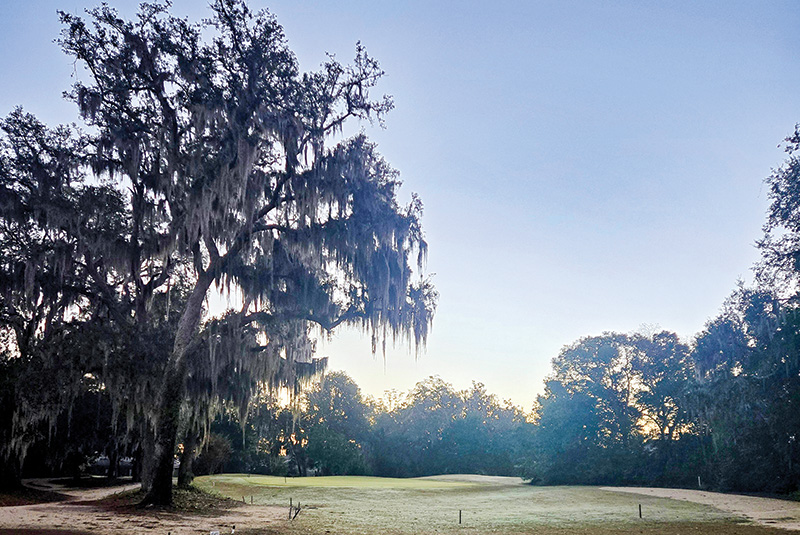
The approach shot to the 15th green and the limestone and oak tree that guard it.
The point of me talking about this is not to get pity. The point is to save somebody from a big stroke by catching it early. As superintendents, we’ll put up with not feeling the best, the scrapes and bruises, all day long. We’re bred that way and tend to ignore minor issues.
But I’m telling you, this hit me like a ton of bricks. Smacked me upside the face. Knocked me down. Who knows what would have happened if I’d just gone to bed that night? If my story can get one person to go to the hospital 10 hours earlier, then I feel like getting my story out there is a win.
I would be remiss if I didn’t mention my colleagues and friends in the industry. They definitely stepped up big time in my time of need. Without health insurance, I faced medical bills in the thousands. But help from the Florida GCSA, national GCSAA, the Central Florida (where I am now president), North Florida and Seven Rivers chapters ensured that my eventual out-of-pocket was manageable.
To all those who helped push me (and continue to push me) to get better and make a change, all I can say, and I say it from the bottom of my heart: Thank you!
Christopher Zinna is the GCSAA Class A golf course superintendent at DeBary (Fla.) Golf & Country Club and an 11-year association member.