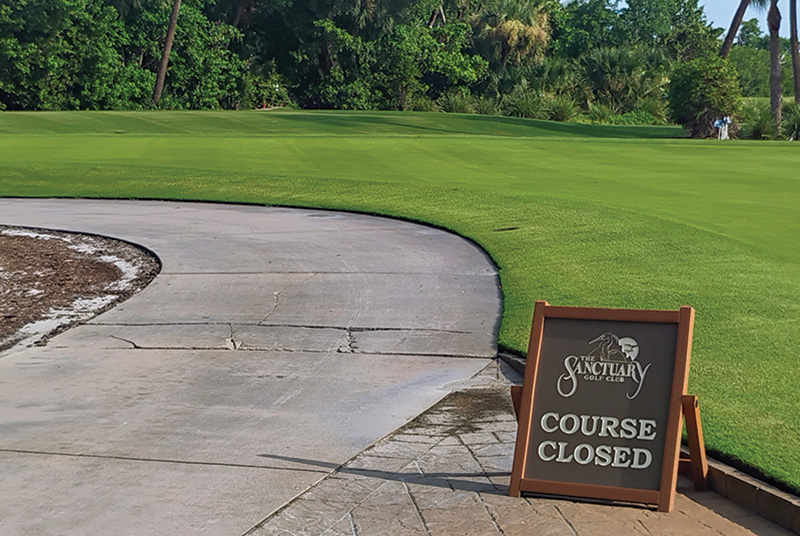
Like most courses, The Sanctuary in Sanibel Island, Fla., is loath to close for weather, but sometimes it’s a necessity. Photo by Josh Czarnecki
Over the 17 years I have written for GCM, I have covered many weather concerns for those who manage golf courses. One of the most important decisions to be made involves when to close a course.
There are several factors to consider.
Jennifer Torres, GCSAA Class A superintendent of Westlake Golf and Country Club in Jackson, N.J., a 20-year GCSAA member, likely spoke for most golf course managers, saying the safety of guests and staff was her No. 1 concern.
Troy Miller, principal of Miller Golf Design, noted another major concern: “Damage to a course (due to various weather conditions) can have lasting effects on playability and need for costly repairs.”
Kyle Sweet, CGCS, superintendent at The Sanctuary in Sanibel Island, Fla., and 35-year association member, added playability, “such as standing water in the way of typical play.”
Economic concerns are another issue, but as Miller pointed out, “The loss of business is less than capital costs of repairs,” that can happen as a result of extreme weather.
There are many weather conditions that can cause closings. Let’s explore them.
Winter weather
Depending on the location, winter weather — cold temperatures, snow and ice — can cause monthslong closings.
On one extreme, Settlers Bay Golf Course in southern Alaska (Wasilla) always closes the second Monday in October, according to Amos Stephens, GM/GCSAA Class A superintendent of golf course operations. Even if the weather is still benign, Stephens said the staff needs the time “due to extensive covers and sensors that we use to monitor greens in the winter.”
How bad does the weather get in that part of Alaska in the winter? Stephens, a 28-year GCSAA member, mentioned one storm last winter, when temps were in the minus-20 F range with 90 mph winds. “Opening in the spring is dependent on the weather and the snow melting away and the sensors letting us know the ground is thawed. We average opening April 20,” he said.
Nearly 4,000 miles to the southeast in southern Florida, Sweet doesn’t have to worry about winter weather. However, he added, “Golf operations are much slower on those colder mornings, so it can affect the bottom line.”
Between these two extremes is Marc Szablewski, GCSAA Class A superintendent at St. Andrews Golf Club in Overland Park, Kan. While St. Andrews doesn’t technically close for the winter, “If we have snow cover or ice, we will close the course until conditions improve,” says Szablewski, a 20-year association member. “Temperatures also play a part. We need to protect our patrons if it’s not safe. We go with 32 degrees. That is usually accompanied by some wind, which brings the temperature into a range unsafe for golfers.”
Farther north in Wisconsin, Lake Geneva Country Club closes after Thanksgiving and officially reopens in May, said GCSAA Class A superintendent Jeff Heaton, a 14-year GCSAA member.
Frost
Closing a course when there is visible frost on the turf is a common practice, and closing until the frost disappears certainly can affect early tee times. Szablewski said every spring and fall in Kansas, “We implement frost delays as needed to protect the turf from damage.”
Torres added that frost delays are common “in the shoulder seasons” in New Jersey.
According to turf specialist Dale Bremer, Ph.D., a Kansas State University professor emeritus of turfgrass science, horticulture and natural resources, “The exact mechanism isn’t well understood, but physical damage to the leaves from traffic undoubtedly causes physiological responses that result in visible stress to the turfgrass where golf carts drive, greens are rolled or people walk during frost.”
In some cases, the effects may seem temporary (for example, foot traffic), and some superintendents question whether the loss of revenue from closing a course during frost is worth it. There hasn’t been much research to investigate the causes or the long-term effects of traffic during frost.
But turfgrass researchers at Oregon State University are currently investigating and have found that traffic — especially cart traffic and rolling of greens — during frost can significantly reduce the overall health of greens and fairways. Damage from foot traffic during frost is not always observed, and its long-term effects are still being studied.
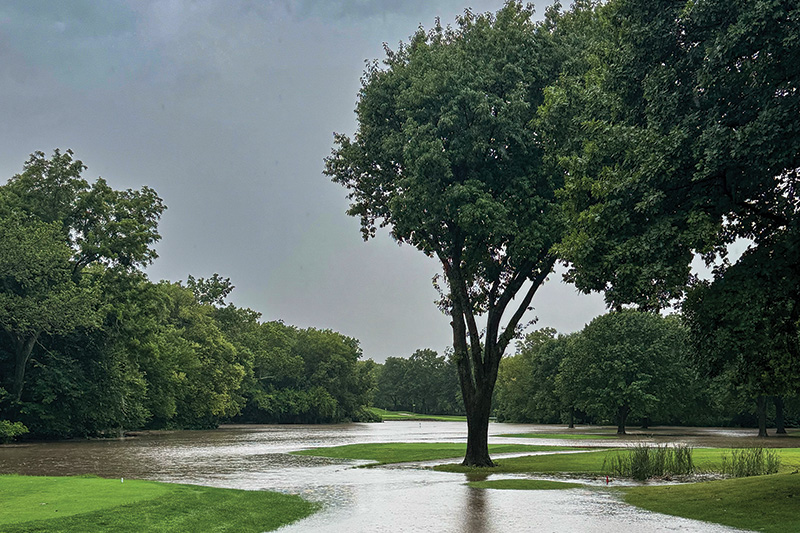
In northeast Kansas, torrential rain and resultant flooding can cause golf course shutdowns. Photos by Marc Szablewski
Heavy rain and flooding
Besides dissuading potential golfers, heavy rain can cause major issues. But Szablewski said in Kansas, he’ll only close if rain causes flooding on the course. “This past July, two storms closed the course for about half a day,” he says. “Our biggest problem is, we have a creek that runs through the property, and if water levels rise too high, we have to close.”
Being on an island, surrounded by the warm waters of the Gulf, Sweet has seen how thunderstorms and low-pressure systems can result in serious rain.
“They happen summer and winter, storms that can close us,” he said. “Due to having limited cart paths on the course, we are careful that carts don’t get out there when it’s too wet during the winter months and mark up the course. In the summer, there is much less play, so we may sometimes have the course open even if there are areas of standing water around drain basins.”
In New Jersey, Torres said the course will often close after heavy rain because of poor drainage, resulting in “ponding on a few greens, and many fairways look like rivers.” The development’s drainage flows into 22 ponds on the course and exits through drains that slow the water as it flows into wetlands.
Course construction, drainage and water management are particularly important to prevent problems caused by heavy rain, so the soil isn’t saturated ahead of these events. “The damage that can be done to the turf in soft, muddy conditions has long-lasting effects ... proper drainage can solve much of these issues,” Miller said.
Lightning
Of all the weather conditions, lightning poses the most direct risk. Forecasts will always mention chances for thunderstorms, and once developed, they can be tracked by radar.
To combat this threat, Jeff Jensen, GCSAA field staff representative in the Southwest Region, said most courses have a detection system that can provide advance warning when lightning is within a certain radius, which is usually 6 to 10 miles.
“That is usually followed by a siren or air horn to alert players that lightning is in the vicinity, and they need to stop play and find a designated shelter (usually clubhouse or a storm shelter on the course). They usually resume play 30 minutes after the last visual lightning strike or thunder is heard,” he said.
In Kansas, Szablewski clears the course if lightning is within 12 miles and moving toward St. Andrews, then waits 30 minutes after the last strike before allowing play to resume.
At Sweet’s course, the warning system sounds if lightning is detected within 5 miles, and in Wisconsin, Heaton’s system “blows a horn. Players are not required to stop play but encouraged to find shelter.”
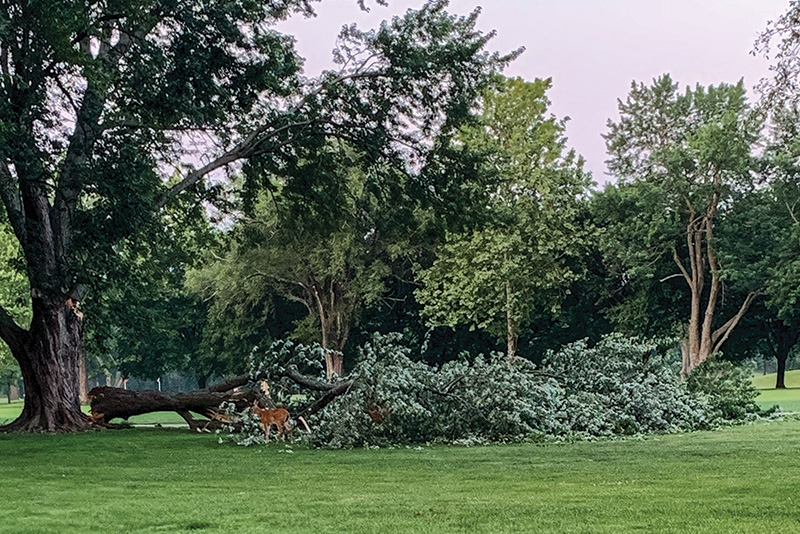
Strong winds can bring down parts (or even all) of a tree, threatening golfers and staff.
Wind
Strong winds can break limbs and bring down an entire tree, threatening golfers and staff and affecting the playability of a course.
In New Jersey, Torres said she has warned the club that dead trees pose issues, making it dangerous to play during high winds.
Heaton, in Wisconsin, thinks tree damage caused by strong winds should warrant a course closing. “But it is more difficult to make the membership believe that dangling tree limbs are extremely dangerous and could fall to the ground at any time,” he said.
Obviously, hurricanes produce sustained strong winds. Sweet dealt with Ian, a Category 5 hurricane that pummeled Sanibel Island in September 2022. “Winds took down too many trees to count,” he said. “Actually, more are falling and dying as we speak.”
And strong, non-tropical low-pressure areas can also bring wind threats. Stephens said with 90 mph winds last winter in Alaska, “We were fortunate this time to only lose trees. We have had issues in the past where buildings froze up due to power outages.
“The fall is starting to see some of these storms,” he said. “It’s much worse with the fall, which is usually wet, and the winds just uproot trees.”
Heat
None of the course managers who responded said they had closed because of extreme heat. Instead, they let golfers determine their own vulnerability.
Heaton, in Wisconsin, said he “definitely” doesn’t close due to heat. “Usually busy before 11 a.m., and then things slow down a lot in the afternoons,” he says, “but they don’t close.”
But Szablewski pointed out that intense heat puts staff in difficult working conditions. It also affects turf, and Szablewski said high humidity, combined with extreme heat, is “the No. 1 weather concern we deal with” as a whole in northeast Kansas. “Extreme heat indexes can cause a rapid decline in turf health,” he says.
Bremer explained that “when it is that hot, the turfgrass is already under heat stress (especially cool-season turfgrasses). Because the turfgrass is already under heat stress, it is more susceptible to other forms of stress, such as foot or cart traffic and divots, which can cause wear in the turfgrass shoots (bruising and crushing injury to leaves, stems, crowns). Traffic can also compact the soil, which adds stress to the (already heat-stressed) roots.”
Tidal flooding
For golf courses on or near the coast, tidal flooding can be an issue. This can occur directly from the ocean or from a nearby river that empties into the sea. Tidal flooding can be expected with coastal storms, tropical or winter storms and even those not that close.
During Hurricane Ian in 2022, Sweet said, the course was affected by a storm surge for the first time in over 50 years, with some low areas under several feet of water. However, high mounds and elevated greens weren’t affected.
Sweet added that salt spray did hurt the turf, even the seashore paspalum. “Greens that went under water were greatly affected but recovered well, once provided with heavy watering, small tine aeration, etc.,” Sweet says.
Recovering from Hurricane Ian forced the course to close for several months. “This was the longest we’ve been closed, from Sept. 28, 2022, until Jan. 3, 2023,” Sweet said. After a massive amount of work and repairs, he added that the course opened “to a very happy, thankful membership that thought that we may not even have a season that year.”
A growing problem in recent years has been “fair-weather flooding,” not with a storm but with seasonal “king tides.” Miller was called to help with this problem at the Charleston (S.C.) Municipal Golf Course.
“Pre-renovation, king tides would inundate the fairways along the Stono River. It would cover over several holes, as much as 6 feet deep,” he said. “Renovations, including elevating parts of the course and improving drainage, have solved most of these problems.”
Wildfires
Although wildfires are generally a less common threat, in some regions, the danger is real, and consequences can be devastating. Drought is a typical precursor, but strong, dry winds can create the highest peril. These “red flag” conditions are typically well forecast.
The Eaton Canyon Golf Course in Altadena, Calif., was ravaged by a wildfire in January 2025, losing all of its buildings. But general manager Johnny Eusebio said that other than some wind damage to trees before the fire, the course itself was intact.
Eusebio added, “There was no advance warning.” However, even if there had been a sufficient warning, Eusebio didn’t think he could have done much before the devastating fires hit. “Not at all. It was a freak of nature,” he said.
Fog
One of the most innocuous weather situations that can perplex golf course managers is fog.
Dense fog lowers visibility considerably, and it can become difficult, if not impossible, to follow the flight of a ball. Of even more concern is the ability to see others on the course, making this a safety issue. Fog develops typically in the early morning but can also move in anytime in some locales.
Torres remembered having a fog delay at the 2017 U.S. Open qualifiers at Makefield Highlands Golf Club in Yardley, Pa. “Safety for all was key,” she said.
Ed Brotak, Ph.D., was a longtime professor of atmospheric sciences at the University of North Carolina, Asheville.