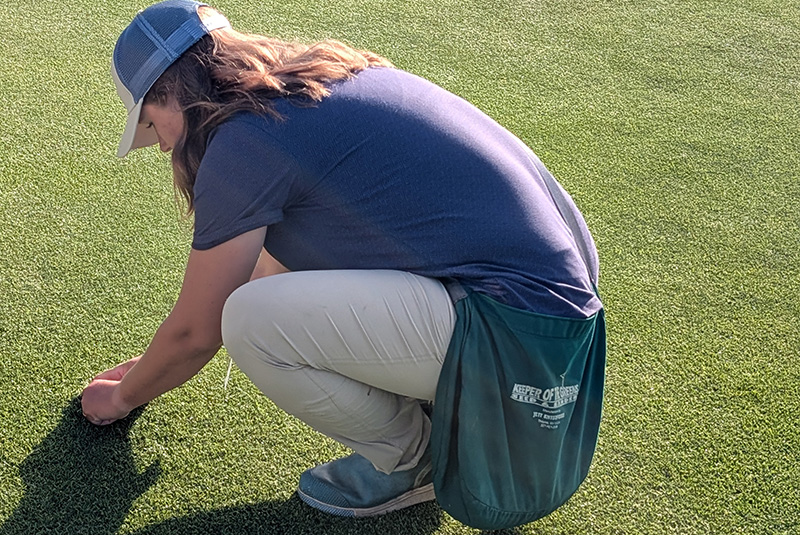
Amy Bultena, second assistant at St George’s Golf & Country Club in Etobicoke, Ontario, Canada, and five-year GCSAA member, cuts turf around a sprinkler head during prep for the U.S. Women’s Open at Riviera Country Club. Photos by Abby Olcese
As preparations for the U.S. Women’s Open continue, the turf at Riviera Country Club is getting good reviews from players.
“It's in pristine condition,” says Nelly Korda, currently the top-ranked player in the Rolex Women's Rankings. “Obviously the men rave about it every year, and for us to get to play this golf course in a major championship, in major championship conditions has … it's already in absolute great condition.”
One element that’s already grabbing attention is the club’s kikuyugrass turf. Being the aggressive grower that it is, it’s made the roughs … well, rough.
“The kikuyu rough is just different than everywhere else,” Jeeno Thitikul, currently ranked second in the Rolex Rankings, says.
The history of East African native kikuyugrass at Riviera goes back to 1934, when it was planted on the club’s famous barrancas that run along the eastern and southeastern parts of the course. Considered a weed in many parts of the world, it’s a common sight at golf courses in California because of its suitability to the climate and its ability to stand up to play.
“The story I was always kind of told is because of its wear tolerance and recovery ability, it used to be on polo fields,” Marshall Dick, Riviera’s superintendent and six-year GCSAA member, says. “That’s what makes it a great sports turf when maintained properly.”
Dick’s own history with Riviera’s kikuyugrass predates his own time in the profession, when he was touring the course as a college student. Even then, it made an impression.
“There’s a fence on the other side of 13, and I remember there was a fencepost way off to the perimeter with a full tuft of grass growing out of the top of the post,” Dick says, still a little in awe even all these years later. “You could see, there was a stolon that was growing out of the entire post.”
Since then, Dick has learned that tough turf requires a strong hand to keep it in line. “Due to the fact that it’s aggressive, your mechanical practices are aggressive too,” he says. “Once you get to know the grass it’s less challenging, it’s just different. Not any more or less challenging than growing any other sports turf, it’s just very different.”
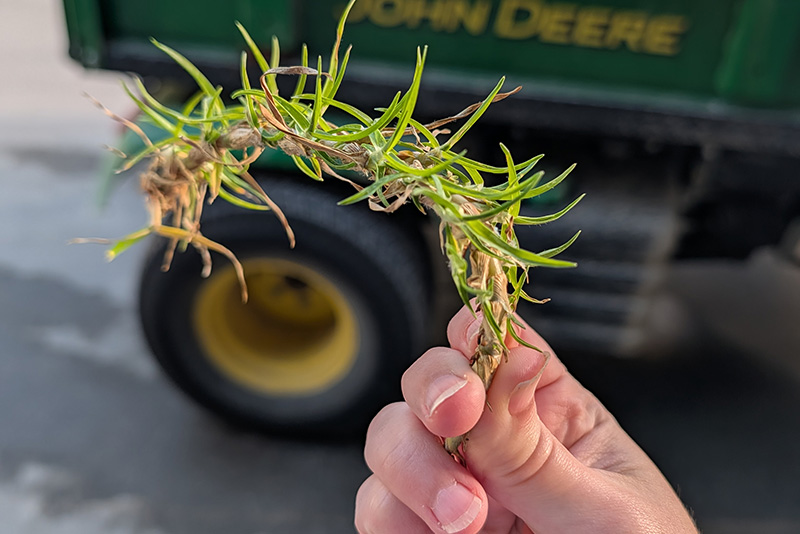
A kikuyugrass stolon.
That difference has been a topic of conversation among volunteers, several of whom are more accustomed to working with cool-season grasses.
“It’s very spongy. The rough is kind of quicksand-grabby and thicker,” Hannah Orr, director of agronomy at Shadow Ridge Country Club in Omaha, Neb., and 12-year GCSAA member, says. Orr says this is her first experience with kikuyugrass. “Bentgrass and bluegrass are very soft, so this is really different.”
The strategy for Dick and the crew at Riviera has been getting kikuyu’s natural toughness to work in their favor. “That’s kind of how it is, so why fight it? Why not make it work for us and make it the best it can be?” Dick says. “Come to find out it can actually be pretty great.”
That certainly seems to be a shared perspective from a player standpoint. Korda says the turf at Riviera presents a challenge worthy of the Women’s Open.
“I would say major championships should always test every part of your game when it comes to hitting the fairway being a key, growing out the rough, distance, the firmness and the speed of the greens,” Korda says. “From what I saw yesterday, it checks all the boxes for sure.”
Abby Olcese is GCMOnline's editor