
Photo courtesy of USGA
Afternoon data tells the rest of the story
Most putting green performance data is collected in the morning when the greens have been mowed and/or rolled and conditions are relatively consistent. Morning data gives superintendents a clean baseline to track the effects of inputs and helps guide daily decision-making. It gives us answers to questions like: How much speed is gained by lowering the height of cut by 0.005 inch? What effect does an extra roll have on smoothness? But morning data doesn’t tell the whole story.
Other than the regular early birds, most golfers do not play immediately after morning maintenance. On busy days, many rounds happen hours after the first data points are collected. By then, the putting surfaces may be different. Greens dry down at different rates, influencing firmness. Foot traffic can affect ball roll. Growth can reduce speed. The differences between morning numbers and afternoon numbers can be significant, and that change may explain the product golfers experience later in the day.
That is why both morning and afternoon data have value. Morning data is the standard reference point. It helps superintendents compare one day to the next, evaluate maintenance practices, identify trends and show how inputs manipulate data points. Afternoon data adds context. It shows how conditions hold up through traffic, weather, shade and growth over the course of the day. The goal is not to chase perfect numbers all day long. That is unrealistic and could lead to over-maintenance. Afternoon measurements help superintendents understand the range of conditions golfers receive. If afternoon speed is dropping too rapidly and clipping yield is high, maybe changes to the plant growth regulator program or mowing practices need to be made. If shaded areas tend to play softer throughout the day, that may support tree-management conversations or changes to hand-watering practices on those greens. If smoothness declines quickly, traffic volume and surface health and recovery come to the forefront.
Data is most useful when it reflects reality. Morning numbers are important, but they are only one chapter. Afternoon measurements help complete the story and give superintendents a better understanding of the playing product from the first tee time to the last. This information can also provide useful context when courses receive a rogue 5 p.m. complaint about how the greens are playing. For help establishing an afternoon data collection routine, reach out to your regional USGA agronomist (https://bit.ly/3QM5XDU).
— Ross Niewola (rniewola@usga.org), USGA agronomist, west region, Portland, Ore., and 10-year GCSAA member
Balihar Kaur/photo by Darrell J. Pehr
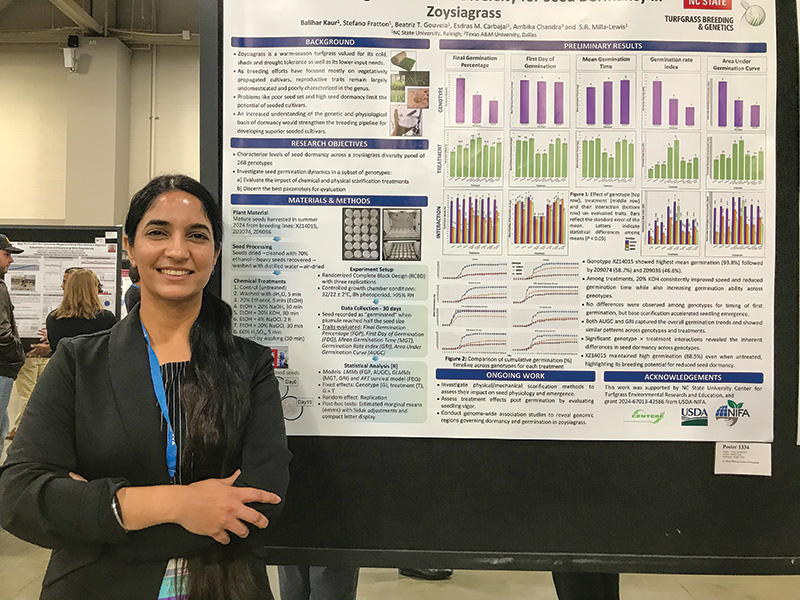
Evaluating ranges of genetic diversity for seed dormancy in zoysiagrass
Zoysiagrass is one of the most economically important warm-season turfgrass species in the United States due to its moderate drought and shade tolerances, low fertility requirements, tolerance to weed encroachment and reduced maintenance needs. Seeded cultivars are preferred by the industry because of their cost as well as storage and transport advantages. However, problems like low germination rates and high levels of seed dormancy pose a challenge in successful establishment of zoysiagrass stands. The objective of this study was to evaluate different chemical scarification treatments for their ability to break seed dormancy in different zoysiagrass genotypes. For this purpose, mature seeds of breeding lines XZ14015, Z09074 and Z09036 were treated with ethanol, sulfuric acid, potassium hydroxide, sodium hydroxide and sodium hypochlorite alongside non-treated controls. The experiment was conducted for 30 days under growth chamber conditions (89.6/71.6 F, 32/22 C day/night with eight-hour photoperiod and >95% relative humidity). Final germination percentage, first day of germination, mean germination time, germination rate index and area under germination curve were calculated to capture differences in speed and uniformity of dormancy release.
Results revealed that germination behavior varied across genotypes as well as treatments. Line XZ14015 showed high germination rates across all treatments, including the non-treated control, suggesting inherent reduced dormancy. Meanwhile, improvement in germination response of lines Z09074 and Z09036 was treatment dependent. On average, KOH and NaOH showed highest improvement in germination of Z09074 (by 41.4%) and Z09036 (by 57.2%) respectively, compared to the control, while also revealing genotype-specific sensitivity to chemical treatments. These findings provide insight into dormancy variation among genotypes as well as treatments. Selection of genotypes with lower seed dormancy along with the identification of effective scarification methods can ultimately aid in breeding improved seeded zoysiagrass cultivars.
— Balihar Kaur (bkaur2@ncsu.edu); Stefano Fratton; Beatriz T. Gouveia, Ph.D.; Esdras Manuel Carbajal Melgar, Ph.D.; Ambika Chandra, Ph.D.; and Susana R. Milla-Lewis, Ph.D.; North Carolina State University, Raleigh
Darrell J. Pehr (dpehr@gcsaa.org) is GCM’s science editor.