Water is a challenge for most, if not all, golf course superintendents, whether it is too little water or even too much. Seldom is the optimal amount of water distributed across the golf course, and extremes like drought or storms can greatly impact how water affects turfgrass.
Several educational sessions and Interactive Facility Tours at this year’s GCSAA Conference and Trade Show included discussions about water conservation, and water moisture measurement techniques were even part of the field test portion of the Florida Turfgrass Science Invitational, which was hosted by GCSAA during the conference.
One educational session, “Practical strategies for golf course irrigation and water conservation,” was presented by experts who gave detailed advice to superintendents. Ross Niewola, CGCS, USGA agronomist in the West Region, and Matteo Serena, Ph.D., senior manager, Irrigation Research and Services for USGA, provided practical tips.
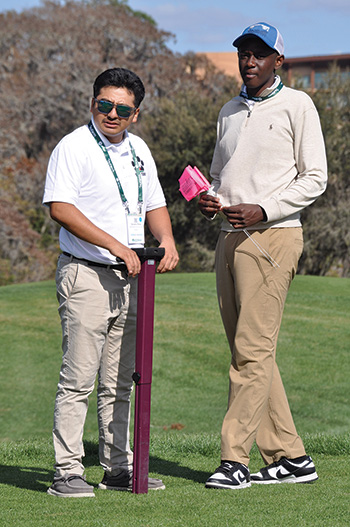
Giovanni Perez, left, and Joshua Sejour, members of the Florida Turfgrass Science Invitational first-place team, handle a soil moisture meter during the competition Feb. 4. Water conservation was a topic that ran throughout the recent GCSAA Conference and Trade Show. Photo by Darrell J. Pehr
Niewola, who visits about 150 golf courses each year across the western U.S. and Canada, suggested superintendents begin by gathering data about their courses and analyzing the data to make decisions about more efficient and precise irrigation. He gave an overview of the tools to gather data, including soil moisture sensors; optical/visual wavelength detection using drones and other methods; and soil analysis.
Niewola recommended superintendents consider leasing or outsourcing drone use since the technology rapidly changes, and drones can quickly become obsolete.
In addition to working with a regional agronomist, an important way to assess ways to gather data is to reach out to other superintendents in your area, Niewola said.
“I highly recommend you use your own regional network,” he said. “What are the guys right down the road from you using? Because that’s going to be one of the best reviews of what’s actually working.”
Regarding soil analysis, Niewola outlined moisture retention, drainage/salinity, infiltration, percolation, porosity and compaction.
“We want to know exactly what’s going on in the soil before we look at anything else,” he said. One aspect of soil analysis — organic matter testing — is so important that the USGA made it a special focus over the past five years.
“We now have a uniform organic matter testing method across the entire world,” he said.
Serena discussed irrigation efficiency and scheduling, especially during drought. With a prediction of a warmer and drier climate, especially in the West, Serena urged superintendents to develop a strategy for managing the change. Beginning with fundamental irrigation stewardship, such as looking at irrigation system use and maintenance, turf management and turf quality expectations, superintendents can then begin to focus on advanced irrigation techniques and conservation, including precision irrigation, introduction of drought-resilient strategies and even reduction of irrigated acreage.
“We need to look at how these different grasses are going to perform in drought,” he said. Working to predispose grass to drought can include steps as simple as changing the irrigation schedule to fewer days per week, helping grass develop more robust roots.
In addition, big-picture topics such as alternative water sources and possible surface water contamination need to be explored.
Serena said a survey showed only 11% of golf courses had performed a recent audit of their irrigation system, although such audits are crucial to determine problem areas.
One recommendation Serena gave was to correct obvious problems before conducting an audit. Dealing with problems like sunken heads, clogged nozzles and broken sprinklers should be handled first to reduce the number of variables when analyzing the system.
In addition to an audit, Serena recommended mapping the soil to determine moisture, compaction and salinity; using computer models for sprinkler placement and nozzle size; and investigating conditions to improve irrigation scheduling by measuring evapotranspiration and other steps.
Both speakers outlined case studies and examples at golf courses in the effort to more efficiently manage water. While there are many tools and strategies to consider, they noted, one of the most important steps is to be sure each golf course is getting started or improving current efforts to “move the needle” when it comes to robust irrigation and water management.
Darrell J. Pehr is GCM’s science editor.