
Aman Jakhar. Photos by Darrell J. Pehr
Optimizing methiozolin strategies for goosegrass control in turf
Goosegrass (Eleusine indica) and smooth crabgrass (Digitaria ischaemum) are among the most troublesome weeds near golf greens due to limited postemergence herbicide options and turfgrass sensitivity. Methiozolin offers a novel mode of action and good turfgrass safety but degrades rapidly in soil, limiting residual control (Peppers et al. 2025). Previous studies indicate that combining methiozolin with bensulide and/or oxadiazon may improve control and extend activity. This study evaluated whether sequential applications of methiozolin following bensulide or bensulide + oxadiazon influence smooth crabgrass and goosegrass control and turfgrass injury on Kentucky bluegrass and creeping bentgrass. Field experiments were conducted at two sites in Blacksburg, Va., arranged in a factorial randomized complete block design with two preemergence (PRE) herbicides and two postemergence (POST) methiozolin levels, replicated four times. PRE herbicides were applied April 29, 2025, and methiozolin was applied five times at two-week intervals starting June 10, 2025. Turf injury and weed cover were visually rated on a 0%-100% scale.
No visible injury occurred on either turf species. For two months, bensulide + oxadiazon controlled smooth crabgrass greater than 85%, comparable to other treatments, but declined to below 20% by 16 weeks when used alone. Sequential methiozolin increased smooth crabgrass control to 90%. Bensulide + oxadiazon, followed by methiozolin, controlled goosegrass 93% at 16 weeks after treatment, outperforming all other treatments. Bensulide alone provided poor goosegrass control, but sequential methiozolin improved control to 36%. Overall, combinations or sequences of bensulide, oxadiazon and methiozolin provided effective weed control and excellent turfgrass safety. Sequential methiozolin improved smooth crabgrass control following bensulide + oxadiazon and enhanced goosegrass control when applied after either herbicide.
— Aman Jakhar (ajakhar@vt.edu); Shawn D. Askew, Ph.D.; and Suzannah Hale, Ph.D.; Virginia Tech, Blacksburg; and Daewon Koo, Ph.D., Moghu USA, Dallas
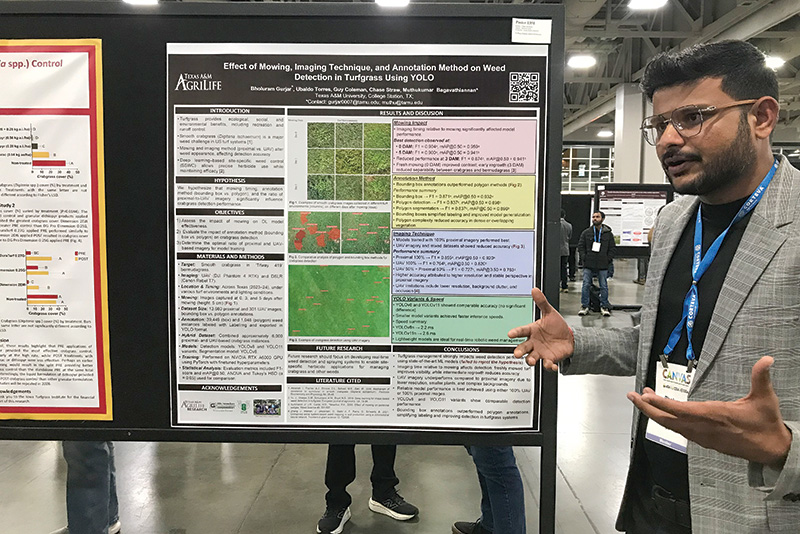
Bholuram Gurjar, Ph.D.
Effect of mowing, imaging technique, annotation method on weed detection in turfgrass using YOLO
Smooth crabgrass (Digitaria ischaemum) is a problematic weed in turfgrass systems, posing significant challenges to turfgrass functionality and aesthetics while competing for essential resources. Herbicides are the most common method of weed control in turfgrass; however, injudicious use of herbicides may cause ecological and environmental issues. Advances in computer vision and deep learning models show great promise for addressing some of these issues through targeted, site-specific weed control (SSWC). Yet, the interactions of these models and their hyperparameters with field practices and plant biology are poorly understood. This study evaluates the effect of mowing on detecting crabgrass in bermudagrass turf using YOLOv8 and YOLO11 models, with images collected at the ground-level (proximal) or using an unmanned aerial vehicle (UAV).
We find that freshly mowed turfgrass did not affect the weed detection accuracy, but intermediate regrowth phases reduced model performance. With respect to annotation methods, bounding box annotations outperformed polygon annotations in detecting smooth crabgrass, achieving high F1-scores (0.87) and mAP@0.50 values (0.93), indicating that simplified bounding box annotations are sufficient for this application. The highest precision, recall and mAP were recorded for YOLO11s (0.806), YOLOv8l (0.766) and YOLO11l (0.795), respectively. Further, smaller variants like YOLOv8n (2.2 ms) and YOLO11 (2.6 ms) demonstrated superior inference speeds, making them well-suited for real-time detection and robotic weed management. Moreover, the models trained using 100% proximal imagery significantly outperformed those that utilized 100% UAV imagery and mixed datasets, achieving the highest F1-score (0.85) and mAP@0.50 (0.92) values. The lower detection accuracies with the UAV imagery could be attributed to lower spatial resolution, background complexity and scale variation.
Overall, this research underscores the critical role of selecting appropriate imaging techniques and annotation methods, as well as understanding the impact of field practices like mowing on the efficacy of weed detection in turfgrass environments.
— Bholuram Gurjar, Ph.D. (gurjar0007@tamu.edu); Ubaldo Torres, Ph.D.; and Muthukumar Bagavathiannan, Ph.D.; Texas A&M University, College Station; Guy Coleman, University of Sydney, Australia; and Chase Straw, Ph.D., Pennsylvania State University, University Park
Darrell J. Pehr (dpehr@gcsaa.org) is GCM’s science editor.