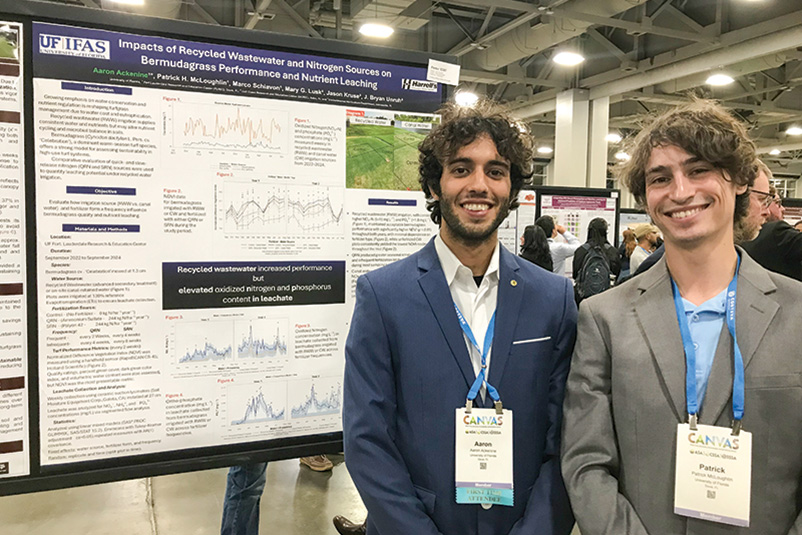
Aaron Ackenine and Patrick McLoughlin Photos by Darrell J. Pehr
Impacts of recycled wastewater and nitrogen sources on bermudagrass performance and nutrient leaching
Rapid population growth and periodic drought have increased both the necessity and accessibility of recycled wastewater (RWW) for landscape irrigation across southern Florida. RWW contains nitrogen and phosphorus that may supplement turf nutrient demand but can also influence nutrient leaching dynamics in sandy soils. A two-year field trial at the University of Florida Fort Lauderdale Research and Education Center (FLREC) evaluated the effects of RWW irrigation and fertilizer source on the performance and nutrient leaching of Celebration bermudagrass (Cynodon dactylon L. Pers.). Plots were irrigated with either on-site canal water (CW) or RWW and received no fertilizer or 218 pounds nitrogen per acre per year (244 kilograms nitrogen per hectare per year) applied as quick-release ammonium sulfate (21-0-0) or a 65% controlled-release polymer-coated urea (42-0-0) at two application frequencies. Visual quality, normalized difference vegetation index (NDVI), dark-green color index, percent cover and volumetric water content were recorded bi-weekly. Weekly leachate from 10.63-inch (27-centimeter) suction lysimeters was analyzed for oxidized nitrogen (NOx-N), nitrite (NO₂-), ammonium (NH₄+) and ortho-phosphate (PO₄³-).
RWW irrigation increased turf quality on more than 70% of rating dates and produced NDVI and color values comparable to and often exceeding fertilized CW treatments, demonstrating the nutrient contribution of reclaimed water. Across both years, RWW elevated mean leachate NOx–N concentrations two- to three-fold and was the sole source of detectable PO₄³-–P. Quick-release N produced NOx–N spikes following application, while controlled-release fertilizer observed less spikes but did not eliminate nitrate losses. Phosphorus leaching was largely irrigation-driven rather than fertilizer-driven, with unfertilized RWW plots having the highest PO₄³- content in leachate and in soil nutrient data. Findings indicate that RWW quality governs nutrient export and can sustain acceptable bermudagrass performance without additional fertilization under high irrigation volumes. Ongoing work should assess nutrient fate under deficit-irrigation conditions more representative of managed turf systems.
— Aaron Ackenine (aaronackenine@me.com), Patrick McLoughlin (patmcl48@gmail.com) and Marco Schiavon, Ph.D., University of Florida, Davie
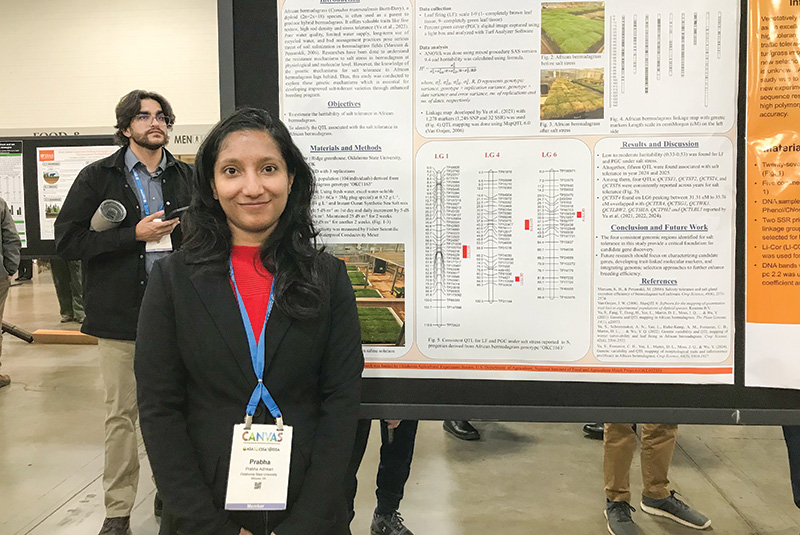
Prabha Adhikari
Detection of QTL associated with salinity tolerance in African bermudagrass
African bermudagrass (Cynodon transvaleensis Burtt-Davy) possesses fine texture, slender stolons and dense canopy, which are favorable attributes to the turf industry. In breeding programs, African bermudagrass is often used as a parent to produce hybrid bermudagrass (C. dactylon × C. transvaalensis). Due to the use of non-potable water for irrigation, salinity stress has been one of the growing concerns in the turf industry. Sufficient variation was reported for salinity tolerance among the bermudagrass species in previous studies; however, information regarding the molecular basis of salinity tolerance is limited. In this study, we aim to identify the genetic region associated with salinity tolerance in African bermudagrass using the developed high-density linkage map. The S1 population (104 individuals) derived from African bermudagrass genotype OKC 1163 was evaluated for response to salinity stress in controlled environment conditions.
Phenotypic data was collected for leaf firing (LF) and percent green cover (PGC) each week. Consistent quantitative trait loci (QTL) associated with salinity tolerance were mapped across experiments and different dates within an experiment. Altogether, 17 QTL in the linkage group (LG) 1, 2, 3, 4, 5, 6 and 7 were found associated with LF and PGC. QTLs qST1, qST2, qST4, and qST6 were consistently reported across years, showing the strong association of these regions for salinity tolerance in bermudagrass. Among these, two QTL, qST1 on LG4 with a peak at 81.98 cM and qST4 on LG6 at 35.75 cM, were mapped at the same position in both years.
— Prabha Adhikari (prabha.adhikari@okstate.edu); Mingying Xiang, Ph.D.; Yanqi Wu, Ph.D.; Charles Henry Fontanier, Ph.D.; Dennis L. Martin, Ph.D.; and Shuhao Yu, Ph.D.; Oklahoma State University, Stillwater
Darrell J. Pehr (dpehr@gcsaa.org) is GCM’s science editor.