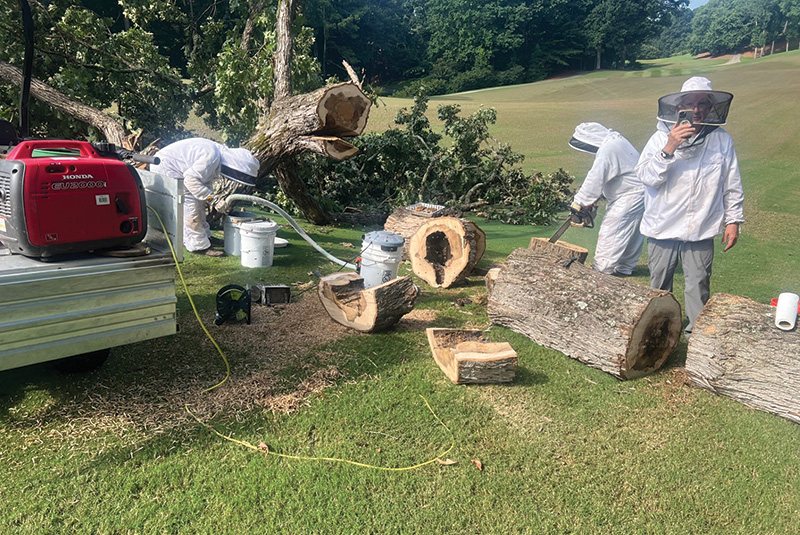
The team vacuuming bees from a fallen post oak at Cherokee Town & Country Club in Atlanta. Photos by Justin Maas
Golf courses often play an overlooked yet essential role in the ecological health of their communities. While most people see fairways and greens, superintendents learn to see something deeper: pockets of green space woven between urban and suburban environments.
These properties give refuge for wildlife to move, nest and feed. Pollinators also find refuge. And native plants hold soil in place and slow stormwater on its way to nearby rivers. The ponds, wetlands and riparian buffers woven throughout many courses quietly filter water, recharge aquifers and protect downstream ecosystems. In cities where natural space is disappearing, golf courses often become the last remaining corridors where nature can still operate as it was meant to.
Yet despite all this, golf courses and their caretakers are often viewed through a narrow lens — judged by what meets the eye, not by the ecological work happening every day behind the scenes. That is why individual moments of stewardship matter. They remind us that caring for a golf course is not only about maintaining playability, but also about protecting the components of the ecosystem that have learned to rely on these spaces. At Cherokee Town & Country Club, one such moment arrived unexpectedly when a declining post oak near our 17th green on the South Course revealed far more than a structural hazard. Hidden inside was a fragile colony of bees whose survival depended on what we chose to do next.
Just 10 miles from downtown Atlanta, Cherokee Town & Country Club is a 36-hole facility nestled along the Chattahoochee River Basin. As a result, we are home to a variety of wildlife that has found a pocket of safety amid the bustle of one of the largest cities in the Southeast. Our location along the river carries a tremendous responsibility to be good stewards of the environment — something that became especially clear during the removal of that hazardous post oak.
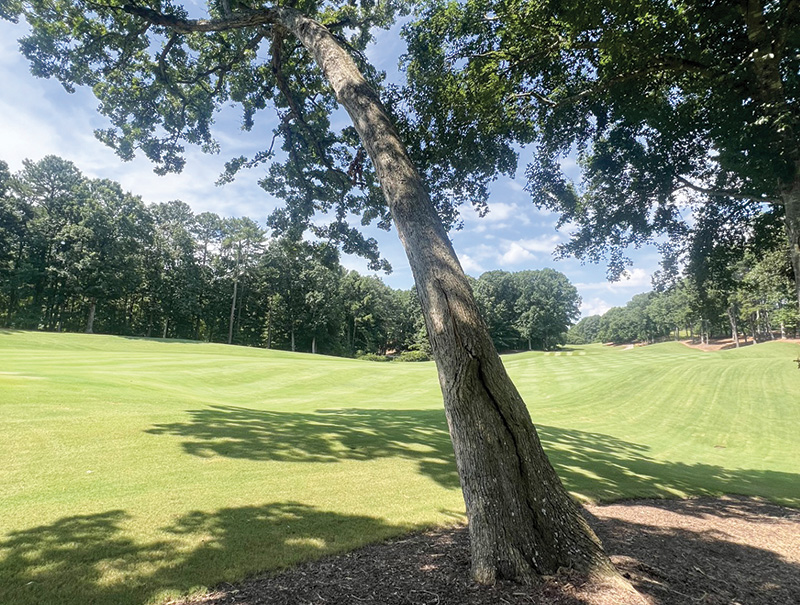
The sickly tree before felling.
On the day of removal, the contracted tree company began climbing the oak, which had a 27-degree lean, to begin a safe takedown. Partway up, the climber stopped. He thought he heard bees inside the trunk. Surprised, I asked, “Honeybees?” Immediately, we halted the operation, and our director, Ken Lee, and I began working on a new plan.
We knew this wouldn’t be a simple fix. We needed someone willing to take on the challenge of accessing a difficult area of the course and safely removing a hive located roughly 30 feet high inside the trunk of a declining oak. To our surprise, the expert we needed was a 40-year club member, Sam Alston. He met with Ken and me the next morning, and together we developed a plan. With South Course aerification scheduled for July 7–11, we had the perfect window to remove both the tree and the hive without further interrupting play.
Alston advised that the safest approach was to fell the tree into the fairway and allow a 24-hour period of stillness before attempting removal. When a hive is disturbed by a fall, bees typically evacuate and guard the area aggressively, but they settle back into the hive once the threat passes. With the course already closed for aerification, we had an ideal window.
The following morning, Alston returned — this time with help from longtime crew member Doug Thomas — to begin the hive removal. He started by smoking the entrance, a practice that triggers a natural response in bees: Believing their hive may be threatened by fire, they retreat and consume honey in preparation to relocate, which makes them calmer and less defensive. Once the bees settled, Alston and Thomas suited up and began cutting small sections from the trunk until they exposed the edge of the hive, vacuuming bees as they worked. After roughly four hours, the hive was fully removed.
Alston estimates that 5,000 to 10,000 bees were collected and will be rehomed in hives he maintains in his backyard. He noted that this colony was already in decline and likely lacked enough honey to survive a typical transition zone winter. By rescuing them, we may have prevented the hive from dying out entirely. The minor damage to the 17th fairway was a small price to pay for saving thousands of honeybees.
Honeybee populations continue to decline across the United States, posing serious threats to agriculture and the economy. These insects play a critical role in pollination, touching nearly every aspect of our lives. As Alston put it, “Ninety percent of the items on the shelf at Whole Foods wouldn’t be there without honeybee pollination.”
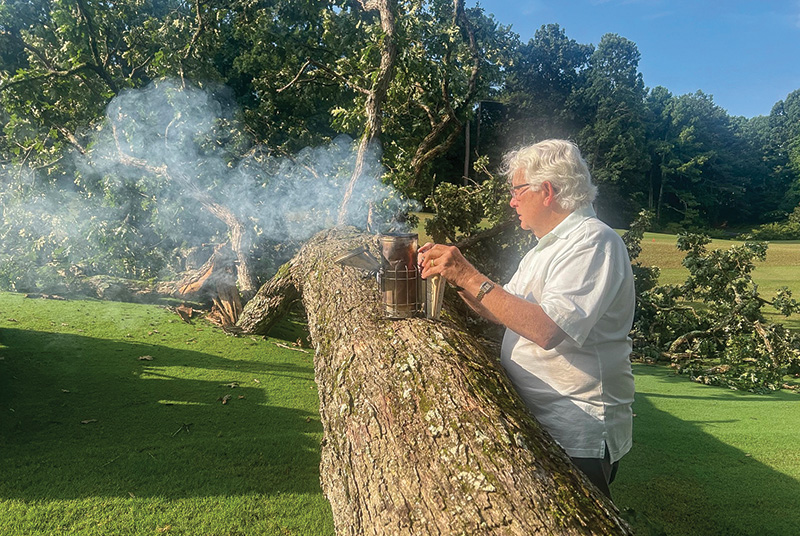
Cherokee Town & Country Club member Sam Alston “smoking” the bees, which makes them calmer and less defensive.
At Cherokee, we remain committed to stewardship through safe plant-protectant practices, building habitats for bluebirds and creating sustainable perennial gardens. Our legacy of care extends beyond this, though. One of the proudest moments of my career thus far is about doing the right thing, even when it became a challenge. Taking on this endeavor in the middle of a four-day closure — where my team worked 60-plus hours to complete a full course aerification — wasn’t the easy thing, but it was the right thing.
Environmental stewardship isn’t always about large-scale initiatives or long-term projects. Sometimes it reveals itself in brief, unexpected moments — like discovering that a hollow tree on a golf course is sheltering a vulnerable colony of bees. What began as a hazard became a rescue, and what could have been overlooked became an opportunity to save the bees.
In the end, this story isn’t just about a tree, a hive or even a golf course. It’s about the quiet power of choosing to care when no one is keeping score.
Justin Maas is a golf course superintendent at Cherokee Town & Country Club in Atlanta and a five-year GCSAA member.