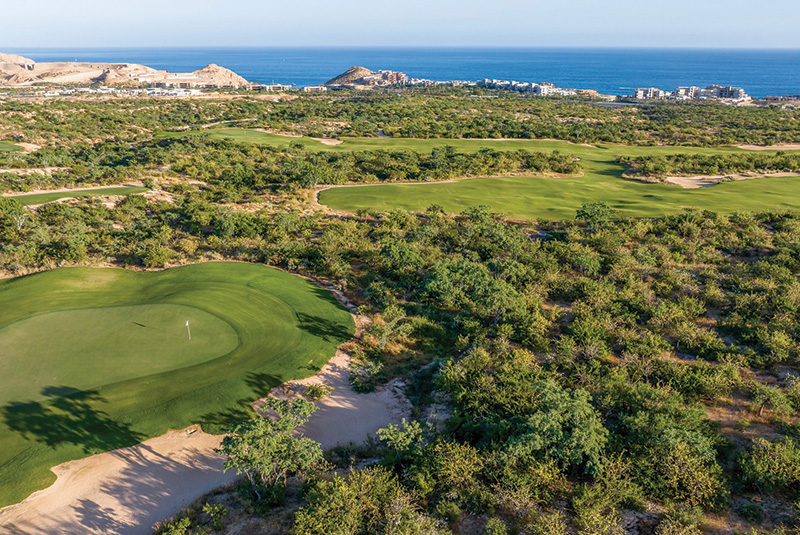
From solar power to a reverse osmosis desalination plant and robotic mowers and more, Twin Dolphin Club in Los Cabos, Mexico, boasts some pretty substantial environmental cred. Photo courtesy of Twin Dolphin Club
Los Cabos, Mexico, might be a nice place for a vacation, but it’s no paradise for the folks entrusted with growing turfgrass there.
“We’re in Hurricane Alley,” says Russ Hewitt, director of agronomy at Cabo’s Twin Dolphin Club and four-year GCSAA member. “We get battered by hurricanes. But we’re in an arid, subtropical region. It’s difficult to grow turf with an annual rainfall of 8 to 10 inches, which all comes down in 10 days. We’re on an island, so our supply of decent fertilizer and equipment all comes across the border. Logistics keeps things interesting. It’s an unusual place for golf.”
Despite all those challenges and more, Twin Dolphin — with its 18-hole Fred Couples Signature golf course (“with views of the Sea of Cortez from every hole”) — boasts some serious environmental cred.
Twin Dolphin is the only Audubon International Signature Sanctuary Gold Level Club in Mexico and only one of 13 Signature Sanctuaries outside the United States.
The club also boasts LEED certification, as well as Blue Flag A-plus certification from the Foundation for Environmental Education. The latter, an achievement shared by just two beaches in Cabo, is the highest environmental quality certification a beach can achieve globally.
Hewitt confesses not much of what he and the staff do at the course, which is separated from that decorated Playa Santa Maria by Mexican Federal Highway 1, directly impacts it. But, Hewitt says, the course is well aware of its role in the 1,400-acre Twin Dolphin Master Planned Community.
“We have so much going on here,” says Hewitt, a New Zealand native who worked at another Los Cabos club, as well as in the United States and Dubai, before returning to Cabo for the 2017 grow-in at Twin Dolphin and where he’s served since. “We’re really checking all the boxes, keeping everything sustainable. Sustainability is such a loose term, but I feel fortunate the company I work for is so committed to sustainability.”
Owner Ohana Real Estate Investors recently announced its goal to take the entire community off-grid, which it says would make it the first community to achieve “100% reliable renewable energy in North America.” It partnered with Tesla on a solar project that will generate over 20 gigawatt-hours of electricity — and, crucially, battery backup to store energy, for the club as well as the surrounding community, in the event of a power outage due to natural disasters.
One of the solar system’s six installations is a 22-acre, ground-mounted array located near the property’s reverse osmosis and desalination plant that provides potable water to the entire community.
The golf course irrigates using non-potable water from that plant and from wastewater treatment facilities.
Using that water judiciously is key for Hewitt.
“For me, fine-tuning our water management, making sure our irrigation is working optimally, that’s the No. 1 thing,” he says. “Every drop counts down here. And it has such a knock-on effect. Proper water management reduces cultural and mechanical stresses. If you have stressed turf, you have insect activity, disease pressures. So we’re focusing on making sure we’re not overwatering or underwatering. That’s been the biggest learning curve for me, making sure we’re responsible with our water.”
Hewitt estimates his career in golf course maintenance has allowed him to circumnavigate the world twice. In his spare time, he’s an ultra-trail runner. Ten years ago, he said, he was training for road races up to half marathons — 13.1 miles. Taking advantage of Twin Dolphin’s 6 miles of mountain biking trails, he since has gone off road and has set his sights on “ultra marathons” — defined as a race greater than marathon length (26.2 miles), often stretching to 50 or 100 miles or more.
“Stupidest thing I’ve ever heard of in my life,” Hewitt says. “I did a few 50-kilometer races and thought, ‘Why not sign up for the Moab 240?’ It’s 240 miles through Moab, Utah.”
Hewitt has entered, but not finished, that race twice, but he’ll keep trying.
If nothing else, that sport has served him well as he traverses the Twin Dolphin property.
“You do see a rattlesnake crossing the fairway occasionally,” he said. “But I’m a trail runner. I’m always looking down. It’s an absolutely stunning property. When you see a rattlesnake crossing the fairway, or a deer walking across in the fairway and you look up and see a whale breeching in the distance … it’s really something.”
Andrew Hartsock is GCM’s editor-in-chief.