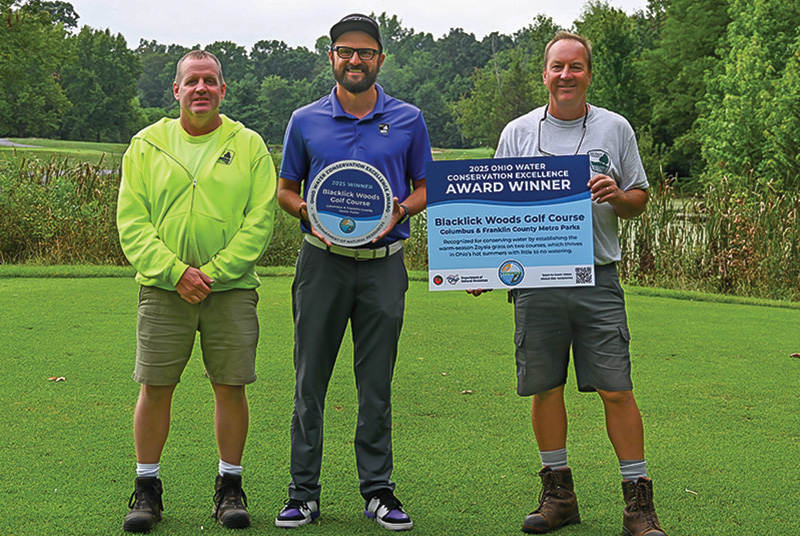
Staff at Blacklick Woods Golf Course, from left, Jay Williamson, Danny Sorgini and superintendent Michael
Samulski show off their 2025 Ohio Water Conservation Excellence Award from atop a zoysiagrass tee box. Photo courtesy of Michael Samulski
Editor’s note: Just hours before deadline for the December issue of GCM, the staff learned that the subject of this feature, Michael Samulski, CGCS, had passed away. We decided to publish the article in his memory.
Blacklick Woods Golf Course in Reynoldsburg, Ohio, doesn’t pay for its water, but that didn’t prevent its superintendent from exploring novel ways to cut back on its use.
Among the most unusual methods was to replace no small amount of Blacklick Woods GC’s turfgrass to a less thirsty version. What makes it so atypical is that, led by Michael Samulski, CGCS, the crew swapped out the cool-season annual bluegrass/bentgrass on some of its fairways and tees with warm-season zoysiagrass. In Ohio.
“It’s working really good,” says Samulski, a 31-year association member who has been Blacklick Woods GC’s superintendent since 1999. “I’m really proud of it. We’re just not experiencing any failures with this.”
It’s worth noting here that Reynoldsburg, a suburb of Columbus, is right on the 40th parallel. It would be a bit of a stretch to describe that as the northern edge of the transition zone. A 2022 survey of U.S. golf courses — part of Phase III of GCSAA’s Golf Course Environmental Profile series — found only 1% of courses in the North Central region used zoysia, and only on tees, roughs and practice areas. Not that that could come as a surprise to Samulski.
“All of the golf facilities in the Columbus area are growing cool-season grasses,” he says. “I don’t know anyone else using warm-season grasses.”
Zoysia’s relative scarcity made it difficult for Samulski to source it when, around 2011, he began toying with the idea of introducing it to Blacklick Woods GC. A native Southerner and University of Georgia graduate, Samulski found his team struggling to maintain parts of the 27-hole facility’s fairways and tees in Reynoldsburg’s sultry summers. “I moved here in ’99, and I was surprised how hot and humid it gets. Summers can be brutal,” he says.
Vexed by a 50-year-old irrigation system, the crew battled leaks and breakdowns and spent countless hours hand-watering. Poor drainage in some areas exacerbated the struggles.
Samulski figured zoysia might be the answer, but first he had to find some. The nearest seller of zoysiagrass sod was 100-some miles southeast, near Cincinnati, where in 2006 he purchased enough for a 400-square-foot test plot.
“It was amazing,” he says. “We didn’t mow it much, didn’t water it, and it had grown into a durable surface.”
Five years later, Samulski bought about $1,000 of Zenith zoysiagrass seed (at $18 per pound) in hopes of seeing how the turfgrass would establish from seed. “That went really good,” he says. “We mowed it to fairway height. If we mismanaged it, it wasn’t a big deal. Everybody was really impressed with its performance.”
Starting in 2019, the crew started moving to zoysia tees, then fairways over a five-year span. The work was done in phases so the courses could remain open for play during establishment. Tees were changed out using sod from the zoysia growing plot, while fairways were sprayed out and reseeded. The fairways on all nine holes of the Learning Course and the practice facility are now zoysia, which now is the grass of choice on five tees on the Learning Course and 16 of the 18 holes of the Championship Course. For its efforts, the course was given an Ohio Water Conservation Excellence Award by the Ohio Department of Natural Resources.
Samulski, who was set to retire last month, anticipates the change to zoysia fairways for the 18-hole course will begin next spring.
“Those fairways have never been watered,” Samulski says. “Some are 5 years old. I barely fertilize them. I used no fertilizer on them last year. It’s been a big success for us. It’s a wonderful surface. It goes brown in the wintertime, but I don’t see that as a detriment. The only thing I’ve seen is, if you’re a little too wet in the early spring, February or March, it will waterlog. It gets a little goopy. It’s a little sloppy before it starts to green up, but I haven’t experienced that every year, and our play is light that time of year anyway.
“It’s not feasible for us to spend a million on irrigation and drainage upgrades. We have found a way to secure permanent vigorous fairway surfaces for the cost of seed. I feel so good about this initiative. I want more superintendents to know about this. I don’t pay for water, but it can’t stay that way. I just want more superintendents to look into this. It has worked out so well for us.”
Andrew Hartsock is GCM’s editor-in-chief.