Binod Pokhrel. Photos by Darrell J. Pehr
Impact of plant growth regulators on seedhead suppression and spring greenup of bermudagrass putting greens
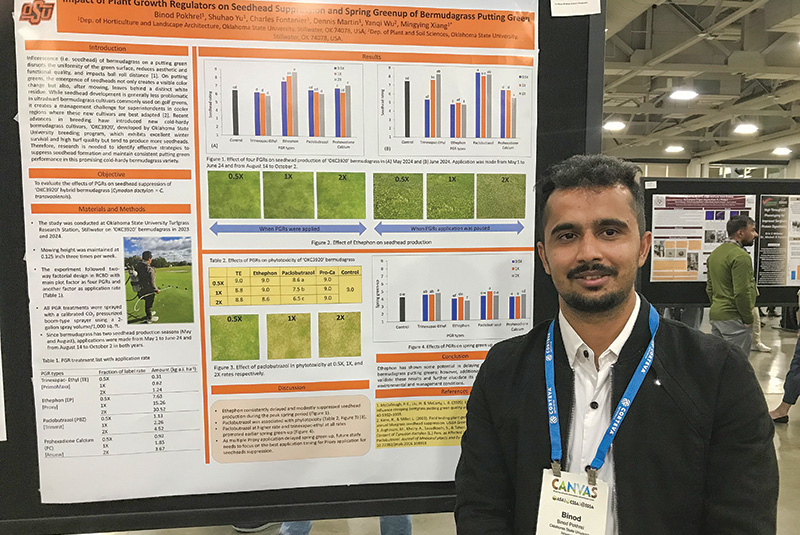
Bermudagrass seedheads compromise the quality and aesthetics of the playing surface, while also increasing labor costs for golf course superintendents due to added wear on mowing equipment and the need for more frequent reel mower sharpening. To suppress seedhead production, plant growth regulators (PGRs) have been used. The primary objective of this study was to evaluate the effects of four PGRs and different application rates on seedhead suppression of an OKC3920 bermudagrass putting green. The secondary objective was to assess any phytotoxicity effects of these products on OKC3920 and their impact on spring green-up. A two-year field study at the Oklahoma State University Turfgrass Research Station, Stillwater, was conducted to evaluate different types of PGRs and their application rate, with three replications.
PGR treatment included trinexapac-ethyl (PrimoMaxx; Syngenta Crop Protection Inc., Greensboro, N.C.), ethephon (Proxy; Bayer Environmental Science, Research Triangle Park, N.C.), prohexadione calcium (Anuew; Nufarm, Alsip, Ill.), paclobutrazol (Trimmit; Syngenta Crop Protection Inc., Greensboro) and an untreated control. The application rate included 0.5X, 1X and 2X label rate, applied biweekly using calibrated CO2-pressurized boom-type sprayer at 2-gallon spray volume per 1,000 square feet (81.5 liters per 1,000 square meters). Treatments were applied two weeks before the average time of typical seedhead emergence and continued for nine weeks during both the spring and fall seasons. Applications were made from May 1 to June 24 and Aug. 14 to Oct. 2 for both years. Data was collected on seedhead production and spring green-up.
The results indicated that ethephon, even at 0.5X the labeled rate, significantly suppressed seedhead formation during the spring peak, likely by delaying seedhead emergence until later in the summer in both years. However, ethephon also delayed spring green-up. In contrast, paclobutrazol at higher rates and trinexapac-ethyl (TE) at all rates promoted earlier spring green-up. However, higher rates of paclobutrazol and TE resulted in phytotoxicity, reducing turfgrass quality.
— Binod Pokhrel (binod.pokhrel10@okstate.edu); Mingying Xiang, Ph.D.; Shuhao Yu, Ph.D.; Dennis L. Martin, Ph.D.; Charles Henry Fontanier, Ph.D.; and Yanqi Wu, Ph.D.; Oklahoma State University, Stillwater
James Sprague
Influence of crabgrass (Digitaria spp.) on golf ball roll
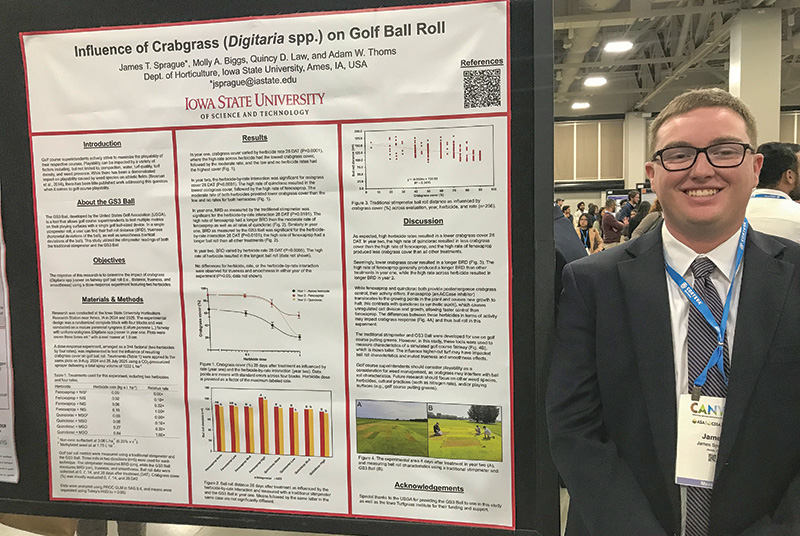
Golf course superintendents actively strive to maximize the playability of their respective courses. Playability can be impacted by a variety of factors including, but not limited to, compaction, water, turf quality, turf density and weed presence. While there has been a demonstrated impact on playability caused by weed species on athletic fields (Brosnan et al., 2014), there has been little published work put into answering this question when it comes to golf course playability. The objective of this research, conducted at the Iowa State University Horticulture Research Station near Ames, Iowa, is to determine the impact of crabgrass (Digitaria spp.) on fairway golf ball roll (i.e., speed, trueness and smoothness) using a dose-response experiment consisting of postemergence crabgrass controls fenoxaprop and quinclorac at varying rates. Year One results indicated an interaction between ball roll length and herbicide/herbicide by rate.
— James Sprague (jsprague@iastate.edu); Molly A. Biggs; Quincy Law, Ph.D.; and Adam W. Thoms, Ph.D.; Iowa State University, Ames
Darrell J. Pehr (dpehr@gcsaa.org) is GCM’s science editor.