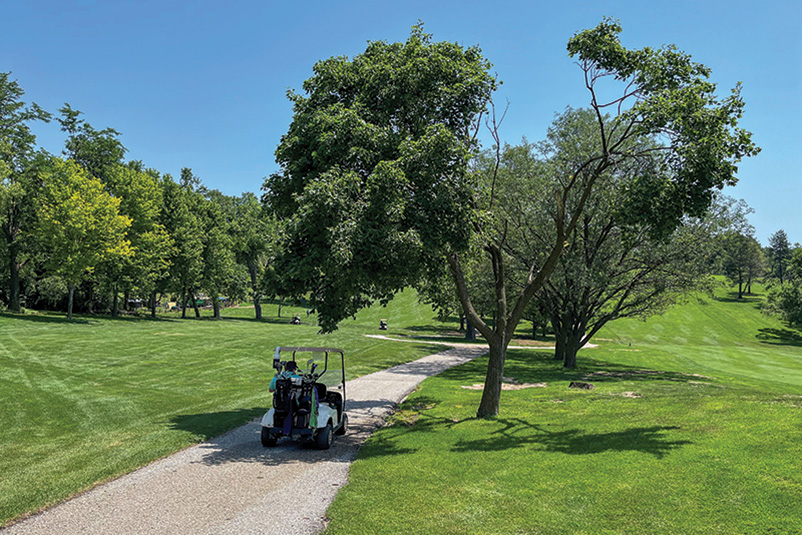
Not only is this tree badly damaged, but it’s also difficult to determine what purpose it serves. Photos by John Fech
With a tip of the cap to the golf instructional book, “Every Shot Must Have a Purpose” by Pia Nilsson, Lynn Marriott and Ron Sirak, it’s important to remember that tree placement and presence must be intentional, not just random. Sure, trees bring many benefits, but they can interrupt play, add unnecessary expense to management and create unhealthy turf.
The best way to avoid these undesirable outcomes is to go back to the drawing board and identify at least two purposes that each tree serves. Put another way, trees should be thought of as “therefore” elements on the golf course — that is, what are they there for? After all, a golf course is not an arboretum.
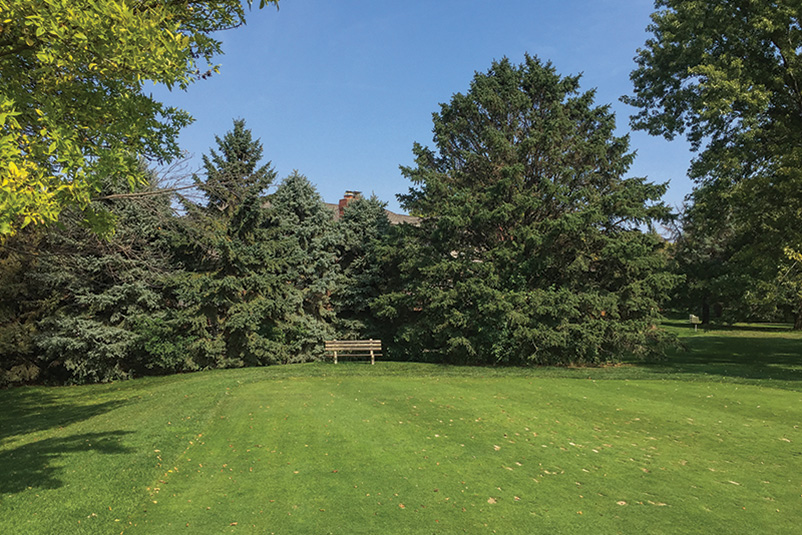
Most golfers would prefer to look at attractive trees than run-down apartments.
“Therefore” trees
Asking the question “What is it there for?” is an essential undertaking. In way too many situations, trees are planted randomly without consideration as to what they add in terms of value. There are a great many purposes of trees on a golf course, including:
Screening of undesirable views. Especially when massed together, both conifers and broadleaves can put an aesthetically pleasing element between the course and objectionable items such as rundown apartment buildings, manufacturing plants and junk yards.
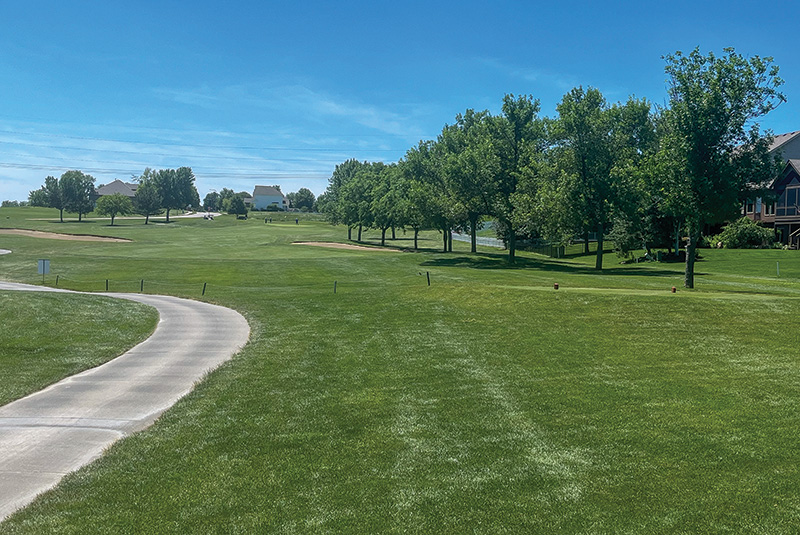
Dense tree canopies provide a good physical barrier between a golf hole and residential housing.
Physical barriers between fairways. When insufficient space between fairways exists, trees can be an effective buffer to intercept errant shots that don’t land in the rough before they enter the adjacent fairway.
Backdrop for greens. Trees strategically placed on the back side of a green serve to aid in distance estimation when hitting an approach shot. They can either be placed directly in line with the fairway or as framing trees on the left and right side.
Shade for clubhouses in the afternoon. Well-placed trees can reduce glare and heat in highly used areas of a clubhouse or refreshment stand, making them much more enjoyable spaces for relaxation.
Fairway definition and dogleg awareness. In addition to the height of cut and possible turf species differences, the presence of trees in roughs and out-of-bounds areas serves to heighten awareness of the most desirable playing surfaces. As fairways change direction, well-placed trees create awareness of the need to change the path of the next shot.
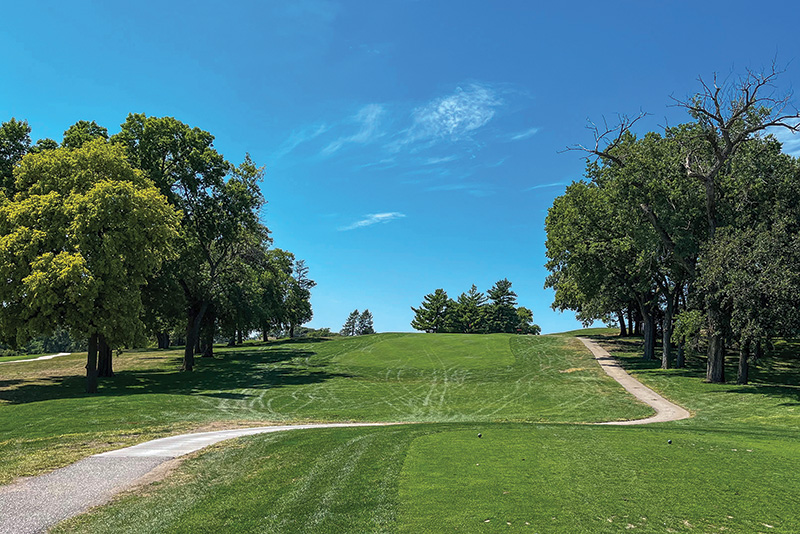
Well-placed trees help to provide distance perception and assistance with club selection.
Memorial trees. In some situations, trees planted to honor individuals and families that have been philanthropic or provided leadership can be included on the golf course. Memorial trees are sometimes limiting in terms of their inherent and often unrealistic value and accompanying maintenance costs. To reduce this limitation, memorial areas are sometimes planted that provide an homage without the time and effort to care for a large tree.
Habitat for animals. Dead snags in tree canopies and pockets of decay in trunks often provide a respite or harborage for raptors and songbirds.
Sound reduction. Both coniferous and broadleaf trees can serve to absorb sound from railroad trains, maintenance yards and interstate highways.
Property line definition. Depending on where the out-of-bounds areas join neighboring properties, healthy trees can serve to be a good landmark and reference point for planning purposes.
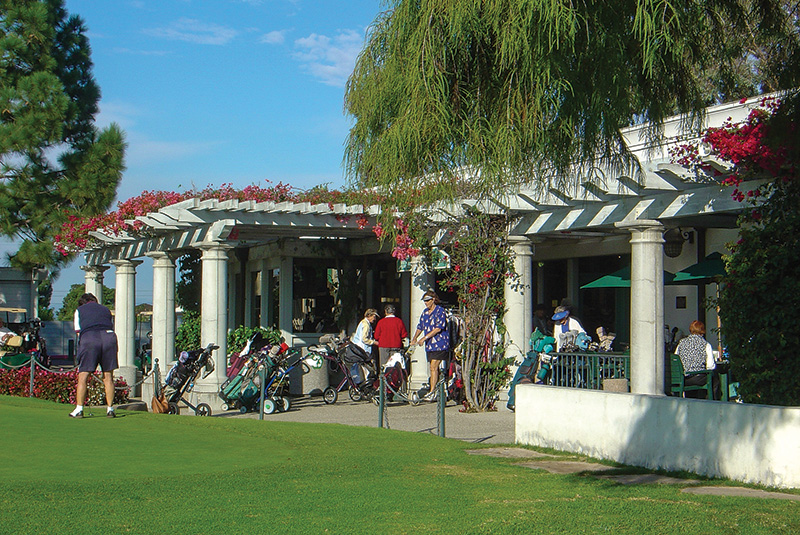
Outdoor activities near a clubhouse are much more enjoyable when a little shade is cast on the space.
Prioritization
As the benefits above are considered, it’s important to reexamine the original priorities of the master plan — the needs, goals and intentions as they relate to woody plants. Guiding principles are critical to success in the process of evaluating how well various specimens implement or manifest them. Some trees provide great value and benefit and others minimally so.
It can be quite difficult to think of an existing golf course as a blank slate, but to the extent possible, looking past the current plant material and instead envisioning that which was intended to exist will keep a healthy perspective in terms of purposeful tree and shrub plantings. Once that mindset is adopted, attention can be turned to the existing plants, considering whether they mesh well.
In many situations, the process of determining fit and function can be helped along by realizing that there are often levels of priority within the master plan guidelines. It’s possible that all trees are equal in terms of priority; however, a little digging into the details may indicate that high priorities can be met by placing or retaining trees in certain locations, while others can serve to meet the needs of areas of lesser importance.
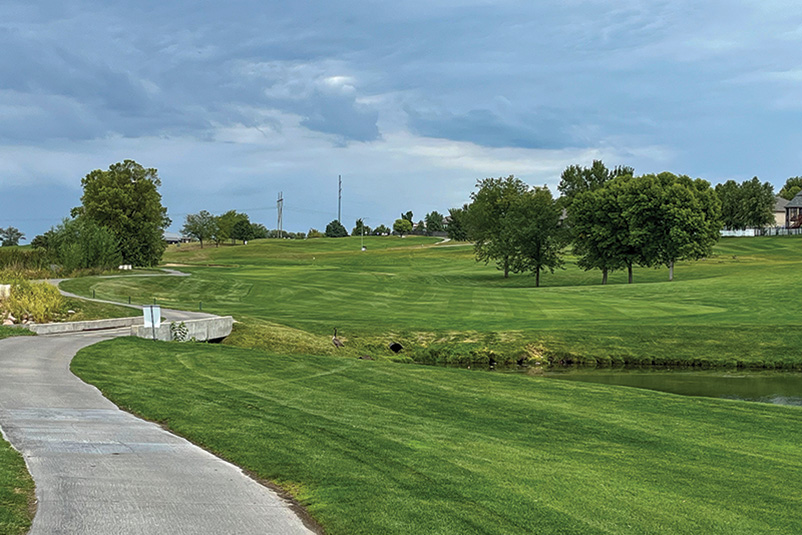
This mass of small trees serves to define the fairway and direct approach shots without intruding into golf play.
Flaws and defects
No matter whether an existing tree is in a high-, medium- or low-priority location, the current condition should be taken into account. Sure, a given tree or group of trees may be in a good location and closely aligned with the original guidelines of screening, massing, perspective for approach shots, physical barrier or needed shade; however, changes in health or structure have occurred over time and need to be addressed.
Many defects can develop, such as heartwood decay, cracks, co-dominant leaders, orientation lean and stem girdling roots. These issues can not only shorten the life of a tree, they can also cause serious harm to golfers and require significant resources to maintain properly. Some flaws simply cannot be addressed to any level of success. These need to be removed sooner than later. A high-priority plant in poor condition is akin to a person eating healthy, nutritious food made with spoiled ingredients.
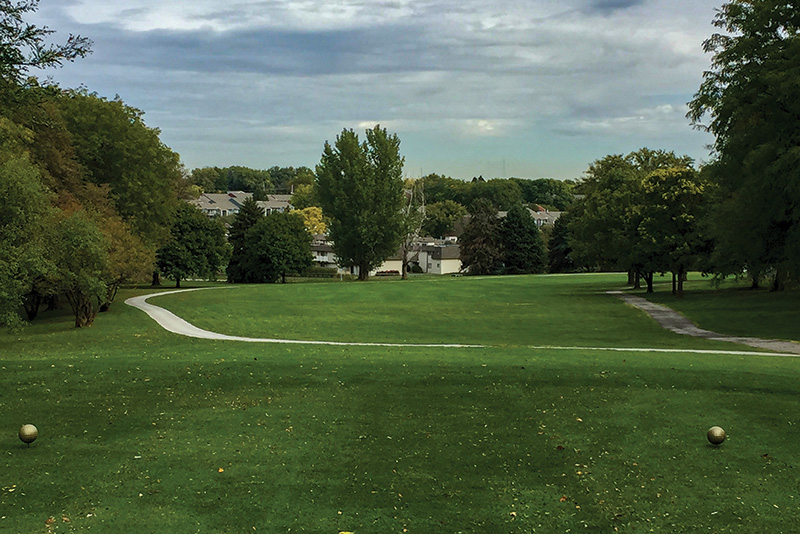
These trees serve to create awareness that the direction of the fairway changes abruptly.
Cost savings
With purpose, priority and condition in mind, getting rid of trees that are difficult to support in terms of benefit or value to the course is helpful to the bottom line in the maintenance budget. Let’s face it, managing golf turf is expensive enough. Adding in keeping unhealthy trees alive through additional fertilization, pest control applications, soil decompaction, mycorrhizae incorporation, plant growth regulator injections and frequent pruning is a significant drag on available resources.
Documenting cost savings is a somewhat blunt but powerful first step toward the justification of selective removals. Keeping records of tree-management inputs over several years helps to bolster a request for elimination of non-purposeful trees.
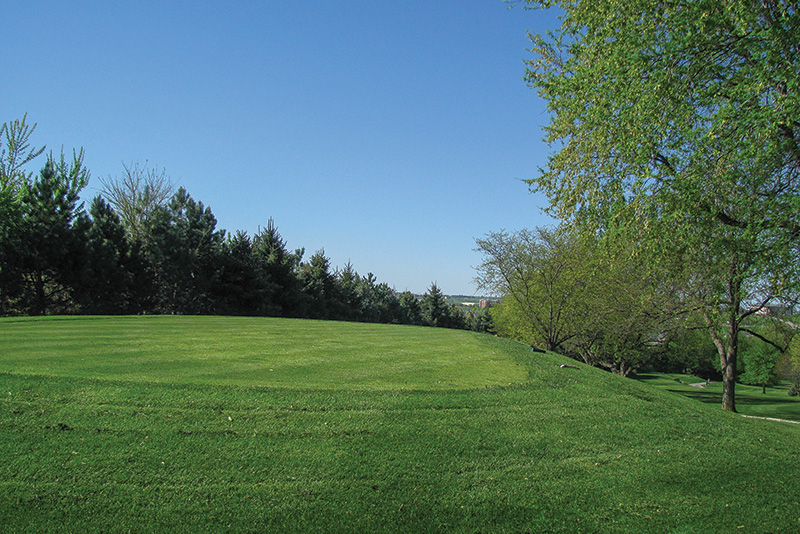
Noise from adjacent properties can be significantly reduced by well-placed trees.
Eyes-wide-open reconsideration
To help determine whether a tree’s purpose is currently being met, a reconsideration venture is needed. Whether using a system of hole-by-hole, complaint-based reaction or cost to maintain, a concerted effort to consider each tree on the course in an open-minded manner is a worthwhile endeavor.
During your examination, if you find that a given tree is no longer serving its purpose from the original design or master plan, and no other real value has developed over the years, then consider the current return on investment and place it in the possible removal category. As well, not only do some trees lose value, develop defects and fail to bring their original value over time, they cause the turf to lose vigor through excessive shading and nutrient/water competition. Others develop surface roots that interfere with cart path stability and/or create a tripping hazard for golfers. As such, they also become good targets for elimination.
While every superintendent has a different degree of autonomy over tree removal, perhaps the best approach is to evaluate each specimen related to original purpose, current benefits, problems being caused by the tree, individual priority, potential for injury to golfers and costs to maintain, then create a simple spreadsheet for documentation.
Once in place, it’s prudent to collaborate with a Registered Consulting Arborist or an ISA-Certified Arborist for additional support with the remove/retain decision. Gaining the approval of a recognized arboricultural expert will strengthen the pitch for refining the current tree inventory.
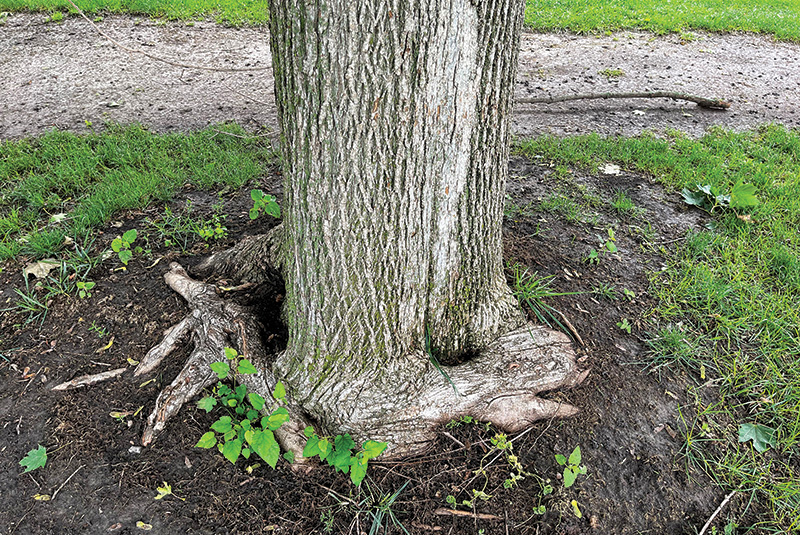
Roots that develop in a circular arrangement over time severely restrict nutrient and water flow and often create a hazardous condition.
Justification
Certain stakeholder groups may object to tree removal and planting projects. Often, they don’t see the real needs of the course or resource limitations that superintendents face. With that in mind, it’s helpful to tailor the presentation for tree removals to their background.
Each of us is a combination of an introvert and an extrovert. Likewise, we are all motivated by several inherent factors. While there are many, three common ones are influential — ones that were identified by the Greek philosopher Aristotle:
Ethos Utilizing credibility or ethical appeal. This feature ties the process of convincing to the character or credentials of a person. For example, the reputation of an ISA-certified arboricultural consultant.
Pathos An attempt to evoke an emotional response. This could be done by highlighting the potential for harm to occur if no action is taken. Note: Be careful with emotion, especially with fear — we still want to be accurate.
Logos Persuading by reasoning and using logic. That is, if A, then B and/or C, etc., will occur. For example, removal (A) would lead to (B) healthier turf, (C) a reduced tree maintenance line item in the budget and (D) greater ROI overall.
In many ways, being deliberate about purpose and priority is similar to a negotiation. As outlined by Phil Helmn, MG, there are many recommendations for give and take to consider, including:
Don’t be afraid to ask for what you want.
- Listen.
- Do your homework.
- Be willing to walk away.
- Don’t be in a hurry.
- Aim high.
- Focus on the other side’s pressure, not yours.
- Show the other person how their needs will be met.
- Don’t give anything away without getting something in return.
- Don’t take the issues or the other person’s behavior personally.
- Being intentional about who makes up the audience that will approve or deny a proposal is important, especially if it’s only one or two people who will be considering it.
- If it’s the entire green committee, then a mix of messages is most appropriate.
In either case, a little background on the listener is well worth the time and effort. Keeping purpose, priority, course needs, available budget, return on investment and tree/turf condition in the discussion will help to focus the presentation and lead to positive outcomes.
John C. Fech is a horticulturist and Extension educator with the University of Nebraska-Lincoln. He is a frequent and award-winning contributor to GCM.