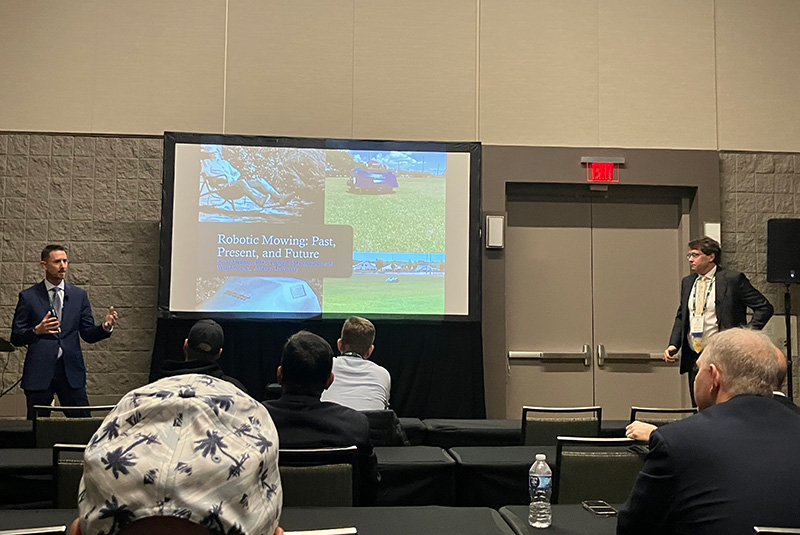
Dan Meersman, GCSAA Class A director of grounds at Philadelphia Cricket Club and Scott McElroy, Ph.D., presented on the history, present and future of autonomous mowing at the GCSAA Conference and Trade Show. Photo by Phil Cauthon
Attendees at the GCSAA Conference and Trade Show on Wednesday joined two industry experts for a pair of presentations on the use of autonomous mowers in turf management.
Scott McElroy, PhD., opened with a look at the history, present and potential future of autonomous mowers. Superintendent Dan Meersman — GCSAA Class A director of grounds at Philadelphia Cricket Club and 26-year GCSAA member — also shared operational insights from deploying 35 robots across diverse facilities.
McElroy started by asking the room with who is currently using or has had experience with autonomous mowers. Three superintendents out of the 26 attendees raised their hand. One said they had done a full demonstration with Husqvarna, but hadn’t made the leap yet. “They worked pretty well,” he said. “It was cool to come in in the morning and already have stripes on the course.”
Two others volunteered that they may have purchases on the horizon — they’ve budgeted the expense already — but were concerned with getting in too early.
“I’m concerned if we buy in today then in two or three years we may have to switch it all out because it’s obsolete. It’s expensive,” said Johnny Perry, GCSAA Class A superintendent at Bent Brook (Ala.) Golf Course.
To that, McElroy had an analogy for an answer. “The technology today is like an iPhone 6 or 7 compared to an iPhone 15. The basis for the technology, the hardware and a lot of the software is not going to change. It’s going to be incremental and nuanced increases in development in these products. Not grand changes to the technology. Technology today is going to be the technology for the next 10 or 15 years and it’s going to be software upgrades and subtle changes to the user interfaces. But that changes all the time.”
In his presentation, McElroy emphasized that some form of robotic mowing is not a new concept. He showed photos from the 50s with wired and remote-control versions of remote mowers, along with a series of attempts through the 80s, 90s and early 2000s for autonomous mowers that proved to be before their time.
“Since we started mowing grass, people have been trying to get out of mowing grass,” McElroy said. “So this is not a new concept, but it has finally reached the critical point where it’s actually useful.”
He said balancing the economics of using autonomous equipment is the main remaining question for superintendents to answer.
“Can you create efficiencies that maximize the expense and amount of savings that get in time and money to run your facility? That is the most critical part right now,” McElroy said.
“Autonomous technology is and will continue to revolutionize golf course management. And I don’t use that word lightly. This is revolutionary technology,” he said. “It’s not just mowing grass. It’s going to change the way you hire people, the training that they need, the other equipment that you buy, potentially the weeds and diseases that are present, the way we fertilize and the way we irrigate.”
Most importantly, he said it’s about moving from mechanical combustion engines to battery-powered computer-driven tools.
“It’s a completely different skill set for the way you manage equipment. You don’t fix anything anymore. You replace. If something goes wrong, a motherboard that goes out, you just swap that out and put it back to work. You just need software for diagnostics. That’s revolutionary.”
A question came in about why autonomous mowers weren’t yet common for mowing greens.
Meersman answered: “It’s the highest risk situation on a golf course and the smallest acreage. So, while there’s still a lot of labor going into greens, you’re not going to take your eyes off greens and not have a guy there mowing them. If a rough unit goes into the fairway in the middle of the night, that’s not a huge deal. If a greens mower were to go into the rough or a fairway, that’s a major major problem. I think as superintendents, we all know our jobs are on the line, when it comes to the greens especially.”